

Why Trading Discipline Is Important for Long-Term Success
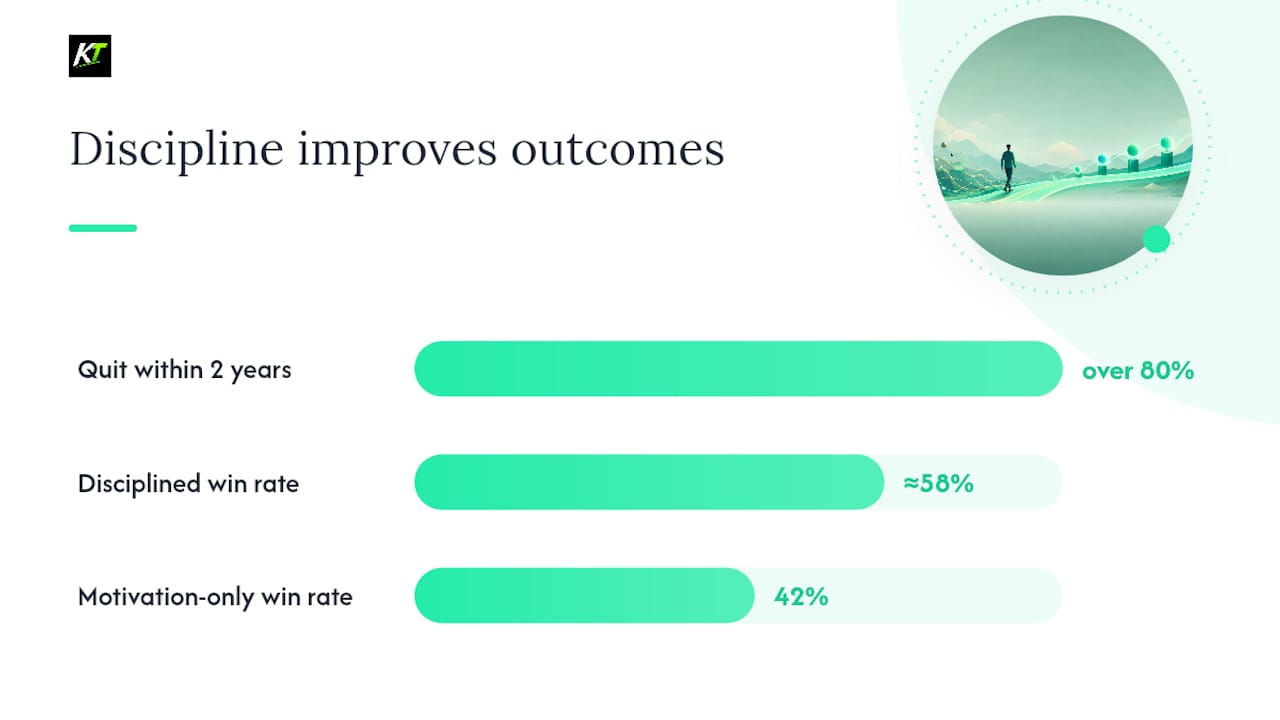
Discipline is the single biggest determinant of whether a retail trader survives and compounds returns over time. Not strategy. Not indicators. Not a mentor’s secret entry signal. Over 80% of retail traders quit within their first two years, and poor risk management combined with emotional decision-making drives most of that attrition. The traders who last aren’t the ones with the fanciest system. They’re the ones who follow their own rules when it’s uncomfortable to do so.
Here’s what that actually means for your trading:
- Discipline preserves capital through consistent risk control, sizing every position the same way and honoring stops instead of hoping.
- Discipline produces repeatable edge by enforcing a process, so the strategy you tested is the strategy you actually trade.
- Discipline reduces emotional mistakes like revenge trading and moved stop-losses, the two habits that quietly wreck expectancy.
Start today with one rule: before the market opens, write down your maximum risk for the day and commit to logging every trade you take, win or lose.
Key Takeaways
Discipline determines trading survival because it converts a statistical edge into repeatable results through consistent risk control and rule adherence.
| Point | Details |
|---|---|
| Discipline beats strategy alone | A modest edge executed with near-perfect discipline usually outperforms a strong edge executed inconsistently. |
| Attrition is real and preventable | Over 80% of retail traders quit within two years, largely from poor risk management and emotional decisions. |
| Track compliance, not just P&L | A weekly discipline score often precedes equity curve improvement by two to four weeks. |
| Build systems, not willpower | Checklists, journaling, and automated stops remove decisions from moments of highest emotional stress. |
| Hardware can enforce rules | Key-trade’s programmable keypads let traders execute stops and partial closes as fast as the rule requires, without extra clicks. |
Table of Contents
- Why Trading Discipline Is Important: Defining Discipline vs. Patience vs. Skill
- The Real Payoff: How Discipline Improves Your Trading Results
- Why Discipline Breaks Down: FOMO, Revenge Trading, and Other Traps
- Building Trading Discipline: A Seven-Step Program
- How Execution Tools Reinforce Discipline Under Pressure
- A Practitioner’s Note on Process Over Outcome
- Make Discipline the Default, Not the Effort
- Sources
- FAQ
Why Trading Discipline Is Important: Defining Discipline vs. Patience vs. Skill
Trading discipline is rule-following under pressure. It’s not a personality trait or a moral virtue. It’s the mechanical act of executing a predefined system when your gut is screaming at you to do something else. A trader who cuts a loss at the exact stop level they wrote down last night, even while convinced the market is about to reverse, is exhibiting discipline. A trader who moves that stop “just this once” is not, regardless of how the trade turns out.
Patience is a related but distinct behavior. It’s controlled timing: waiting for your setup to actually appear instead of forcing a trade because you’re bored or itching to be in the market. Patience also governs the exit side of the equation, letting a winning trade run toward its target instead of closing it early out of fear of giving profit back. A patient trader can sit through an entire session without a single trade and count that as a good day.
Skill is different from both. Skill is your edge, the strategy, the pattern recognition, the market read that gives you a statistical advantage in the first place. Skill without discipline is a car with a great engine and no brakes. You might know exactly when to enter a breakout, but if you can’t stick to your position size when the trade starts moving fast, that skill never translates into consistent results. Discipline is the mechanism that turns a good strategy into good outcomes.
| Behavior | Discipline | Patience | Skill |
|---|---|---|---|
| Core indicator | Adheres to stop-loss without hesitation | Waits for the exact setup criteria | Identifies high-probability patterns |
| Failure mode | Moves or removes stops mid-trade | Enters early out of boredom or FOMO | Misreads market structure or context |
| Timeframe focus | Every single trade execution | Setup formation and trade duration | Strategy design and backtesting |
| How it’s built | Checklists, automation, journaling | Rule-based entry filters | Study, backtesting, screen time |
The Real Payoff: How Discipline Improves Your Trading Results
Position sizing is where discipline earns its keep first. Same strategy, same losing streak, wildly different survival odds. Discipline is what keeps the risk number fixed regardless of how confident you feel.
Stop-loss adherence works the same way over hundreds of trades instead of ten. Rule-following trades typically show a better win rate, profit factor, and average R than trades where a rule got broken, based on practitioner analysis of trading-journal data. That gap compounds. A strategy with a modest statistical edge, executed with near-perfect discipline, will usually outperform a stronger strategy executed sloppily.
Here’s how disciplined execution maps directly onto the numbers you already track:
- Higher expectancy because you’re not letting occasional oversized losses drag down your per-trade average.
- Better profit factor since losers stay capped at your planned risk while winners are allowed to reach their targets.
- Lower max drawdown, which matters more for psychological survival than most new traders realize.
- A steadier equity curve, which makes it far easier to stick with a strategy long enough to see its real edge play out.
- Real compounding, because compounding only works on capital that’s still in your account.
The stakes behind these numbers aren’t abstract. Retail trading has a brutal failure rate, and over 80% of traders quit within their first two years, most often citing poor risk management and emotional decision-making as the cause, not a lack of market knowledge. Discipline is the variable that separates the traders who survive long enough to become profitable from the ones who blow up before their edge ever gets to prove itself. One practitioner source even reports disciplined traders achieving roughly 58% win rates compared to 42% for traders relying on motivation alone, a single-source figure worth treating as directional rather than universal, but the pattern it describes matches what shows up across the trading-journal data cited above: systems beat willpower, consistently.
Why Discipline Breaks Down: FOMO, Revenge Trading, and Other Traps
Scenario one. A trader sees a stock ripping higher without them, jumps in near the top with no plan, and watches it reverse within minutes. That’s FOMO, and it rarely ends with a stop in place because the entry itself wasn’t planned.
Scenario two. A different trader watches the same stock rip higher, checks it against their own setup criteria, sees it doesn’t qualify, and does nothing. Their account doesn’t move that day. Neither does their blood pressure.
The gap between those two traders isn’t intelligence or market knowledge. It’s the presence or absence of a rule that was actually followed. Most discipline failures trace back to a small set of predictable psychological traps:
- Loss aversion, which makes closing a loser feel worse than an equivalent gain feels good, so traders hold losses too long hoping to avoid “making it real.”
- Revenge trading, jumping back into the market immediately after a loss to “win it back,” usually with larger size and less planning.
- Overconfidence after a winning streak, which leads to skipping the checklist because “I’ve got a feel for this right now.”
- Confirmation bias, seeking out chart patterns or news that support a trade you already want to take.
- Ego protection, refusing to admit a trade thesis is wrong because being right feels more important than being profitable.
Decision fatigue makes all of this worse as the session wears on. Every trade decision, every stop adjustment, every “should I take this setup” question draws down the same limited pool of mental energy. That’s why rule violations cluster late in the trading day and after a string of trades, not at the market open when a trader is fresh. Recognizing this is best framed as a systems problem rather than a willpower problem: telling a fatigued trader to “just have more discipline” is like telling someone running on no sleep to just concentrate harder. It doesn’t work because it ignores the mechanism.
The trader who wins isn’t the one who never feels the urge to revenge trade. It’s the one whose system makes that urge irrelevant, because the stop already executed before the emotion had time to take over.
Building Trading Discipline: A Seven-Step Program
Discipline isn’t a mindset you talk yourself into once. It’s a structure you build so the disciplined action becomes the default action, even on your worst day. Here’s a sequential program to build that structure.
- Define your edge and write it down. If you can’t describe your setup criteria in three sentences, you don’t have a system, you have a hunch.
- Set your risk-per-trade and daily loss limit before the market opens. A common range is 0.5% to 1% of account equity per trade, with a daily loss cap around two to three times that, hit it and you’re done trading for the day.
- Build a pre-trade checklist covering setup confirmation, position size, stop level, and target, and refuse to enter a trade until every box is checked.
- Automate your hard stops at entry, not after. If your platform or hardware lets you set the stop as part of the order ticket, use that every single time.
- Log every trade, not just the ones that went badly. The winners teach you as much about your process as the losers do.
- Run a weekly review and score your compliance rate, not just your P&L, since compliance is the leading indicator and P&L is the lagging one.
- Run progressive habit challenges, like committing to five consecutive fully compliant trading days before increasing size or adding a new setup to your rotation.
Copy this checklist directly into your journal or platform notes for use before every trade:
- Setup matches my written criteria, yes or no
- Position size calculated at my fixed risk percentage
- Stop-loss level set and entered as part of the order
- Target or exit plan defined before entry
- Emotional state checked: am I trading this setup or trading a feeling
A simple journaling template makes step five painless instead of a chore. Track these fields for every trade: setup type, entry price, stop price, position size, whether you followed every rule, your emotional state going in, and the final outcome. That last compliance field is the one most traders skip, and it’s the one that matters most.
| Metric | What it tells you | How to calculate it |
|---|---|---|
| Discipline score | % of trades where every rule was followed | Compliant trades ÷ total trades |
| Expectancy | Average result you can expect per trade | (Win% × avg win) minus (Loss% × avg loss) |
| Profit factor | Gross profit relative to gross loss | Gross profit ÷ gross loss |
| Max drawdown | Largest peak-to-trough equity decline | Track running equity high vs. current low |
| Risk-per-trade | Consistency of position sizing | Dollar risk ÷ account equity, per trade |
Building this from scratch takes patience of its own. In the first two to four weeks, expect to catch yourself breaking rules you just wrote, that’s normal, not a failure. One practitioner analysis found that a rising weekly discipline score tends to precede visible P&L improvement by roughly two to four weeks, which means the score itself is worth tracking as a leading indicator, not just a report card. The logic behind structured checklists isn’t unique to trading either: surgical teams that adopted procedural checklists saw a documented reduction in complications, and the same principle, reducing reliance on memory and willpower under pressure, applies directly to a trade you’re about to place.
How Execution Tools Reinforce Discipline Under Pressure
The best discipline systems remove the decision entirely at the moment it matters most. A scripted order flow that enters your stop-loss as part of the trade, not after, means there’s no window where fear or hope can talk you into skipping it. Hard stops that execute automatically don’t care how confident you feel about a reversal. Programmable controls that let you fire a partial close or move to break-even with a single action take the split-second, high-stress decision out of your hands and turn it into muscle memory instead.
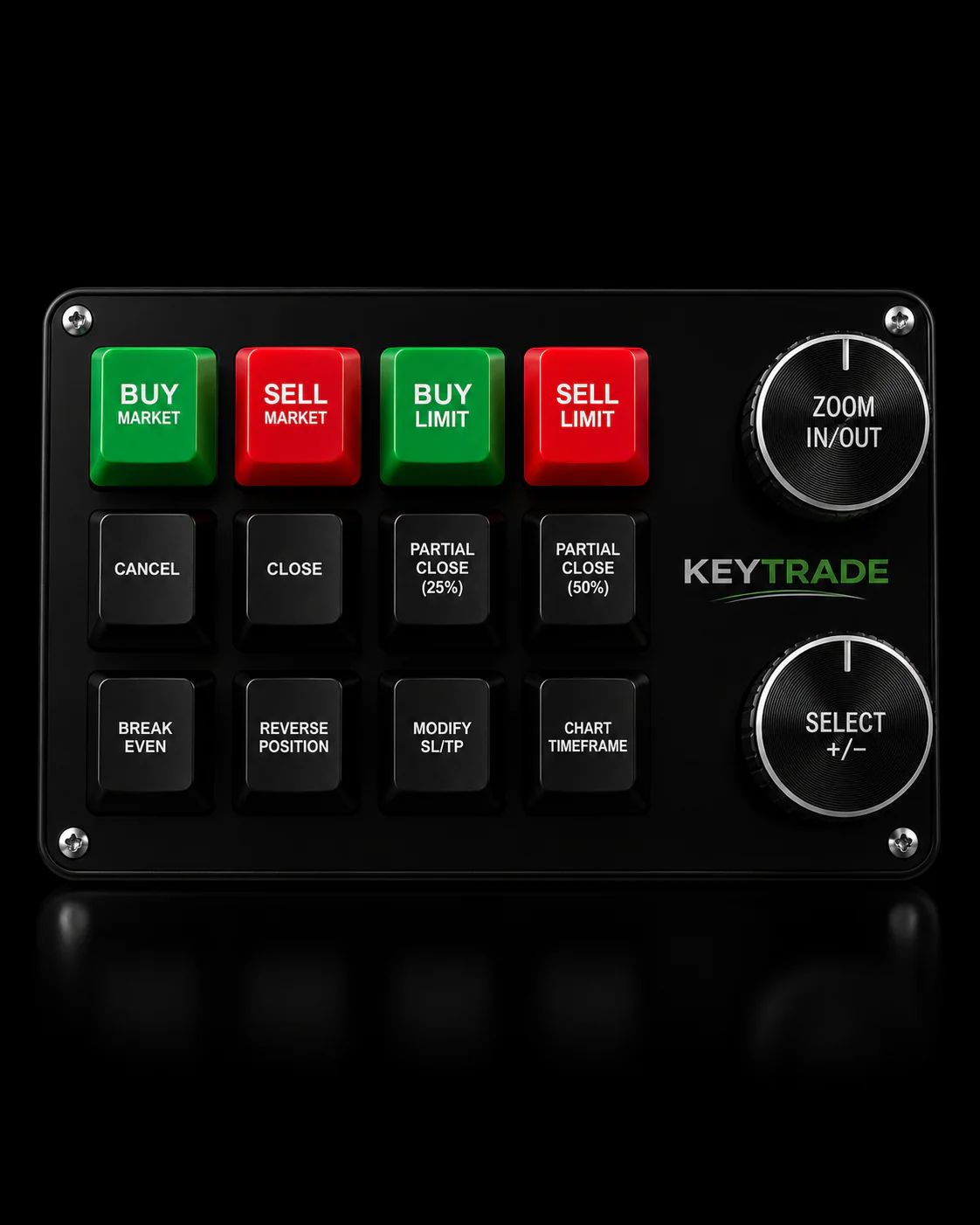
Pairing your pre-trade checklist with the actual order types your platform supports closes the gap between “I know what I should do” and “I did it.” If your checklist says “stop-loss set at entry,” your execution setup should make that the fastest, easiest action available, not an extra step you have to remember three seconds after the fill.
Pro Tip: Grade your trading days by compliance percentage, not by P&L. A day where you followed every rule and lost money is a good day. A day where you broke your own rules and got lucky is a warning sign, not a win.
A useful compliance dashboard tracks three things at a glance: percentage of trades where the stop was set at entry and never moved, percentage of trades that matched your written setup criteria, and percentage of days you stayed under your daily loss limit. None of that requires fancy software, a spreadsheet and a habit of updating it daily gets you most of the way there.
A Practitioner’s Note on Process Over Outcome
The traders who actually improve are the ones who stop grading themselves on whether a single trade made money and start grading themselves on whether they followed their own process. That shift changes everything about how a losing week feels. A losing week where every stop was honored and every position was sized correctly isn’t a failure, it’s data confirming the system is being run correctly, and the edge will show up over a large enough sample.
What changes an equity curve isn’t a better indicator. It’s watching your compliance percentage climb from the 50s into the 80s and 90s over a few months and noticing, almost as a side effect, that the account stopped taking the gut-punch drawdowns it used to take. That’s not motivation talking. That’s what happens when the rule-following stops being optional.
Make Discipline the Default, Not the Effort
Key-trade builds the hardware layer of that discipline system: physical trading keypads with programmable buttons that let you execute, modify, and manage trades across TradingView, MetaTrader, cTrader, NinjaTrader, SierraChart, Thinkorswim, and Tradovate without hunting through menus while a trade is moving against you.
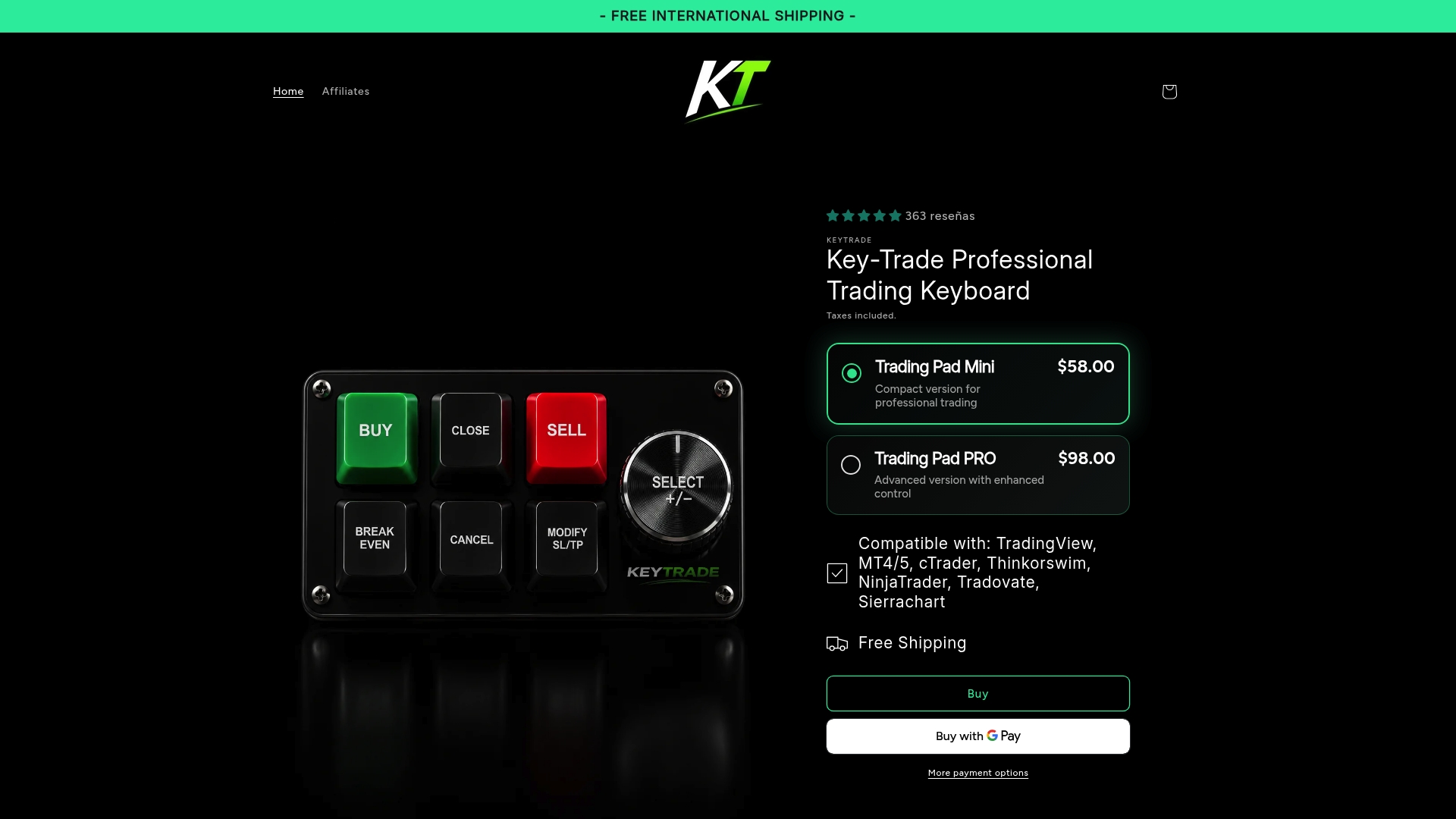
A single programmed button can trigger a partial close, move a position to break-even, or fire your predefined stop, the exact actions that get skipped or fumbled when you’re relying on a mouse and a stressed hand. That’s the practical link between hardware and discipline: it doesn’t ask you to have more willpower in the moment, it removes the extra clicks and menu navigation where willpower usually fails. If you already use hotkey-based execution to win on speed, a dedicated keypad takes that same principle further by making your risk rules physically faster to execute than breaking them. Check the setup guides for your platform and see how a programmable keypad fits into the checklist you just built.
Sources
- 20 Rules Followed by Professional Traders — Investopedia
- Trading Discipline: The Real Difference Between Winners and Losers | DayTradingToolkit
- Why Trading Discipline Beats Motivation Every Time — The Reborn Trader
- Trading Discipline Guide — Building Consistency — ohYaaa
This article is general information, not a substitute for advice from a qualified financial advisor. Consult a qualified financial professional about your own circumstances before acting on anything here.
FAQ
What is the 3-5-7 rule in trading?
It’s a framework some traders use to enforce the position-sizing discipline covered earlier in this article.
What are the five importances of discipline in trading?
Discipline preserves capital through consistent risk control, produces repeatable results by enforcing your tested process, reduces emotionally driven mistakes like revenge trading, improves measurable metrics like expectancy and profit factor, and builds the consistency needed for compounding to actually work over time.
How can I build trading discipline?
Start with a written trading plan, fixed risk-per-trade, and a pre-trade checklist, then log every trade in a journal that tracks whether you followed your own rules. Reviewing your compliance percentage weekly, alongside tools like a Key-trade programmable keypad that automates stop execution, turns discipline into a system instead of a daily willpower test.
What are the core rules of discipline for a trader?
The core rules are: risk a fixed percentage per trade, never move a stop-loss further from entry once it’s set, only trade setups that match your written criteria, and log every trade regardless of outcome. These four rules cover most of what separates disciplined traders from the 80% who quit within two years.
Recommended
- What Is a Trading Journal and Why It Matters – Key-Trade Trading Keyboards
- Prop Trader Performance Improvement Tools for 2026 – Key-Trade Trading Keyboards
- TradingView Risk Management Setup Tips for Pro Traders – Key-Trade Trading Keyboards
- Trading Desk Efficiency Improvement Guide for Pros – Key-Trade Trading Keyboards