

Prop Trader Performance Improvement Tools for 2026
TL;DR:
- Prop trader performance tools focus on enhancing execution, risk control, and behavioral discipline using advanced analytics. Combining real-time risk monitoring, behavioral analytics, auditing, multi-account dashboards, and automated coaching improves success chances, with each layer addressing specific trading weaknesses. Proper use of these tools, along with disciplined review routines and fast hardware, maximizes profitability and minimizes risk.
Prop trader performance improvement tools are specialized technologies and analytics platforms designed to enhance execution precision, risk management, and behavioral discipline in proprietary trading environments. The industry is moving fast: the prop trading analytics market is projected to reach $6.52 billion in 2026, reflecting how deeply data has become central to firm operations. Professional traders who ignore this shift compete at a structural disadvantage. The core metrics that determine your fate at any prop firm, including profit factor, daily drawdown, and consistency score, are now tracked in real time by automated systems that never sleep and never miss a pattern.
1. What are the essential categories of prop trader performance improvement tools?
Performance improvement in prop trading breaks down into five distinct tool categories. Each addresses a different failure point that causes traders to lose accounts or underperform.
- Real-time risk monitoring engines: Automated systems that enforce daily loss limits, trailing drawdowns, and position sizing rules without human intervention.
- Behavioral analytics platforms: Software that detects emotional trading patterns, unusual order frequency spikes, and rule-breaking behaviors before they escalate.
- Performance auditing tools: Platforms that analyze historical trade data, calculate key metrics, and identify execution weaknesses through gap analysis.
- Multi-account aggregation dashboards: Unified views that consolidate multiple funded accounts into one interface for global risk control.
- Automated coaching and soft-breach systems: AI-driven tools that flag risky behaviors early and intervene before a full rule violation occurs.
Each category solves a specific problem. A trader who only uses auditing tools but ignores real-time monitoring is flying blind during live sessions. The strongest performers combine all five layers.
Pro Tip: Start by auditing your last 50 trades before adding any new tool. You need a baseline before you can measure improvement.

2. How do real-time risk monitoring tools enhance trader discipline?
Real-time risk monitoring is the backbone of how prop firms monitor live trading. Automated risk engines enforce daily loss limits, trailing drawdowns, and position sizing rules in milliseconds, eliminating the inconsistent rule application that plagued manual oversight. Human monitoring is simply obsolete at the top firms. Automated engines process thousands of accounts simultaneously with zero lag.
The most advanced systems go beyond enforcement. AI systems predict rule violations 15–30 minutes before they occur by analyzing order frequency, position sizing velocity, and behavioral deviations. That predictive window gives traders and firms a chance to intervene before a breach becomes permanent. Predictive risk management reduces preventable breaches by up to 35%.
Three metrics drive real-time monitoring accuracy:
- Order frequency: Sudden spikes in trade frequency signal panic or revenge trading, two of the most common account killers.
- Position sizing velocity: Rapid increases in lot size often precede martingale-style recovery attempts, which most prop firms prohibit.
- Equity-based drawdown: Unrealized losses can trigger breaches even if a trade eventually closes profitably. Firms track floating equity, not just closed P&L.
Maintaining a drawdown buffer of 30–50% below your firm’s stated limit is the single most effective way to avoid accidental rule violations caused by slippage or spread widening during volatile sessions.
Understanding fast execution requirements matters here too. Slow order entry during high-volatility moments can push your floating drawdown past the limit before you can react.
3. What performance auditing tools help traders optimize consistency?
Performance auditing is the practice of systematically reviewing historical trade data to identify execution weaknesses and behavioral leaks. The industry standard for a fundable track record requires a profit factor above 1.6, daily drawdown under 3% with a buffer, and a win rate between 45% and 65%. A consistency score above 60% is the threshold most firms require for payout eligibility. Win rate alone tells you almost nothing without consistency data behind it.
The most effective auditing method uses normalized risk multiples, known as R values. Transforming CSV trade exports into R-based data lets you compare your planned risk-to-reward ratio against your realized outcomes on every single trade. That gap analysis is the highest-leverage activity available for improving execution consistency.
Key metrics every audit should cover:
- Profit factor: Total gross profit divided by total gross loss. Anything below 1.3 signals a structural problem with your edge.
- Recovery factor: Net profit divided by maximum drawdown. A low recovery factor means you are taking too much risk to generate your returns.
- Consistency score: The distribution of your daily P&L relative to your average. Erratic days destroy payout eligibility even when the monthly total looks fine.
- Plan adherence rate: The percentage of trades that matched your pre-session setup criteria. Low adherence exposes psychological leaks.
Pro Tip: Tag every trade with a setup type before you close the session. Pattern tagging turns raw data into a self-coaching system within 30 days.
| Metric | Target Threshold | What a Breach Signals |
|---|---|---|
| Profit factor | Above 1.6 | Weak edge or poor trade selection |
| Daily drawdown | Under 3% with buffer | Overtrading or poor session management |
| Consistency score | Above 60% | Erratic sizing or emotional decision-making |
| Win rate | 45%–65% | Outside this range, risk-reward ratios need review |
Tools like drawdown calculators and profit calculators, available through most prop firm portals, give you the raw numbers. The interpretation and pattern tagging are your job.
4. How can multi-account dashboards improve portfolio risk control?
Managing multiple funded accounts manually creates dangerous visibility gaps. A trader running three accounts across different prop firms has no reliable way to track combined drawdown exposure without a unified dashboard. Multi-account dashboards aggregate per-account drawdown, position sizing, and combined P&L into one real-time view, giving you enterprise-grade risk control without enterprise-grade infrastructure.
The operational advantage is speed. When a correlated position moves against you across multiple accounts simultaneously, you need to stop all trading instantly. A fragmented setup means logging into each platform separately, which takes time you do not have during a fast-moving market. Centralizing all funded accounts into one dashboard prevents cascade failures where one bad session bleeds into another account before you notice.
Top traders use APIs and read-only investor credentials to pull live data from multiple prop firms into a single aggregated view. This approach enables instant global risk checks and synchronized position controls without requiring manual data entry. The setup takes time upfront but pays off every time the market moves fast.
| Management Approach | Visibility | Response Speed | Breach Risk |
|---|---|---|---|
| Manual per-platform monitoring | Low | Slow | High |
| Unified aggregated dashboard | High | Immediate | Low |
A drawdown buffer alert set at 30% below your firm’s stated limit gives you a warning before the actual breach threshold. That buffer is your margin for error during slippage events.
5. What role do automated coaching and soft-breach protocols play?
Soft-breach protocols are AI-driven interventions that trigger when a trader’s behavior approaches a rule violation without crossing it. 82% of leading prop firms use real-time behavioral surveillance to detect emotional and rule-breaking patterns before significant losses occur. That adoption rate reflects how seriously top firms take proactive coaching over reactive punishment.
The mechanics work like this. The system detects a behavioral pattern, such as increasing position sizes after a losing streak, and flags it as a soft breach. Instead of closing the account, the firm sends an alert, restricts trading temporarily, or requires the trader to review a coaching module. Soft-breach protocols produce 28–31% higher trader retention, 22% increased second-attempt pass rates, and 37% higher lifetime value. Those numbers explain why AI-native firms have adopted them at a 68% rate.
Behavioral patterns that trigger soft-breach flags include:
- Emotional trading: Increasing frequency and position size immediately after a loss, a classic revenge trading signature.
- Martingale recovery attempts: Doubling position size to recover losses, which most prop firm agreements explicitly prohibit.
- Coordinated multi-account trading: Placing correlated trades across multiple accounts to amplify exposure beyond per-account limits.
- Unusual session timing: Trading outside your declared strategy hours, which signals deviation from your approved trading plan.
Pro Tip: Review your flagged soft-breach events weekly. Patterns repeat. Catching them in your data before the firm does is the difference between keeping and losing your account.
For traders using platforms like cTrader, understanding trade management features at the platform level helps you align your execution habits with the behavioral expectations that monitoring systems enforce.
Key Takeaways
The most effective approach to prop trader performance improvement combines real-time risk monitoring, behavioral analytics, performance auditing, multi-account dashboards, and automated coaching into one integrated system.
| Point | Details |
|---|---|
| Real-time monitoring is non-negotiable | Automated risk engines enforce rules in milliseconds, eliminating human lag and inconsistent application. |
| Audit with R values, not just win rate | Normalizing trades into risk multiples reveals execution gaps that raw P&L data hides. |
| Buffer your drawdown aggressively | Maintaining 30–50% below your firm’s stated limit protects against slippage and spread events. |
| Soft-breach tools improve retention | Firms using AI coaching protocols see up to 37% higher trader lifetime value compared to pure enforcement models. |
| Multi-account dashboards prevent cascade failures | Unified views enable instant global position control when correlated trades move against you simultaneously. |
The tools matter less than how you use them
Most traders I work with make the same mistake. They add a new analytics platform, spend a week exploring the interface, and then revert to trading on instinct. The tool becomes a dashboard they glance at rather than a system they act on. That is not a technology problem. It is a discipline problem that technology cannot fix on its own.
The traders who actually improve are the ones who build a weekly review ritual. They export their trades every Friday, run the R-value normalization, check their consistency score, and compare their plan adherence rate against the previous week. That process takes 45 minutes. It is not glamorous. But it compounds over months in a way that no single tool ever will.
Hardware matters more than most traders admit. When you are managing a position in a fast market, the time between your decision and your execution is not trivial. A physical trading keypad with programmable buttons for partial closes, break-even moves, and stop adjustments removes the mouse-click bottleneck entirely. Software analytics tell you what went wrong. Hardware execution tools help you avoid the mistake in the first place. The combination is where real performance gains live.
My honest recommendation: start with the auditing layer, build your baseline, then add real-time monitoring. Add multi-account dashboards only when you are running more than two funded accounts. Soft-breach coaching tools are worth adopting early if your firm offers them, because the behavioral data they generate is more valuable than any metric you can calculate manually.
— Key-trade
Hardware that keeps pace with your analytics
Software tools tell you where your performance breaks down. Executing on that knowledge requires hardware that matches your reaction speed.
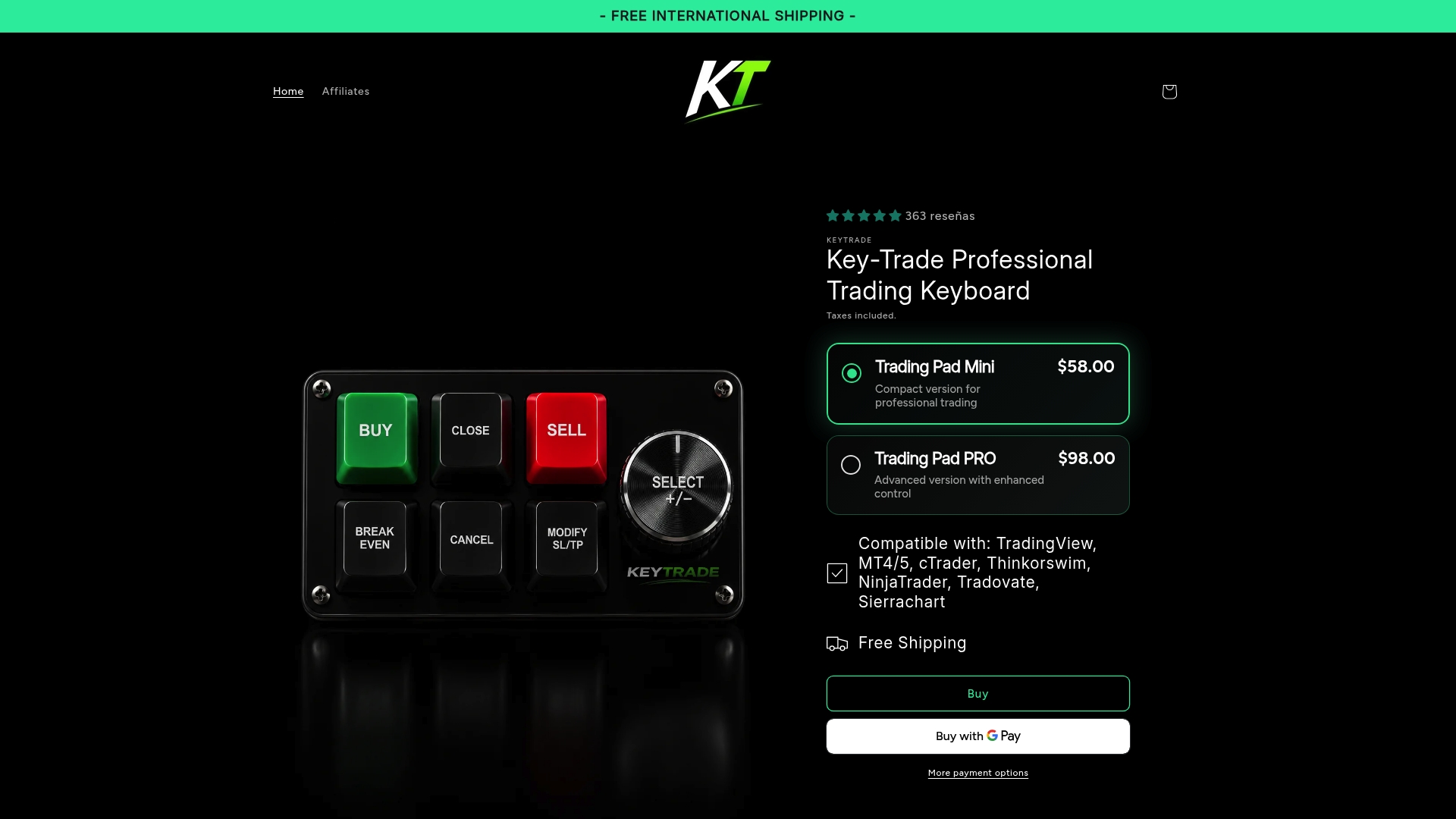
Key-trade builds physical trading keypads designed for prop traders who need fast, precise order management across platforms including TradingView, MetaTrader 4 and 5, cTrader, NinjaTrader, SierraChart, Thinkorswim, and Tradovate. Each button is programmable for actions like partial closes, break-even moves, and stop-loss adjustments, removing the mouse-click delay that costs traders real money during volatile sessions. No technical knowledge is required to set up the device, and it ships worldwide. Traders who have already built strong analytics habits find that pairing those insights with a professional trading keyboard closes the gap between knowing what to do and actually doing it fast enough to matter.
FAQ
What is a trader performance metric?
A trader performance metric is a quantifiable measure used to evaluate trading results, including profit factor, win rate, consistency score, and maximum drawdown. Prop firms use these metrics to determine payout eligibility and account scaling decisions.
How do prop firms monitor live trading?
Prop firms use automated risk engines that track real-time equity drawdown, order frequency, and position sizing in milliseconds. AI systems can predict rule violations 15–30 minutes before they occur by analyzing behavioral deviations from a trader’s established patterns.
What profit factor do prop firms require?
Professional-grade performance audits recommend a profit factor above 1.6 for a fundable track record. A consistency score above 60% is also required by most firms for payout eligibility, regardless of total monthly profit.
What are soft-breach protocols in prop trading?
Soft-breach protocols are AI-driven interventions that flag risky trading behaviors before a full rule violation occurs. Firms using these systems report 28–31% higher trader retention and 22% increased second-attempt pass rates compared to pure enforcement models.
Why use a multi-account dashboard for prop trading?
A multi-account dashboard aggregates per-account drawdown, position sizing, and combined P&L into one real-time view. This prevents visibility gaps that cause cascade failures when correlated positions move against a trader across multiple funded accounts simultaneously.
Recommended
- Trading Desk Efficiency Improvement Guide for Pros – Key-Trade Trading Keyboards
- 5 Hardware Trading Alternatives 2026 – Key-Trade Trading Keyboards
- cTrader Trade Management Features: Complete 2026 Guide – Key-Trade Trading Keyboards
- TradingView Chart Trading: A Complete 2026 Guide – Key-Trade Trading Keyboards