

TradingView Trade Management Tools: 2026 Guide
TL;DR:
- TradingView trade management tools are either chart-native for fast execution or webhook-based for multi-asset automation. Chart-native tools support sub-100ms speeds and are ideal for discretionary traders, while webhook tools introduce delays suitable for systematic strategies. Combining these tools with dedicated platforms for ATM strategies creates a professional, efficient trading workflow.
TradingView trade management tools fall into two distinct categories: chart-native execution tools and webhook-based relay tools. Understanding the types of TradingView trade management tools is the single most important decision you make before building any active trading workflow. Chart-native tools deliver sub-100ms execution speeds, while webhook-based tools introduce 1–3 seconds of latency. That gap determines whether a tool fits discretionary scalping or systematic, alert-driven strategies. Broker compatibility, pricing models, and automation complexity all follow from this foundational choice.
1. What are the types of TradingView trade management tools?
TradingView trade management tools split cleanly into two families. The first is chart-native execution tools, which run locally and integrate directly with TradingView Desktop. The second is webhook-based relay tools, which receive TradingView alerts and forward orders to a broker through cloud infrastructure.

The distinction matters because latency is not just a technical detail. It determines which trading styles each tool supports. A scalper who needs fills in under a second cannot rely on a webhook relay. A systematic trader running Pine Script alerts across 20 symbols has no reason to pay for a chart-native integration.
Most traders start with one tool and discover its limits only after going live. Knowing the category differences upfront saves real money and real losses.
2. How chart-native execution tools enhance discretionary trading
Chart-native execution tools integrate locally with TradingView Desktop and bypass cloud infrastructure entirely. That local connection is the source of their speed advantage.
Key features of chart-native tools include:
- Sub-100ms order execution for near-instant fills on fast-moving markets
- Auto-bracket orders that attach stop loss and take profit levels the moment an entry fires
- One-click order entry directly from the chart without switching windows
- Visual trade controls that let you drag stops and targets on the chart itself
- Single-leg order support for straightforward directional trades
The ideal trader for a chart-native tool is an active discretionary trader. Think forex day traders, futures scalpers, or options traders who enter and exit based on real-time chart reads rather than automated signals. The workflow stays entirely inside TradingView, which reduces friction and cognitive load.
The main limitation is scope. Chart-native tools typically support single-leg orders only. Complex multi-leg options spreads or multi-target scaling strategies require a different approach. For those needs, webhook tools or a dedicated execution platform become necessary.
Pro Tip: Test any chart-native tool on a demo account for at least two weeks before going live. Verify that auto-brackets fire correctly on your broker’s specific order types before risking capital.
3. How webhook-based relay tools support systematic trading
Webhook-based relay tools work through a different mechanism entirely. TradingView fires an alert, that alert sends a JSON payload to a cloud server, and the server relays the order to your broker. The webhook relay mechanism introduces 1–3 seconds of latency as a structural feature, not a bug.
Core capabilities of webhook relay tools include:
- Multi-asset automation across stocks, futures, forex, and options simultaneously
- Multi-leg order support for spreads, brackets, and complex entry sequences
- Pine Script alert integration that triggers orders from any TradingView strategy or indicator
- Cloud-based infrastructure that runs 24/7 without requiring your computer to stay on
- Free tier availability on some platforms, with paid tiers for higher order volume
Webhook tools excel in systematic trading workflows. If you run a Pine Script strategy that generates buy and sell signals automatically, a webhook relay converts those signals into live orders without any manual input. That is a genuine productivity gain for traders managing multiple instruments or running overnight strategies.
The 1–3 second latency is acceptable for swing trades, end-of-day signals, and strategies where the entry price window is measured in minutes rather than milliseconds. For scalping or news-driven trades, that delay is disqualifying. Independent testing shows significant cost differences among webhook relay tools, with some delivering similar fill rates at a fraction of the price of premium alternatives.
4. What TradingView’s native features lack compared to dedicated platforms
TradingView’s built-in order panel handles basic entries and exits. What it does not handle is post-entry automated trade management at a professional level. The platform lacks native ATM strategies, which are the automated rule sets that manage stops, targets, and trailing stops after an entry fires.
ATM strategies, short for Automated Trade Management strategies, remove the need for split-second decisions after you are already in a position. A properly configured ATM strategy will move your stop to breakeven when price reaches a defined profit level, scale out at multiple targets, and trail the remainder automatically. Without that automation, you are making those decisions manually under pressure, which is where most trading errors occur.
Dedicated execution platforms handle this natively. The gap creates a real workflow problem for professional futures traders who rely on TradingView’s charting quality but need execution-level control. Common features missing from TradingView’s native tools include:
- Multi-target scaling that exits partial position size at predefined profit levels
- Auto breakeven stops that move the stop loss to entry price after a set profit threshold
- Trailing stop automation that follows price without manual adjustment
- DOM (Depth of Market) order ladder for one-click entries at specific price levels
- Saved ATM templates that apply a full risk management plan with a single click
The hybrid workflow that professional futures traders use addresses this gap directly. TradingView handles analysis and signal generation. A dedicated execution platform handles order entry and post-entry management. The combined monthly cost for this setup runs approximately $13–$112 depending on platform tiers and subscription choices.
Pro Tip: If you trade futures and need ATM strategies, review the ATM strategy features available on execution platforms before committing to a TradingView-only setup. The gap in functionality is significant.
5. How to choose the right TradingView trade management tool
The right tool depends on four variables: latency tolerance, trading style, automation complexity, and broker compatibility. Getting one of those wrong means rebuilding your setup after going live.
Latency tolerance is the first filter. If you scalp or trade news events, chart-native tools are the only viable option. If you swing trade or run systematic strategies, webhook latency is irrelevant.
Trading style determines the feature set you need. Discretionary traders benefit from visual controls and one-click entries. Systematic traders need Pine Script compatibility and reliable alert-to-order conversion.
Automation complexity separates simple from advanced needs. Single-leg directional trades work fine with chart-native tools. Multi-leg spreads, multi-target exits, and overnight automation require webhook relays or a dedicated execution platform.
Broker compatibility is often the deciding factor. Not every tool connects to every broker. Verify your broker appears on the tool’s supported list before purchasing any subscription.
A practical decision framework:
- Choose chart-native tools when execution speed is critical and trades are discretionary
- Choose webhook relay tools when running Pine Script strategies across multiple assets
- Add a dedicated execution platform when you need ATM strategies and DOM trading
- Validate automation chains on a demo account before any live deployment to catch alert failures and duplicate order risks
Budget matters too. Webhook tools with free tiers let you test the automation chain at zero cost. Chart-native tools typically require a paid subscription from day one. Factor in the cost of a second execution platform if your strategy requires ATM features that TradingView cannot provide natively.
6. Key features across TradingView trade management tools
Understanding which features belong to which tool category helps you build a checklist before committing to any setup. The table below maps common TradingView tool features to their typical availability by tool type.
| Feature | Chart-native tools | Webhook relay tools |
|---|---|---|
| Execution latency | Sub-100ms | 1–3 seconds |
| Auto-bracket orders | Yes | Varies by platform |
| Multi-leg order support | Limited | Yes |
| Pine Script alert integration | No | Yes |
| Trailing stop automation | Basic | Advanced |
| Multi-target scaling | Rare | Common |
| Runs without local PC | No | Yes |
| Free tier available | Rarely | Often |
Hotkey support and TradingView chart trading integration are features that sit outside both categories. Physical trading keyboards, like those from Key-trade, add programmable hotkeys that trigger order actions across platforms without relying on software menus. That layer of hardware control reduces input errors and speeds up execution regardless of which software tool you use underneath.
Automated trade management, when configured correctly, enforces predefined risk rules objectively. That objectivity is the core value proposition. Manual management under pressure produces inconsistent results. Automated management produces consistent ones.
Key Takeaways
The most effective TradingView trade management setup combines chart-native tools for speed, webhook relays for automation, and a dedicated execution platform for ATM strategies when futures trading demands it.
| Point | Details |
|---|---|
| Two core tool types | Chart-native tools offer sub-100ms speed; webhook relays suit systematic alert-driven trading. |
| Latency drives the choice | Scalpers need chart-native tools; swing and systematic traders can accept webhook latency. |
| TradingView’s native limits | The platform lacks ATM strategies, multi-target scaling, and auto breakeven natively. |
| Hybrid workflows work | Professional futures traders pair TradingView analysis with a dedicated execution platform. |
| Test before going live | Demo account validation catches alert failures and duplicate orders before they cost real money. |
The tool category matters more than the tool name
Most traders spend hours comparing specific products when the real decision is choosing the right category first. I have seen traders buy a premium webhook relay subscription and then discover their strategy requires sub-100ms fills. The product was not the problem. The category was wrong from the start.
The hybrid workflow, TradingView for analysis and a dedicated platform for execution, is not a workaround. It is the professional standard for futures traders who need both charting quality and ATM-level control. The fast execution requirement is not optional in active markets. Treating it as optional is how traders develop bad habits around manual stop management.
Automation validation on a demo account is the step most traders skip. Full automation reduces manual errors but introduces new failure modes: alert misfires, duplicate orders, and broker-side rejections. Every automation chain deserves at least two weeks of paper trading before it touches a live account. That is not caution. That is professional practice.
The best traders I have observed do not chase the most feature-rich tool. They identify their actual latency requirement, match it to the right tool category, and then build consistent habits around that setup. The tool becomes invisible. The process becomes the edge.
— Key-trade
Hardware that keeps up with your TradingView setup
Managing trades across TradingView and a dedicated execution platform means switching between windows, triggering hotkeys, and adjusting orders under time pressure. Software tools handle the automation layer, but your physical input device determines how fast and accurately you execute those actions.
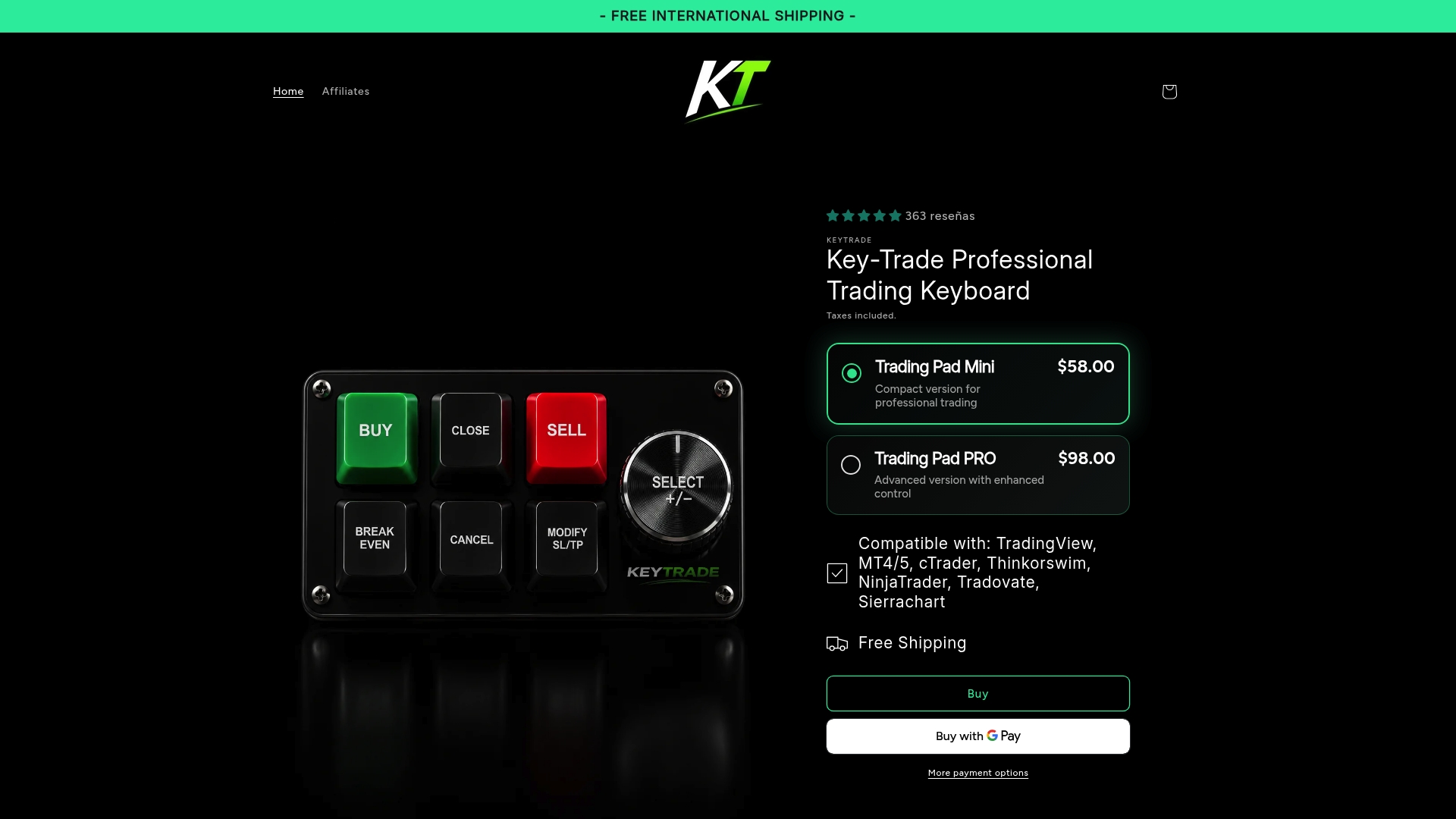
Key-trade professional trading keyboards give active traders programmable physical buttons mapped to order actions across TradingView, MetaTrader 4 and 5, cTrader, and other major platforms. Each button can trigger partial closes, breakeven moves, stop adjustments, and full exits without touching a mouse or navigating menus. The result is fewer input errors and faster responses in fast-moving markets. Traders running complex multi-platform setups use Key-trade keyboards to reduce the gap between decision and execution. Visit the Key-trade trading keyboard page to see the full feature set and compatibility list.
FAQ
What are the two main types of TradingView trade management tools?
TradingView trade management tools divide into chart-native execution tools, which offer sub-100ms speed, and webhook-based relay tools, which introduce 1–3 seconds of latency in exchange for multi-asset automation support.
What is an ATM strategy and does TradingView support it?
An ATM strategy is an Automated Trade Management rule set that controls stops, targets, and trailing stops after entry. TradingView does not support native ATM strategies, which is why professional futures traders add a dedicated execution platform to their workflow.
How do I use TradingView tools for risk management?
Chart-native tools attach auto-bracket orders at entry, while webhook relay tools apply predefined risk rules through Pine Script alert logic. For full ATM-level risk control, a hybrid setup with a dedicated execution platform is the standard professional approach.
When should I use a webhook relay tool instead of a chart-native tool?
Use a webhook relay tool when you run Pine Script strategies that generate automated signals across multiple assets, or when your trades do not require sub-100ms execution. Webhook tools also support multi-leg orders that chart-native tools typically cannot handle.
Is it safe to automate TradingView trade management?
Automation reduces emotional errors but introduces risks like alert failures and duplicate orders. Always validate your full automation chain on a demo account for at least two weeks before deploying it on a live account.
Recommended
- cTrader Trade Management Features: Complete 2026 Guide – Key-Trade Trading Keyboards
- TradingView Chart Trading: A Complete 2026 Guide – Key-Trade Trading Keyboards
- Why TradingView Lacks Native Hotkeys for Traders – Key-Trade Trading Keyboards
- NinjaTrader Partial Close Futures Guide for Traders – Key-Trade Trading Keyboards