

What Is a Trading Desk? Explained for Professionals
A trading desk is defined as a specialized unit within a financial institution where traders execute buy and sell orders for securities and other financial instruments. Understanding what is a trading desk explained properly requires knowing that it functions as the execution engine of markets, handling everything from equities and fixed income to foreign exchange, commodities, and derivatives. These desks sit at the center of how banks, asset managers, hedge funds, and broker-dealers move capital through global markets. Traders, salespeople, and risk managers work together on the desk to serve clients and manage the firm’s own exposure.
What are the core functions of a trading desk?
Trading desks perform four core functions: liquidity provision, order execution, risk management, and market intelligence. Each function is distinct, but all four operate simultaneously during market hours.
- Liquidity provision. The desk stands ready to buy or sell instruments at quoted prices. Without this, markets would seize up during periods of stress. A fixed income desk at a major bank, for example, continuously quotes bid and ask prices on government bonds even when no natural buyer exists.
- Order execution. Traders find the best available price for each trade, whether through electronic venues, voice brokerage, or dark pools. Execution quality directly affects client returns and the desk’s reputation.
- Risk management. Desks use tools like Value-at-Risk (VaR) to measure potential losses under adverse market conditions. A VaR model might estimate the maximum loss on a portfolio if the S&P 500 drops sharply in a single session. That number sets the boundary for how much risk the desk can carry.
- Market intelligence. Traders monitor order flow, news, and price action to form views on supply and demand. This intelligence feeds back into pricing decisions and client advice.
Pro Tip: Track your desk’s VaR limit daily, not just when volatility spikes. Desks that monitor risk metrics continuously catch limit breaches before they escalate into serious losses.
How do trading desk operational models work?
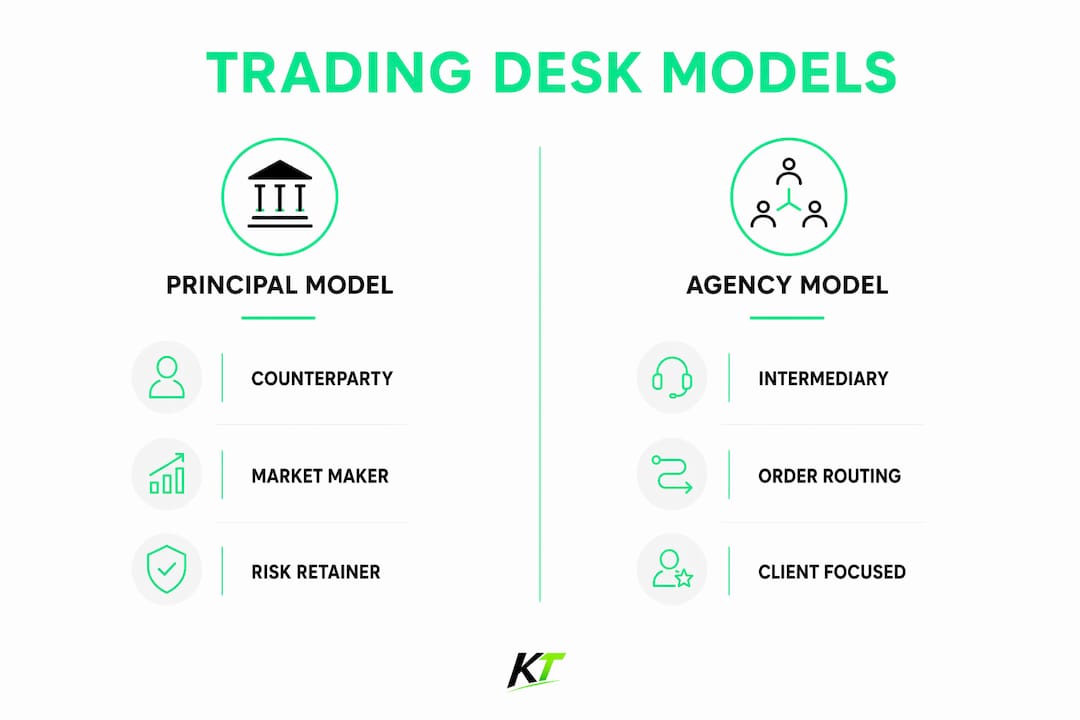
Dealing desks operate under two main models: the principal model and the agency model. The difference between them determines how orders are filled, how revenue is earned, and where conflicts of interest can arise.
Principal model (market maker)
In the principal model, the desk acts as the direct counterparty to every trade. A client sells 10,000 shares of a stock, and the desk buys them, adding those shares to its own inventory. The desk then works to sell that inventory at a higher price. Traders earn from the bid-ask spread by pricing instruments under uncertainty and managing the resulting inventory risk. The skill lies in real-time pricing across hundreds of fluctuating positions.
Agency model
In the agency model, the desk acts as an intermediary. It routes the client’s order to the best available market price without taking the other side of the trade. The desk earns a commission or fee rather than a spread. This model carries less inventory risk but also generates less revenue per trade.
| Feature | Principal model | Agency model |
|---|---|---|
| Desk role | Counterparty to the trade | Intermediary routing orders |
| Revenue source | Bid-ask spread | Commission or fee |
| Inventory risk | High | Low |
| Conflict of interest | Possible (desk profits when client loses) | Minimal |
| Transparency | Lower | Higher |
Post-2008 regulations have largely limited proprietary trading at US banks, pushing most bank desks toward client-facilitated flow business rather than speculative principal positions. The Volcker Rule, part of the Dodd-Frank Act, is the key regulatory instrument behind this shift.
Pro Tip: Confirm whether your broker’s desk acts as principal or agent before you open an account. That single distinction affects your execution quality, the fees you pay, and whether your broker profits when your trade moves against you.
What types of trading desks exist across financial institutions?
Trading desks specialize by asset class and institution type. The taxonomy matters because each desk type serves a different purpose, faces different risks, and employs people with different skill sets.
Sell-side desks
Sell-side desks operate at banks and broker-dealers. Their primary job is market making and client order execution. A Goldman Sachs or JPMorgan equities desk, for example, quotes prices to institutional clients all day and manages the resulting inventory. Sell-side desks are further divided by asset class:
- Equities desks handle stocks and equity derivatives, including single-stock options and index products.
- Fixed income desks trade government bonds, corporate bonds, mortgage-backed securities, and interest rate swaps.
- FX desks quote currency pairs around the clock, serving multinational corporations, central banks, and institutional investors.
- Commodities desks trade oil, natural gas, metals, and agricultural products, often using futures and options.
- Derivatives desks structure and trade complex instruments like credit default swaps and exotic options.
Buy-side desks
Buy-side desks sit inside asset managers, pension funds, and hedge funds. Their job is not market making but portfolio execution. A buy-side trader at a large asset manager receives an order from a portfolio manager to buy $50 million of a specific bond. The trader then decides how to execute that order across multiple sell-side desks without moving the market price against the fund.
Roles within desks include traders, salespeople, and risk managers who collaborate to optimize execution and control exposure. Salespeople maintain client relationships and relay order flow to traders. Risk managers monitor position limits and flag breaches in real time.
How is technology transforming the modern trading desk?
The modern trading desk faces a structural problem known as the “silo tax.” Fragmented systems across equities, FX, and fixed income units create duplicated workflows, inconsistent data, and slower execution. A trader managing a multi-asset portfolio must often log into three separate platforms to execute a single hedged position. That friction costs time and increases the chance of error.
Leading firms are responding with unified technology stacks that consolidate data and execution across asset classes. The goal is a single architecture that supports consistent workflows regardless of whether the desk is trading bonds, currencies, or stocks. This matters because AI tools require clean, consistent data to function reliably.
The most significant technology shift underway involves agentic AI overlays. Agentic overlays allow traders to give natural language commands that are automatically converted into structured, compliant trading processes. A trader might say, “Execute 30% of the bond order before the Fed announcement and hold the rest,” and the system translates that instruction into a sequenced execution plan with built-in compliance checks.
The steps toward this future look like this:
- Consolidate data infrastructure. Firms first unify market data, order management, and risk feeds into a single platform.
- Standardize workflows. Execution protocols are written consistently across asset classes so AI tools can apply them reliably.
- Deploy agentic AI layers. Natural language interfaces sit on top of the unified stack, translating trader intent into structured orders.
- Monitor and refine. Risk managers review AI-generated execution logs and adjust parameters based on outcomes.
The defining characteristic of the trading desk of the future is architectural consistency, not any single technology. Firms that build on fragmented foundations will find AI enhancements difficult to scale.
Pro Tip: If you work at a firm evaluating new trading technology, prioritize data architecture before selecting AI tools. The AI is only as reliable as the data it reads.
What risks and challenges do trading desks face?
Trading desk operations carry a distinct set of risks that differ from those in other parts of a financial institution. Managing these risks is not optional. It is the core discipline that separates profitable desks from those that generate catastrophic losses.
- Inventory risk. In the principal model, the desk holds positions that move with every market tick. A fixed income desk holding a large bond position faces immediate losses if interest rates rise unexpectedly. Real-time position monitoring is the primary defense.
- Regulatory constraints. Post-financial crisis frameworks stress governance, reporting, and escalation paths rather than simple position limits. Compliance teams require detailed audit trails for every trade, and regulators can examine those records at any time.
- Limit breaches. Risk managers escalate limit breaches immediately to prevent unauthorized risk accumulation. A trader who exceeds a position limit, even by accident, triggers an immediate review. Desks that lack clear escalation protocols are exposed to outsized losses during volatile markets.
- Conflicts of interest. Principal desks face a structural tension: the desk profits when it buys low and sells high, which is the opposite of what the client wants. Regulatory disclosure requirements exist precisely to manage this tension.
- Operational risk. Technology failures, fat-finger errors, and connectivity outages can cause significant losses in seconds. Desks run redundant systems and maintain manual backup procedures for this reason.
Understanding these risks is not just academic. Traders who internalize risk frameworks make better real-time decisions under pressure.
Key Takeaways
A trading desk is the execution and risk management center of a financial institution, and its model, whether principal or agency, determines pricing, transparency, and conflict of interest for every trade it handles.
| Point | Details |
|---|---|
| Core definition | A trading desk executes buy and sell orders across asset classes for clients and the firm. |
| Four key functions | Liquidity provision, order execution, risk management, and market intelligence define every desk. |
| Two operational models | Principal desks act as counterparty; agency desks route orders to the best market price. |
| Types by institution | Sell-side desks make markets at banks; buy-side desks execute portfolio orders at asset managers. |
| Technology direction | Unified architecture and agentic AI are replacing fragmented, siloed trading systems. |
The part of trading desks most professionals overlook
Most articles about trading desks focus on what they do. The more useful question is how the model a desk chooses shapes every interaction a trader or investor has with it.
I have watched professionals spend years trading through a broker without knowing whether that broker’s desk was acting as principal or agent. That distinction is not a technicality. It determines whether the desk profits when your trade goes wrong, what price you actually receive, and how much information your counterparty holds that you do not. Regulation has improved disclosure, but it has not eliminated the information gap.
The technology shift toward agentic AI is real, but firms underestimate how much the underlying architecture matters. I have seen institutions spend heavily on AI tools only to find those tools unreliable because the data feeding them was inconsistent across desks. The firms making genuine progress are the ones that fixed their data infrastructure first and treated AI as the final layer, not the starting point.
For professionals aiming to work on or alongside trading desks, the most valuable skill is not coding or financial modeling. It is the ability to make fast, defensible decisions under uncertainty with incomplete information. That skill does not come from software. It comes from understanding the mechanics of how desks price risk, manage inventory, and handle client flow in real time.
— keytrades
Hardware built for the speed trading desks demand
Execution speed separates profitable trades from missed opportunities. At the desk level, every second between decision and order entry carries real cost.
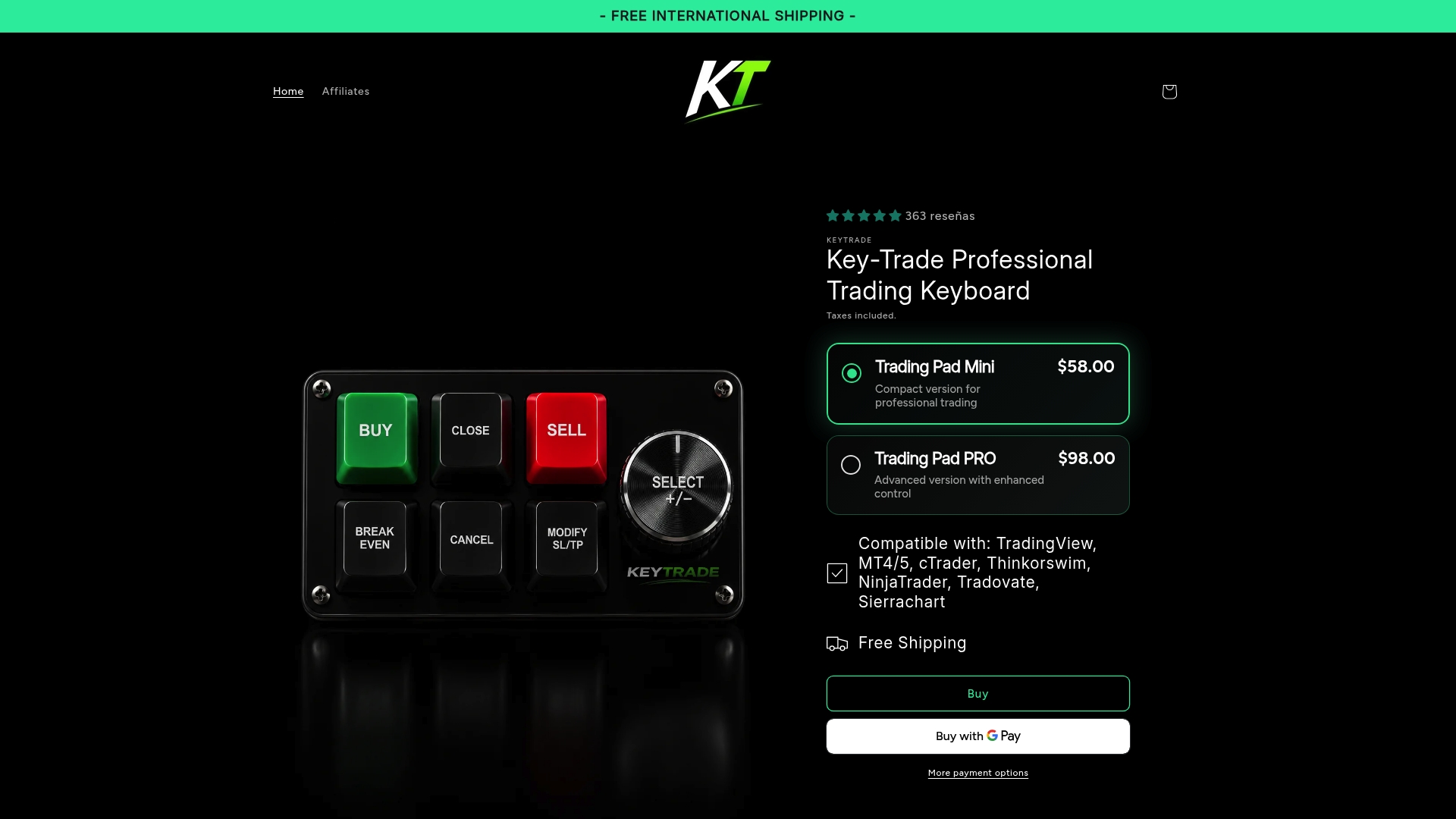
Key-trade builds physical trading keypads designed for professional traders who need faster order entry without relying on mouse clicks or software menus. The keypads integrate directly with platforms including TradingView, MetaTrader 4 and 5, cTrader, NinjaTrader, SierraChart, Thinkorswim, and Tradovate. Programmable buttons handle order execution, partial closures, stop-loss and take-profit modifications, and break-even adjustments in a single press. No technical setup is required. The Key-trade trading keyboard ships worldwide and works with both live and prop trading accounts, making it a practical tool for serious retail traders and proprietary trading firms alike.
FAQ
What is a trading desk in simple terms?
A trading desk is a team within a bank, broker, or asset manager that buys and sells financial instruments on behalf of clients or the firm. It handles execution, risk, and market analysis across asset classes like equities, bonds, and currencies.
What is the difference between a broker desk and a trading desk?
A broker desk typically refers to an agency model operation that routes client orders to the best available market price without taking the other side of the trade. A trading desk is a broader term that includes both agency and principal (market maker) operations.
How do trading desks make money?
Principal desks earn revenue from the bid-ask spread by buying at a lower price and selling at a higher price. Agency desks charge commissions or fees for routing orders to external markets without holding inventory.
What does a risk manager do on a trading desk?
A risk manager monitors position limits, flags limit breaches in real time, and escalates violations to senior management. The role exists to prevent unauthorized risk accumulation before it becomes a significant loss.
How is AI changing trading desk operations?
Agentic AI overlays now translate natural language trader instructions into structured, compliant execution workflows. Firms with unified data architectures across asset classes are best positioned to deploy these tools reliably.