

2026 Trading Hardware Import Duty: What U.S. Importers Must Check
Trading hardware imports to the United States are generally subject to customs duty and fees, and the exact cost depends on the Harmonized Tariff Schedule (HTS) classification, country of origin, and dutiable value, typically the price plus freight and insurance. Before you ship or buy, confirm the HTS code, confirm the country of origin, and confirm the dutiable value. For high-value shipments or uncertain classifications, a CBP binding ruling or a licensed customs broker settles the question before it becomes a clearance delay.
TL;DR:
- Classify trading hardware by its actual function, not its marketing name; dedicated trade controls may fall outside automatic data processing headings such as 8471.
- Formal entries incur MPF subject to statutory minimums and maximums, while ocean shipments add HMF and origin based surcharges can stack atop base duty.
- CBP’s bulletin says the de minimis exemption is suspended for nonpostal shipments, so courier, air, and ocean arrivals may face duty at low values.
- Prepare an itemized invoice, origin details, function list, schematics, manual excerpts, and matching packing list; seek a broker or binding ruling for unclear classifications.
Table of Contents
- How to Find the Correct HTS Code for Trading Hardware
- How Customs Duty, MPF, and HMF Add Up on an Import
- Tariff Layers That Stack on Top of the Base Rate for Electronics
- Entry Procedures and the De Minimis Rule Changes You Need to Know
- Estimating Landed Cost Before You Commit to a Shipment
- Importer Checklist for Trading Hardware Shipments
- Publisher Perspective: What We See Shipping Trading Hardware
- How Key-Trade Supports Importers Buying Trading Keypads
- FAQ
- Sources
How to Find the Correct HTS Code for Trading Hardware
Classification starts at the Harmonized Tariff Schedule maintained by the United States International Trade Commission. Search by function and keyword rather than by product name, since “trading keypad” will not appear as a tariff term. What matters legally is what the device does: whether it processes data generally (automatic data processing, or ADP) or performs a dedicated control function.
This distinction decides whether a device lands in Chapter 84’s ADP-related headings (such as 8471) or in a residual heading like 8543 for electrical machines with individual functions not elsewhere specified. USITC search results confirm that a product connecting to a computer is not automatically an ADP machine. Technical function and intended use drive the outcome, and specialized control devices often fall outside 8471 entirely.
- Read the Chapter 84 and 85 notes, especially Note 5, before assuming a heading applies.
- Match your device’s actual function (programmable buttons, dedicated trade-execution controls) to the heading language, not to how the product is marketed.
- Compile schematics, a function list, and user manual excerpts that describe what the hardware does.
- When classification stays unclear, request a binding ruling from CBP or confirm with a licensed customs broker before the shipment moves.
Pro Tip: Write your technical file in the same vocabulary the tariff schedule uses (dedicated function, programmable control input) rather than marketing language; it speeds up broker review and CBP questions alike.
How Customs Duty, MPF, and HMF Add Up on an Import
Dutiable value is usually the invoice price plus freight and insurance when the terms of sale include them, following the general CIF principle customs officers apply. Some invoice structures exclude freight from the dutiable base, so how your supplier itemizes freight and insurance on the commercial invoice directly affects what you owe.
Beyond the ad valorem HTS rate, three recurring fees shape the real cost of a shipment:
- The HTS ad valorem duty, calculated as a percentage of dutiable value based on your classification.
- The Merchandise Processing Fee, an ad valorem fee with a statutory floor and ceiling that applies to formal entries and must be budgeted alongside duty.
- The Harbor Maintenance Fee for ocean shipments, plus any brokerage or Partner Government Agency costs tied to your entry.
MPF applies to formal entries as an ad valorem fee bound by a statutory floor and ceiling set by CBP guidance. That cap matters for higher-value shipments, since MPF stops scaling once the ceiling is reached, while duty keeps scaling with value.
A clean landed cost estimate is duty plus MPF plus HMF (if applicable) plus broker fees, all layered on top of dutiable value. Clear invoice descriptions, itemized freight and insurance, and an unambiguous country of origin reduce the back and forth that slows an entry down.

Tariff Layers That Stack on Top of the Base Rate for Electronics
The base rate in the HTS is only the starting point for many electronics and hardware imports. Several additional, often unrelated layers can apply depending on origin and product category, and they stack rather than replace one another.
- The Most Favored Nation (MFN) base rate, published directly in the HTSUS, applies to normal trading partners absent a specific exclusion.
- Section 301 duties targeting goods from China, including forced-labor-related tariffs, can add a separate percentage on top of the base rate.
- Section 232 duties, originally built around metals and autos, can touch components or materials used in electronics manufacturing.
- Other presidential actions under statutes like IEEPA have added further country- or product-specific surcharges in recent years.
Because these layers stack, a device with a modest base HTS rate can carry a meaningfully higher effective duty once origin-specific surcharges apply. Free trade agreement eligibility or documented origin outside an affected country can exclude some of these layers, but only when the paperwork supports the claim. Verify which layers apply to your specific product and origin before you price a shipment or commit to accepting one at the border.
Entry Procedures and the De Minimis Rule Changes You Need to Know
Formal entries and informal entries are treated differently by CBP, with the entry type driven by shipment value, product category, and the presence of quotas or Partner Government Agency requirements. Low-value shipments historically moved through simplified administrative processing, but that landscape shifted substantially in 2026.
A CBP Customs Bulletin issued in July 2026 detailed changes to the Section 321 de minimis administrative exemption, including its suspension for shipments arriving through non-postal modes. That means courier, air, and ocean shipments that once cleared duty-free under the low-value exemption may now face formal duty assessment regardless of their modest value.
- Confirm whether your shipment moves by mail or by a non-postal carrier, since treatment now differs meaningfully between the two.
- Check whether your product category triggers mandatory formal entry regardless of value, which applies to goods subject to antidumping, countervailing duty, or quota restrictions.
- Prepare commercial invoices, packing lists, and country-of-origin documentation before the shipment departs rather than after it arrives.
- Engage a licensed customs broker when entry requirements are unclear, particularly for first-time shipments of a new hardware model.
Estimating Landed Cost Before You Commit to a Shipment
A reliable landed cost estimate starts with a fixed set of inputs: invoice value, the applicable HTS ad valorem rate or rates, freight, insurance, MPF, HMF where relevant, and broker or Partner Government Agency fees. Missing any one of these produces an estimate that looks clean but understates the real cost.
- Start with dutiable value: invoice price plus freight and insurance, following the terms your invoice actually specifies.
- Apply the base HTS rate, then layer on any Section 301, Section 232, or other applicable surcharges identified for your product’s origin.
- Add MPF for formal entries, respecting the statutory floor and ceiling, and add HMF if the shipment moves by ocean.
- Add broker fees and any Partner Government Agency costs tied to your specific product category.
Reputable landed cost calculators can help structure this math and catch a missed fee line, though their output is an estimate rather than a binding figure. For a non-binding illustrative example: a hardware shipment valued at $5,000 with a 3% base HTS rate owes $150 in base duty before any additional surcharge layers or fees are added, a figure useful only for understanding the mechanics, not for budgeting an actual shipment.
Pro Tip: Run your estimate twice, once with and once without any applicable Section 301 or 232 surcharge, so you see the full cost spread before a surcharge determination comes back.
Importer Checklist for Trading Hardware Shipments
A clean customs-ready file for a trading keypad or similar device typically includes a commercial invoice with itemized charges, a detailed technical description of the device’s functions, relevant user manual excerpts, schematics, a packing list, and a certificate of origin where one applies.
The technical file itself should emphasize what makes the device a dedicated-function tool rather than a general-purpose computing accessory: a function list, connectivity details, and a clear description of programmable macro keys and trade-execution controls.
- List every control function by name rather than describing the device only by its general category.
- Label country of origin clearly on the invoice and packing list so the carrier and broker see it immediately.
- Share your suggested HTS search terms with your customs broker proactively rather than waiting for a classification question.
- Keep a packing list that matches the invoice line for line, since mismatches are a common cause of clearance holds.
Pro Tip: A one-page function summary attached to the invoice often resolves a classification question before it reaches a CBP officer’s desk.
Publisher Perspective: What We See Shipping Trading Hardware
Shipping trading keypads regularly, we see the same documentation gaps slow down clearance again and again: vague invoice descriptions, missing function lists, and country-of-origin fields left blank. A clear technical file and an itemized invoice cut classification questions dramatically, and that is the single biggest lever an importer controls.
— key-trade
How Key-Trade Supports Importers Buying Trading Keypads
We build and ship professional trading keyboards with documentation that supports import clearance: clear function descriptions, itemized invoices, and worldwide shipping support for professional and prop trading accounts.
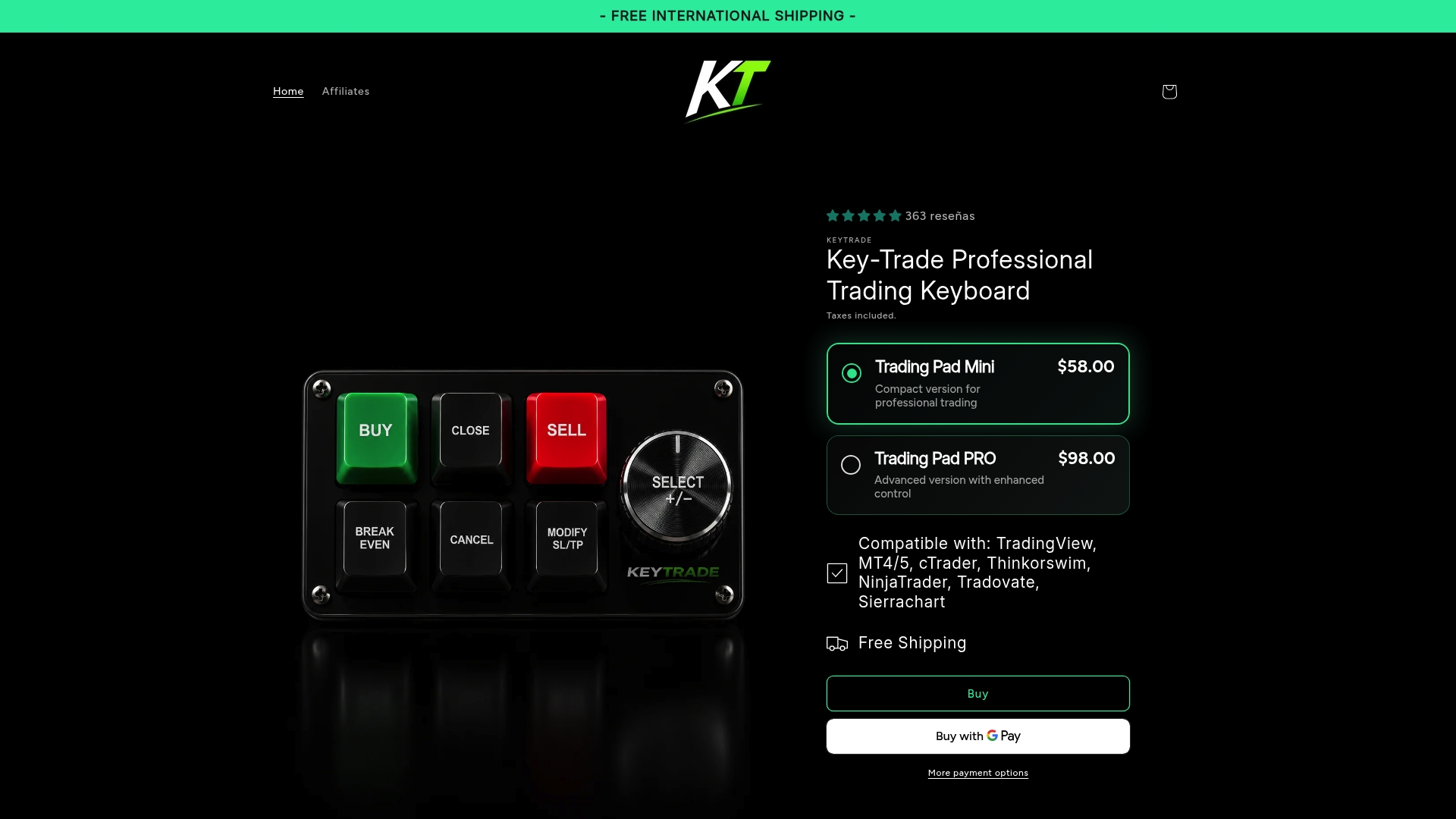
- Review the Key-Trade Professional Trading Keyboard lineup, priced from $59 one-off per unit.
- Contact support for HTS search term suggestions or export paperwork before your order ships.
- Check our guide on trading keypad models and comparisons for the technical detail your customs broker may request.
Browse the full collection and place an order with documentation built in from the start.
FAQ
What are the current import duty rates for the US?
Rates vary by product because each item is classified under a specific HTS line with its own ad valorem percentage, so there is no single flat rate for electronics or trading hardware. Check your product’s exact classification on the Harmonized Tariff Schedule and confirm with a licensed customs broker when the rate affects a significant order.
What items are exempt from import duty?
Certain goods qualify for duty-free treatment under specific HTS provisions or free trade agreement rules, but exemptions depend on the product’s classification and documented origin, not on its price or category alone. The International Trade Administration recommends verifying any exemption claim against the official tariff schedule or through a broker before relying on it.
Are there tariffs on orders under $800?
The administrative exemption that once let many low-value shipments clear duty-free has changed significantly, with CBP’s 2026 Customs Bulletin detailing a suspension of that exemption for shipments arriving through non-postal modes like courier and air freight. Shipments that once avoided duty under the low-value exemption may now face formal duty assessment depending on how they arrive.
How much can I import to the USA without paying duty?
There is no longer a simple dollar threshold that guarantees duty-free entry for every shipment type, since the de minimis exemption changes detailed in CBP’s 2026 bulletin now depend heavily on shipping mode and product category. Mail shipments and non-postal shipments are treated differently, so confirming your carrier type and product classification is the only reliable way to know your actual exposure.