

Use Hotkeys as Risk Controls: Hardware vs Software for Prop Desks
Hardware hotkeys, meaning dedicated physical trading keypads, win the latency and reliability argument for anything execution-critical or emergency-related on a professional desk. Software hotkeys built into a platform still earn their place for routine, non-urgent tasks where cost matters more than milliseconds. Which one a desk should lean on mostly comes down to platform compatibility and how much risk sits on a single keystroke.
TL;DR:
- Hardware hotkeys provide faster, more reliable execution and operate independently during system freezes or UI updates, unlike software hotkeys that depend on focus and may lag.
- A dedicated hardware kill switch can bypass software vulnerabilities, ensuring critical risk controls still function if the trading platform becomes unresponsive.
- Compatibility varies across trading platforms; verifying global hotkey support and testing full macro functionality is essential before deployment.
- High-frequency, execution-critical desks must prioritize hardware for latency reduction and emergency safeguards, while other desks can start with software options.
- Regular calibration, physical inspection, and drills are necessary to maintain hardware accuracy and muscle memory over time.
Table of Contents
- Hardware vs Software Hotkeys: Pros and Cons for Execution
- How Hardware Hotkeys Support Risk Controls and Emergency Procedures
- Mapping Hardware Hotkeys to Major Trading Platforms
- When to Choose Hardware Hotkeys (and When Software Is Enough)
- Setting Up Hardware Hotkeys on a Trading Desk
- Keeping Hardware Hotkeys Accurate Over Time
- What Trading Desks Actually Ask Us About Hardware Hotkeys
- Get Faster, More Reliable Execution With a Physical Keypad
- Sources
- FAQ
Hardware vs Software Hotkeys: Pros and Cons for Execution
The gap between hardware vs software hotkeys shows up first in timing. A dedicated keypad fires one physical action per command. Software hotkeys inside a platform often need a specific window in focus, and in many cases a multi-key sequence, before the order actually goes out, a limitation Interactive Brokers documents directly in its own hotkey setup guide.
Where hardware pulls ahead:
- Faster, more consistent input timing through physical button design built for rapid repeated presses
- No dependence on which window currently has focus
- Keeps working during a platform freeze, update, or UI redesign
- Preserves muscle memory across multiple platforms and accounts
- One-time hardware cost instead of ongoing platform-specific configuration work
Where software still holds up:
- Zero added hardware cost for a desk already paying for the platform
- Faster to reconfigure for a single trader testing a new workflow
- Fine for research, journaling, or low-urgency adjustments
Timing precision isn’t just a feel-good claim. Research on impact activation found that button design measurably improves accuracy during rapid, repetitive presses, exactly the motion pattern of scaling out of a position five times in ten seconds. Separately, psychophysiology research on delayed system response found that lag changes how hard and how fast people press, and raises stress markers in the process. That’s a real cost when a laggy software click makes a trader hesitate or double-tap.
Pro Tip: If you’re testing hardware for the first time, run it alongside your current software hotkeys for a week rather than swapping cold. You’ll feel the latency difference on the first partial close.
How Hardware Hotkeys Support Risk Controls and Emergency Procedures
Pre-trade risk controls aren’t optional anymore, and regulators have been direct about it. Regulation AT calls for testing, monitoring, and emergency safeguards including kill switches for automated trading environments. FINRA’s market access rule guidance goes further, warning firms against leaning entirely on vendor-supplied controls and stressing that hard blocks and kill switches need active monitoring, not a set-and-forget mindset.
That guidance matters because a software kill switch lives inside the same platform it’s supposed to shut down. If the platform hangs, the button hangs with it. A hardware kill switch sits outside that failure path entirely, so a “flatten all” command still fires even when the trading terminal has stopped responding.
Desks that take this seriously tend to build in a few habits:
- Calibrate button thresholds so a hard stop doesn’t trigger accidentally during normal trading
- Log every kill-switch activation for audit and post-mortem review
- Run scheduled emergency drills, not just at onboarding but quarterly
- Cross-check that hardware overrides can’t be silently disabled by a software update
Historical SEC enforcement cases have shown software-only controls set at thresholds too loose to catch real problems, which is exactly the failure mode an independent hardware layer is built to avoid.
Mapping Hardware Hotkeys to Major Trading Platforms
Before buying anything, check how a platform actually treats hotkeys. Some support true global hotkeys that fire regardless of which window is active. Others only respond when the platform window has focus, which defeats the point of a dedicated keypad if you’re glancing at a second screen.
- Confirm whether the platform supports global hotkeys, an API, or input emulation, not just an in-app shortcut list.
- Test whether a single button press can trigger a full macro (entry plus stop plus take-profit) or whether it only maps to one action at a time.
- Check for modal dialogs and confirmation prompts that can silently swallow a keystroke sent while a popup has focus.
- Verify behavior across every account tab or chart window you actually trade from, not just the default layout.
Platform documentation backs up why this step can’t be skipped. NinjaTrader’s own global hotkey documentation distinguishes global hotkeys from window-specific ones, and MetaTrader 5’s hotkey guide notes that some shortcuts are context-dependent and change behavior based on what currently has focus.
Pro Tip: Open a confirmation dialog on purpose and fire your hotkey while it’s up. If the order doesn’t go through, that’s exactly the failure mode you’ll hit live, at the worst possible moment.
When to Choose Hardware Hotkeys (and When Software Is Enough)
Four things drive the decision: how much latency you can tolerate, how much regulatory exposure you carry, how big the desk is, and what your training budget looks like.
Latency tolerance. If a half-second delay changes your fill price meaningfully, hardware wins. If you’re managing swing positions checked a few times a day, software is fine.
Regulatory and risk exposure. Any desk needing an independent kill switch under Regulation AT or FINRA’s market access expectations should treat hardware as a control layer, not just a convenience.

Desk scale and budget. A single discretionary trader might start with software and upgrade later. A prop firm running multiple seats benefits from standardizing hardware across the desk so every trader’s muscle memory transfers between stations.
Three quick scenarios:
- High-frequency manual desk: hardware, non-negotiable, latency and kill-switch reliability both matter
- Discretionary multi-instrument desk: hardware for entries, exits, and emergency flattening; software for portfolio review and journaling
- Research or surveillance desk: software hotkeys are usually sufficient since execution speed isn’t the bottleneck
To evaluate quickly: run a one-week pilot with a small group, measure time-to-fill against your current setup, and get feedback on a live vendor trial before committing desk-wide.
Setting Up Hardware Hotkeys on a Trading Desk
- Map your five most common actions first (entry, stop adjustment, partial close, scale out, flatten all) before touching anything else.
- Test each mapping against a demo account and record time-to-fill compared to your existing software hotkeys.
- Run a dry-run session where a colleague deliberately triggers platform popups while you execute, to catch focus failures early.
- Set acceptance criteria before rollout, such as consistent sub-second execution across ten repeated test trades.
- Document every mapping and keep a backup file. Treat firmware or mapping changes with the same change control you’d apply to a platform update.
Pro Tip: Pilot with your most experienced trader, not your newest. They’ll catch subtle timing issues a newer trader won’t notice until it costs them a fill.
Keeping Hardware Hotkeys Accurate Over Time
Hardware doesn’t stay perfectly calibrated forever. A button that’s been hammered thousands of times a day can develop debounce issues, tiny double-fires or missed presses that quietly erode timing accuracy.
- Schedule firmware checks and debounce testing on a recurring calendar, not just when something feels off
- Inspect for physical wear on the most-used buttons, usually flatten, partial close, and scale-out
- Rotate operators on long shifts to reduce fatigue-driven mis-presses
- Run periodic emergency flatten drills so muscle memory stays sharp under real pressure
- Require a competency sign-off before a new trader goes live with hardware controls
What Trading Desks Actually Ask Us About Hardware Hotkeys
Desks evaluating a physical keypad tend to ask the same handful of questions, and the answers usually settle the decision fast. Does it work across every platform we run. Does it survive a platform freeze. Can it flatten everything in one press without touching a mouse.
What we consistently hear back after deployment is fewer platform-dependent misses, faster fills on scale-outs, and a much clearer emergency procedure everyone on the desk actually trusts. Worldwide shipping and setup support matter here too. A device that arrives configured for popular trading platforms removes the excuse to keep putting off the switch.
— key-trade
Get Faster, More Reliable Execution With a Physical Keypad
If everything above sounds like the argument for hardware, this professional trading keyboard is built around exactly that case. It’s a physical keypad with programmable buttons for order execution, partial closures, break-even adjustments, and emergency flattening, designed to work across multiple popular trading platforms.
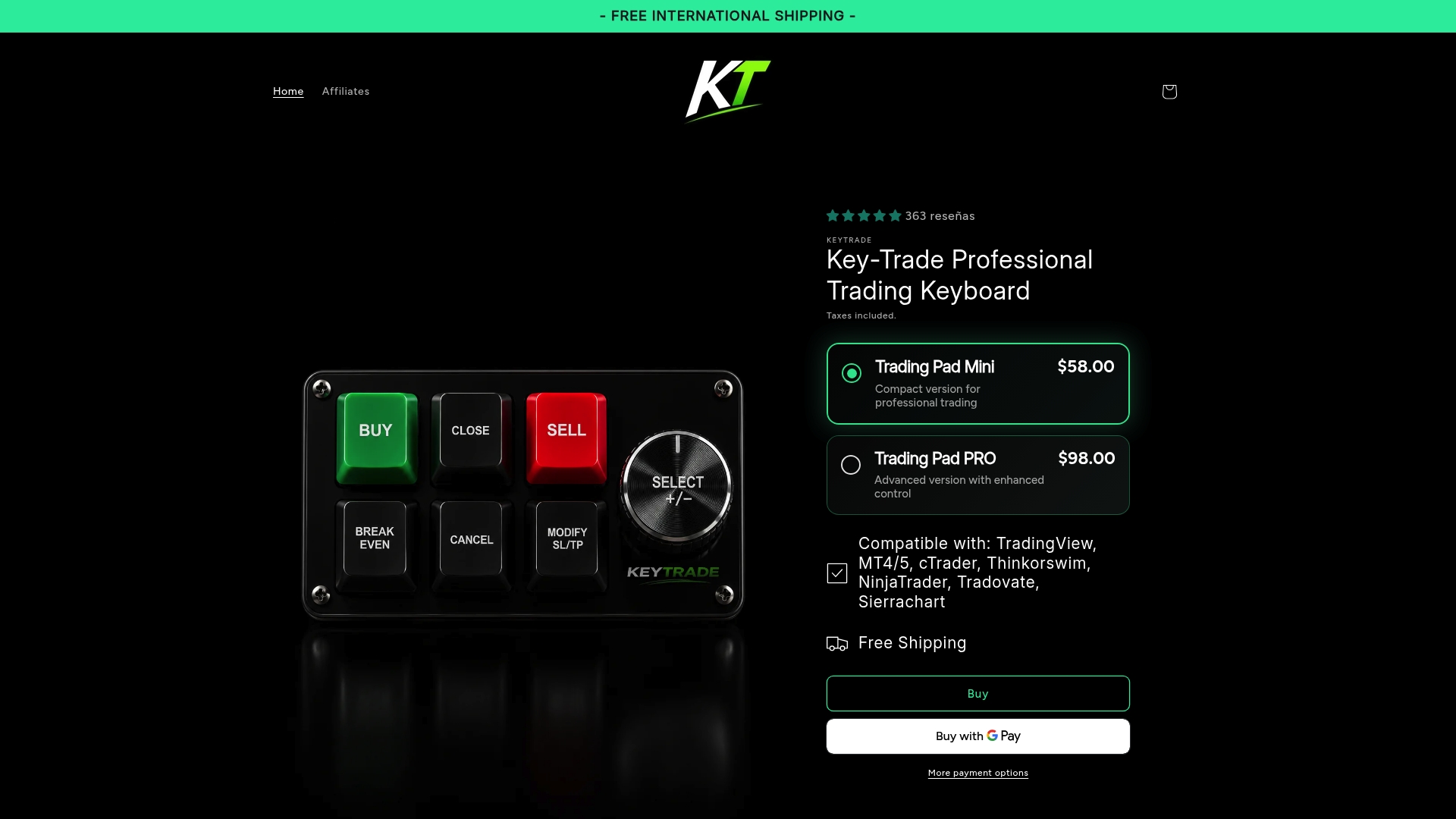
It fits desks that want plug-and-play setup with no coding involved, whether that’s an individual trader standardizing muscle memory across accounts or a full desk rolling out identical stations for every seat. Setup guides and support walk you through platform-specific mapping to clarify focus behavior from the start.
Check specs, pricing, and compatibility on the Key-Trade Professional Trading Keyboard collection page, or go straight to the full product listing to see what’s included and place an order.
Sources
- Interactive Brokers — Hotkeys configuration guide
- Regulation automated trading — Federal Register
- FINRA — Market access rule guidance (2022)
- Psychophysiology — Effects of delayed system response on button dynamics
FAQ
Are hardware hotkeys actually faster than software hotkeys?
Yes, for single-action execution. A dedicated keypad triggers one physical action per command, while platform software hotkeys often require the trading window to have focus and sometimes a multi-key sequence, a limitation Interactive Brokers describes in its own hotkey documentation.
Do hardware hotkeys still work if my trading platform freezes?
Yes, that’s their main advantage over an emergency software button. A hardware kill switch operates outside the platform’s own process, so it can still fire a flatted or cancel-all command even when the terminal itself has stopped responding.
Which trading platforms does the Key-Trade keyboard support?
The Key-Trade Professional Trading Keyboard integrates with TradingView, MetaTrader 4 and 5, cTrader, NinjaTrader, SierraChart, Thinkorswim, and Tradovate, with more platforms planned. Full compatibility details are listed on the product page.
How much does the Key-Trade trading keyboard cost?
The Key-Trade Professional Trading Keyboard starts at $59 as a one-off purchase, with no subscription attached. Exact pricing by configuration is listed on the product collection page.
Do I need coding skills to set up a hardware trading keypad?
No. The Key-Trade keyboard is built for plug-and-play setup with guided, platform-specific mapping instructions, so traders without technical backgrounds can configure buttons for entries, exits, and risk controls without writing code.