

Stop Misfires, Speed Execution: Chart Trading Hotkeys for Prop Traders
Programmable hardware chart trading hotkeys let a trader fire, adjust, and flatten orders straight from a chart without reaching for a mouse. The physical buttons trigger repeatable macros, not the software shortcuts built into a platform’s menus, and they work by talking directly to a broker’s trading API. The payoff is speed and consistency: the same keystroke produces the same order behavior every time, whether the market is calm or falling apart.
TL;DR:
- Hotkeys should be programmed with single, purpose-specific actions to prevent unpredictable errors during fast market moves.
- The panic key must be tested thoroughly to reliably cancel all orders and close positions instantly, even after connection drops.
- Wired USB connections ensure the lowest latency and most consistent execution, which is critical for high-speed trading.
- Prioritize hardware with onboard macro storage and ergonomic placement of keys, especially the panic button within thumb reach.
- Roll out hotkeys gradually, starting with paper trading, before moving to live trading to minimize learning curve risks and ensure proper setup.
Table of Contents
- Why Pros Use Programmable Hardware Hotkeys
- Core Hotkey Functions and Suggested Mappings
- How Hardware Hotkeys Talk to Chart Widgets and Broker APIs
- Programming Hotkeys Safely: Rules and a Testing Checklist
- Choosing Hardware and Desk Ergonomics
- How a Trading Desk Pilots Hardware Hotkeys
- Get a Keypad Built for This
- Sources
- FAQ
Why Pros Use Programmable Hardware Hotkeys
Every extra second between decision and execution is slippage waiting to happen. A trader clicking through a dropdown to scale out of a position during a fast move loses time a single keypress would save, and that gap widens under stress, when fine motor control is the first thing to go.
Hardware hotkeys remove the click path entirely. That consistency matters more than raw speed for most traders, because the biggest execution errors happen when someone fat-fingers a lot size or clicks the wrong order type mid-panic.
Three groups see the clearest return on a physical keypad:
- Scalpers running dozens of trades a day, where seconds compound into meaningful edge.
- Intraday desks managing several open positions simultaneously across multiple charts.
- Prop firm traders operating under strict drawdown rules, where one bad manual entry can end an evaluation.
The muscle-memory effect is the part traders underestimate. After a week or two, the hand finds the panic key without the eyes leaving the chart, which is exactly the point.
Core Hotkey Functions and Suggested Mappings
A workable hotkey layout covers four job categories, not a random pile of shortcuts. Build the profile in this order, then map keys once you know which actions you use every session.
- Entry and exit basics. Market buy, market sell, and limit-from-chart (placing an order at the price under the cursor) form the foundation. Most traders assign these to the most reachable keys on the pad.
- Position lifecycle controls. Partial close, scale-out increments, position reverse, and a flatten-all “panic” action handle everything that happens after entry.
- Risk controls. Set stop-loss, set take-profit, move to break-even, and dynamic position sizing (often tied to a rotary dial rather than a flat key) keep risk attached to every trade.
- Workflow keys. Cycle between charts, jump focus to the order ticket, and toggle one-click trading on or off.
A common mapping pattern looks like this: ENTRY for market buy, SELL for market sell, PARTIAL50 for a half-size scale-out, and PANIC for flatten-all-and-cancel-orders. Reviews of dedicated hardware controllers, including the TRIGGR controller, show traders favoring single-press for routine actions and double-press for anything destructive, like reversing a position, so a slip of the finger doesn’t reverse a winning trade.
Pro Tip: Label your panic key differently from every other key, physically. A raised bump, a different color, or a recessed guard around it prevents you from hitting it by accident while reaching for a partial close.
How Hardware Hotkeys Talk to Chart Widgets and Broker APIs
A hotkey press is only the first half of the transaction. What happens next depends on the plumbing between the keypad and the platform, and that plumbing has to be reliable in both directions.
On charting platforms like TradingView’s Advanced Charts, chart-based trading runs through a Broker API (technically an IBrokerTerminal implementation) that exposes methods such as place Order, orders, positions, and symbolInfo. A hardware hotkey doesn’t bypass this layer. It triggers the same call the platform’s own buttons would make, just faster and without the click.
The UI elements a hotkey ultimately interacts with include:
- The order ticket, where pending orders and their parameters live.
- The account manager, which surfaces account balance, open positions, and P&L.
- One-click trading, the platform toggle that decides whether an order fires instantly or waits for confirmation.
- Depth of market, for traders who scale in and out based on order book liquidity.
Hardware devices send commands to the platform one of three ways: keystroke injection (the keypad emulates a keyboard), a dedicated device driver, or direct API/HTTP calls to the broker’s backend. Whichever path a device uses, the platform still depends on the backend sending back orderUpdate, executionUpdate, and positionUpdate callbacks. Without those, your chart shows a stale position size while your actual account already moved, which is precisely the gap that causes traders to double up on risk without realizing it. The Account Manager component needs accountManagerInfo and orders/positions data to render correctly, so any hotkey setup is only as trustworthy as the API feed behind it.
Programming Hotkeys Safely: Rules and a Testing Checklist
The fastest way to lose money with a programmable keypad is building one macro that tries to do everything. Single-purpose macros fail predictably; combined macros fail unpredictably, usually at the worst possible moment.
Follow a few non-negotiable rules when building a profile:
- Keep each key doing one job. A “scale out and move stop to break-even” combo key sounds efficient until one half of it misfires.
- Reserve instant-fire (no confirmation) for presets you’ve tested dozens of times. TradingView’s own one-click trading setting sends orders immediately with zero preview when enabled, and MetaTrader’s one-click trading feature works the same way. Everything new gets a confirm toggle until proven.
- Build your panic key first, test it hardest. It needs to cancel every working order and flatten every open position in one press, with no dependency on which chart currently has focus.
- Run a full test cycle before going live: paper account first, then simulated fills, then a check of time-to-fill on the panic key specifically, then a reconnection test to confirm the keypad survives a dropped connection without firing a stale command.
Pro Tip: Log the exact timestamp between keypress and confirmed execution during your paper trading phase. That gap tells you whether your hotkey path runs through keystroke injection or a direct API call, and direct API calls are almost always faster and more consistent under load. Backtesting a strategy’s execution assumptions on a platform like Backtestify before wiring up live hotkeys catches sizing errors that are far cheaper to find on paper.
Choosing Hardware and Desk Ergonomics
Not every keypad on the market handles a dropped connection or a crashed background app the same way, and that difference decides whether your panic key works when you actually need it.

Prioritize a device with onboard macro storage. A keypad that stores its profiles in the device firmware itself keeps working even if the host software crashes or Windows throws a permissions prompt mid session, a real risk with keystroke-injection setups. A device dependent entirely on host software for every macro is one software freeze away from a dead panic key.
Connectivity matters more than most buyers expect:
- Wired USB delivers the lowest, most deterministic latency. For anything execution-critical, wired wins.
- Bluetooth is convenient for a clean desk but introduces variable lag that scalpers will feel.
- Rotary encoders for position sizing beat flat buttons for anything that needs fine adjustment on the fly.
- Blank, remappable keys let you build a layout around your own habits instead of someone else’s default.
Placement is half the setup. Put the panic key within thumb reach of your resting hand position, keep frequently used keys closest to your fingers’ natural rest point, and build a separate profile per instrument if you trade products with different tick sizes or contract structures. Most traders have a working profile built within an hour or two, with the muscle memory settling in over the following week.
How a Trading Desk Pilots Hardware Hotkeys
Rolling out hardware hotkeys works best as a staged process, not a full switch on day one. Start with a single trader on a paper account, validate the panic key and one or two entry macros, then extend to live trading with small size before a deskwide rollout. The most common objection is the learning curve, and it’s real for the first week. Good documentation, sample profiles for common platforms, and a short test script for verifying every mapping before it goes live solve most of that friction fast.
— key-trade
Get a Keypad Built for This
Key-trade builds the Key-Trade Professional Trading Keyboard specifically for the workflow this article describes: programmable buttons for entries, exits, partial closes, and a dedicated panic key, wired for low latency and compatible with TradingView, MT4/MT5, cTrader, NinjaTrader, SierraChart, Thinkorswim, and Tradovate, with more platforms added over time.
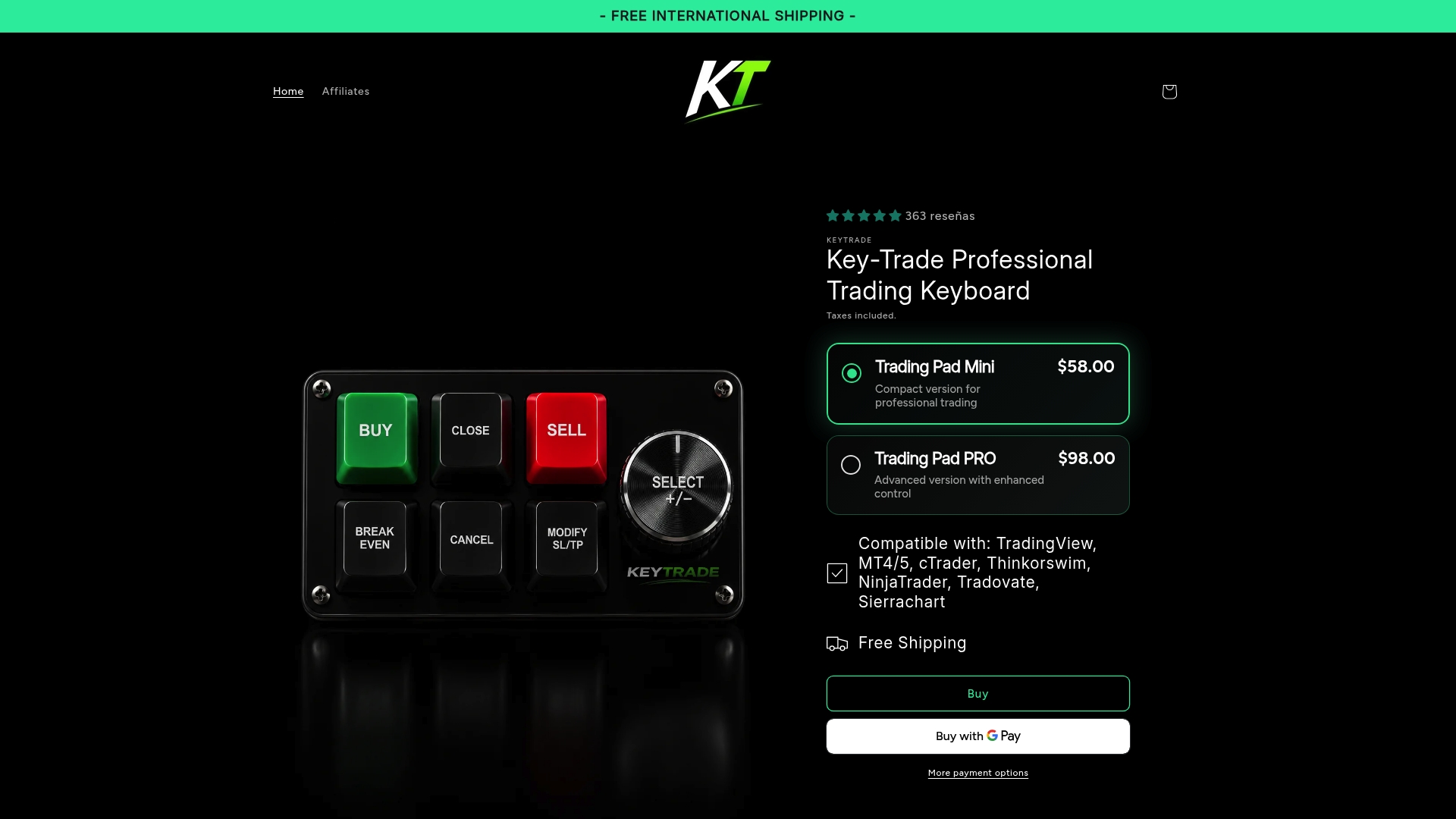
You don’t need to code anything to set it up. Map your entry, exit, and risk keys using the included setup guide, test the full profile on a paper account first, and confirm every mapping fires the action you expect before committing real size to it. The device ships worldwide and works out of the box with no technical background required. Check current specs and pricing on the Key-Trade collection page.
Sources
FAQ
What Are Chart Trading Hotkeys, Exactly?
Chart trading hotkeys are programmable physical buttons on a hardware keypad that execute or manage trades directly from the chart, separate from any software shortcuts built into a platform’s menus. They work by sending commands through the same broker connection the platform itself uses, whether that’s keystroke injection or a direct API call.
How Do Hardware Hotkeys Differ From Sierra Chart Order Hotkeys?
Sierra Chart order hotkeys are software-based, built into the platform’s own keyboard shortcut settings. A hardware keypad sits alongside that software and adds physical, tactile buttons that can trigger the same or additional actions, often with dedicated keys for functions like scale-out or panic-flatten that most platforms don’t expose as single default shortcuts.
What Is the Single Most Important Hotkey to Set Up First?
The panic or flatten key, without question. It needs to cancel every working order and close every open position with one press, tested repeatedly on a paper account before you rely on it live.
Should I Use One-Click Instant-Fire or Confirmation Prompts?
Use confirmation prompts for anything new or destructive, and reserve instant-fire for presets you’ve tested extensively. Both TradingView and MetaTrader offer a toggle between the two, and most experienced traders keep instant-fire limited to a handful of well-proven macros.
How Much Does a Trading Hotkey Keypad Cost?
The Key-Trade Professional Trading Keyboard starts from $59 as a one-time purchase, with no subscription fees attached. Pricing and current specs are listed on the product collection page.