

Why MT4 and MT5 Differ: A Trader's Feature Breakdown
Short answer: MetaTrader 5 is a modern, multi-asset platform with a more capable MQL5 language and a multi-threaded backtester; MetaTrader 4 is a lighter, forex-first platform that still runs the largest library of legacy expert advisors in the industry. The gap between them isn’t cosmetic. It comes down to four things that actually move your results:
- Market access: MT5 handles stocks, futures, and options alongside forex; MT4 was built for forex and CFDs.
- Programming language: MQL5 is object-oriented with far more built-in functions than MQL4’s procedural syntax.
- Backtesting power: MT5’s Strategy Tester runs multi-currency, multi-threaded simulations; MT4 tests one instrument at a time on a single thread.
- Order tools: MT5 offers six pending order types and native Depth of Market; MT4 offers four, with DOM depending on your broker.
Everything below unpacks these gaps and tells you which one actually matters for your setup.
Key Takeaways
MT5’s multi-asset architecture and multi-threaded backtester serve algorithmic and multi-market traders, while MT4’s simpler, forex-first design keeps a large legacy EA base alive.
| Point | Details |
|---|---|
| Core distinction | MT5 supports multiple asset classes and faster backtesting; MT4 focuses on forex with a mature EA ecosystem. |
| EAs don’t cross over | Compiled .ex4 and .ex5 files aren’t interchangeable, so migration means a rewrite, not a copy. |
| Backtesting gap | MT5’s tester runs multi-currency, multi-threaded simulations; MT4 tests one instrument on one thread. |
| Broker matters more than platform | Execution quality depends on your broker’s bridge and routing, not just which MetaTrader version you run. |
| Hardware complements either choice | Key-trade keypads speed up order execution on MT4 or MT5 without requiring a platform switch. |
Table of Contents
- Why MT4 and MT5 Differ on Architecture, Charts, and Order Types
- MQL4 vs MQL5: What Changes for Algorithmic Traders
- What These Differences Mean for Your Actual Trading
- Where Hardware Fits Into Either Platform
- Which Platform Actually Fits Your Workflow
- Faster Execution Without Switching Platforms
- Sources
- FAQ
Why MT4 and MT5 Differ on Architecture, Charts, and Order Types
The split starts underneath the hood. MT4 launched in 2005 on 32-bit, largely single-threaded architecture, built when forex was the only game most retail traders played. MT5 arrived in 2010 as a 64-bit, multi-threaded platform designed to handle multiple asset classes at once, including stocks, futures, and options alongside currency pairs. That architectural jump is why MT5 handles heavier chart loads and multiple simultaneous strategies without choking, while MT4 can start to lag once you stack a dozen charts with custom indicators.
The feature counts back this up. MetaTrader’s own comparison page shows MT5 running 21 timeframes against MT4’s 9, more built-in indicators, more graphical objects, and a native economic calendar that MT4 lacks entirely. For a swing trader who lives on the 4-hour and daily charts, that’s mostly noise. For someone building a system across the 2-minute, 10-minute, and 3-hour intervals, MT4 simply doesn’t have those buckets.
Order types tell a similar story. MT4 gives you four pending order types: buy limit, sell limit, buy stop, sell stop. MT5 adds buy stop limit and sell stop limit, letting you set a trigger price that then places a limit order rather than a market order. MT5 also supports partial order fills natively and includes Depth of Market, though DOM only works if your broker’s liquidity provider actually feeds it, which not all do.
Account modes are where things get genuinely different. MT4 only supports netting, meaning multiple positions in the same instrument get merged into one net position. MT5 gives brokers the choice between netting and hedging mode, where you can hold a long and a short position on the same pair simultaneously. This isn’t a platform preference, it’s a broker configuration decision, so check which mode your account runs before you build a hedging strategy around it.
MQL4 vs MQL5: What Changes for Algorithmic Traders
If you write or run expert advisors, this is the section that actually costs you time and money. MQL4 is procedural, straightforward, and has powered thousands of profitable bots for two decades. MQL5 is object-oriented, with a richer standard library, native support for OpenCL-based parallel computing, and access to the broader resources on Mql5, the developer community and marketplace where most new indicators and libraries get published first.
Here’s the practical friction point:
- No cross-compatibility. A compiled .ex4 file will not run on MT5, and a .ex5 file will not run on MT4. Your EA needs a rewrite, not a copy-paste.
- Migration is a real project. Converting a mature MQL4 strategy into MQL5 usually means rebuilding order handling logic, since MT5 uses a different trade request structure entirely.
- Testing capability jumps significantly. MT5’s Strategy Tester runs multi-threaded and multi-currency backtests using real tick data, with cloud-based optimization for running thousands of parameter combinations in parallel. MT4’s tester runs one instrument, one thread, one pass at a time.
That last point matters more than people give it credit for. A multi-currency, multi-threaded tester lets you walk-forward test a portfolio EA across correlated pairs simultaneously, which cuts overfitting risk in a way single-instrument testing never can.
Pro Tip: Don’t rewrite a working MT4 EA just because MT5 exists. Calculate the migration hours against the strategy’s monthly profit first. If a bot has been consistently profitable for two years, the rewrite has to earn back that dev time before it’s worth doing.
What These Differences Mean for Your Actual Trading
Feature lists are one thing. What happens when you place a trade is another. MT5’s DOM and native six order types genuinely help scalpers working tight spreads on liquid instruments, and its multi-asset reach matters if you’re running forex alongside index or futures positions in one account. The faster, parallel backtester also means less time waiting on optimization runs when you’re refining a portfolio strategy.
MT4 still earns its keep in specific cases:
- You have a legacy EA that’s been profitable for years and a rewrite isn’t worth the risk.
- Your workflow is pure spot forex with no need for DOM, hedging mode, or multi-asset charts.
- You’re running the platform on older or resource-limited hardware where MT4’s lighter footprint helps.
Here’s the part platform comparisons tend to skip: two brokers running the identical MT5 build can execute your trades completely differently. Execution quality depends on the bridge and routing setup behind the platform, whether that’s PrimeXM, oneZero, or a broker’s own liquidity aggregation. Neither MT4 nor MT5 controls that layer; your broker does.
Pro Tip: Before trusting either platform’s numbers, run this four-step check with your specific broker: measure demo account latency during normal hours, watch slippage on a live news event, confirm whether DOM data reflects real liquidity or a synthetic feed, and compare a backtest result against a small live run of the same setup. You can verify a broker’s registration status through the NFA’s basic profile lookup as a first step.
Where Hardware Fits Into Either Platform
Neither MT4 nor MT5 solves one problem: how fast you physically get an order in once you’ve decided to act. That’s a workstation issue, not a software one, and it applies equally whether you’re running MQL4 or MQL5 underneath.
Key-trade’s programmable keypads sit on top of either platform and cut the number of clicks between decision and execution:
- One-button market entry, partial close, and break-even shifts, mapped to physical keys instead of dropdown menus.
- Macros for scaling out of a position or reversing a trade without touching a mouse.
- A bundled CopyTrader license that extends the same control across MT4, MT5, and cTrader accounts.
Setup takes minutes: plug in the device, install the platform-specific driver, and map keys to the actions you use most.
| Feature | MT4 | MT5 |
|---|---|---|
| Key-trade compatibility | Full support | Full support |
| Order entry speed gain | Physical key vs. mouse click | Physical key vs. mouse click |
| CopyTrader integration | Included | Included |
Which Platform Actually Fits Your Workflow
If a legacy MT4 EA has been quietly profitable for two years, leave it alone. Rewriting for MT5 to chase a feature you won’t use is a bad trade of time. New algorithmic development, multi-asset portfolios, or anything needing serious backtesting belongs on MT5.
The honest rule: test with your own broker before trusting either platform’s marketing. Measure your migration ROI in hours saved or profit gained, not in feature counts on a comparison page.
Faster Execution Without Switching Platforms
You don’t have to choose a new platform to fix slow order entry. If clicking through menus during a fast market has cost you a fill, a Key-trade keypad solves that directly, whether you’re on MT4, MT5, cTrader, or several accounts at once.
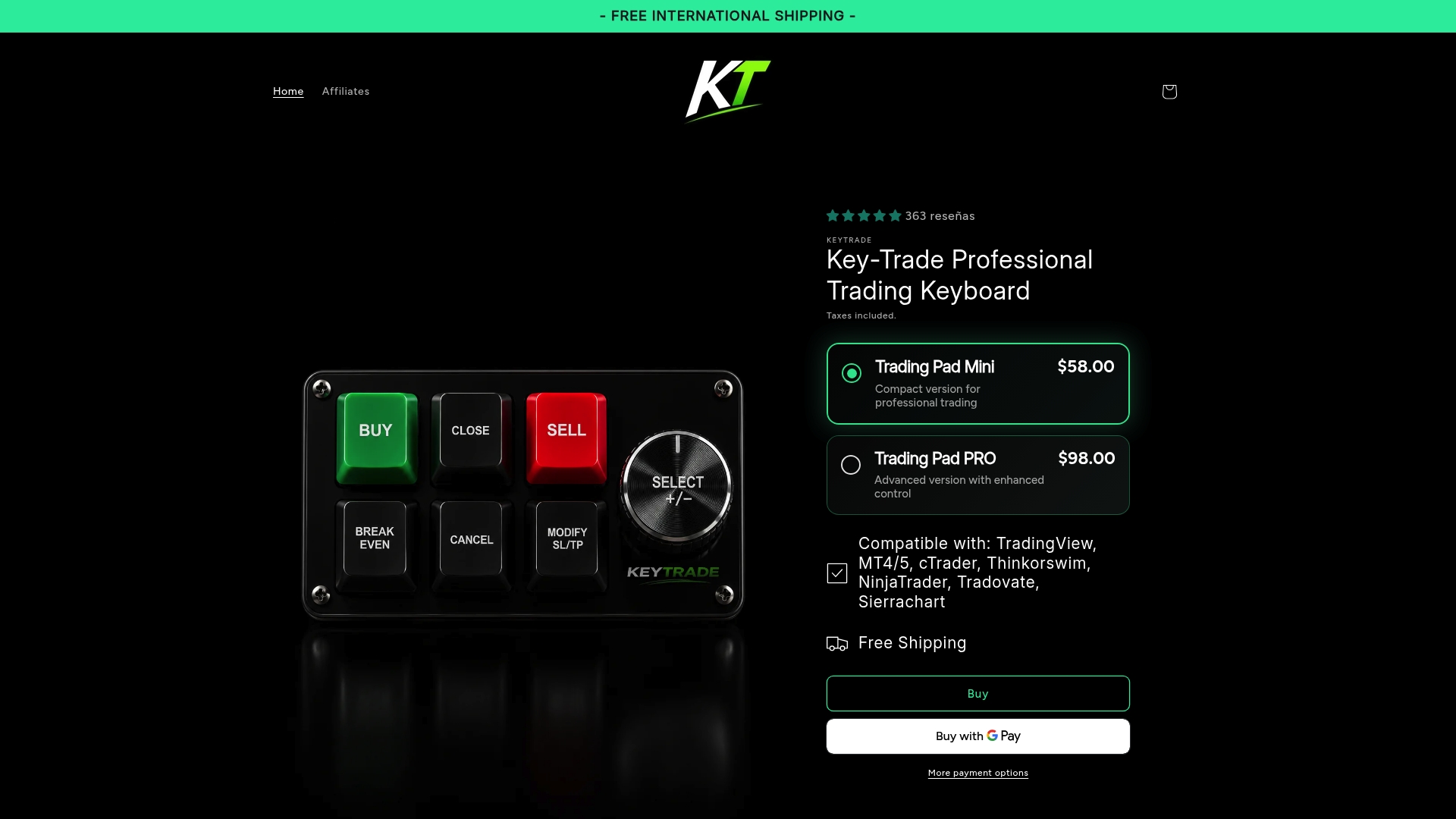
Each device maps market orders, partial closes, break-even resets, and scaling logic to physical buttons, so the platform’s interface stops being the bottleneck between your read on the market and your execution. It works alongside whatever platform decision you land on rather than replacing it, and the free CopyTrader license bundled with select models means one device carries your setup across MT4, MT5, and cTrader without extra cost. Check compatibility and place an order through Key-trade’s product page to see which model matches your current platform and account setup.
Sources
For feature-level detail straight from the source, see the official MT5 vs MT4 comparison. Developers should bookmark MQL5.com for libraries and documentation, and ForexMechanics’ platform breakdown for backtesting and execution context.
- Comparison of the MetaTrader 5 and MetaTrader 4 platforms
- MT4 vs MT5 in 2026: Which platform actually fits your trading style?
- MT4 vs MT5: Which is better for your trading strategy?
- MT4, MT5, cTrader – Industry standard and alternatives | ForexMechanics
- Mql5
FAQ
Which is better to use, MT4 or MT5?
Neither is universally better. MT5 suits multi-asset trading and algorithmic development with heavier backtesting needs, while MT4 remains the stronger fit for traders running proven forex-only expert advisors.
Is MetaTrader 5 legal in the USA?
Yes, MT5 is legal to use in the United States, though your broker still needs proper NFA registration and CFTC oversight regardless of which MetaTrader version you trade on.
Which MetaTrader is better for algorithmic trading?
MT5 generally wins here because of its object-oriented MQL5 language and multi-threaded, multi-currency Strategy Tester, which cuts optimization time significantly compared to MT4’s single-instrument testing.
What does MT4 stand for?
MT4 stands for MetaTrader 4, the fourth version of the MetaQuotes trading platform released in 2005 and still widely used for forex trading.
Does a Key-trade keypad work with both MT4 and MT5?
Yes, Key-trade devices support both platforms along with cTrader, and select models include a bundled CopyTrader license that extends the same control across all three.