

Remap in 2 Minutes: TradingView Buy Hotkey for Active Traders
The TradingView buy hotkey is Shift + B, which opens a market buy ticket, while Shift + Alt + B triggers a limit buy at your cursor price. Neither one fires an actual order unless your trading panel is connected to a broker with the right permissions; without that connection, the hotkey just opens a pre-filled ticket. You can find and remap both under Settings → Hotkeys.
TL;DR:
- Hotkeys like Shift + B and Shift + Alt + B only trigger actual orders if your trading panel is connected to a broker with proper permissions; otherwise, they just open pre-filled tickets.
- Remapping hotkeys to near the home row or number pad can significantly improve execution speed, but should always be tested in paper trading first to avoid costly mistakes.
- Presets automate order details like size and risk management, but orders will only send immediately if your broker connection permits instant execution; otherwise, they open a ticket for manual confirmation.
- Hotkey failures often stem from lack of keyboard focus, browser interference, OS conflicts, or no broker connection, which can be quickly resolved with simple checks and adjustments.
- A programmable trading keypad enhances speed and precision during volatile markets by providing physical buttons for critical hotkeys or risk adjustments, complementing the digital setup.
Table of Contents
- Quick Reference: Every Buy-Related Hotkey You Need
- How to Remap Buy Hotkeys for Faster Execution
- Order Presets and Your Buy Hotkey: How They Work Together
- What a Buy Hotkey Actually Triggers
- Building a One-Handed Buy Hotkey Workflow
- How a Programmable Trading Keypad Extends TradingView Hotkeys
- Buy Hotkey Not Working? Quick Fixes That Actually Solve It
- A Publisher’s Take on Keyboard-First Execution
- Why a Trading Keypad Is Worth Adding to Your Setup
- FAQ
Quick Reference: Every Buy-Related Hotkey You Need
Once you know the base combo, the rest of the buy/sell hotkey system falls into place fast. TradingView built these around a simple logic: Shift plus a letter for the action, and Alt thrown in when you want a limit instead of a market order.
Here’s the working set active traders actually use:
- Shift + B — opens a market buy ticket at the current price.
- Shift + Alt + B — opens a limit buy ticket, typically at your cursor’s price on the chart.
- Shift + S — opens a market sell ticket.
- Shift + Alt + S — opens a limit sell ticket.
- Ctrl/Cmd + click on the DOM — places a limit or stop order directly at that price level on the Depth of Market ladder.
- Alt + Ctrl (Windows) or ⌥⌘ (Mac) — drops an order object right at your cursor price, which saves you from scrolling to the price scale first.
Market orders via hotkey execute against whatever price is live the instant you press the key. Limit orders need a reference point, which is why TradingView anchors them to your cursor or lets you click a specific level on the DOM. The canonical list of every hotkey, including chart navigation and drawing tools, lives in the platform’s Keyboard shortcuts menu, accessible from the Help icon in the bottom left corner of any chart.
How to Remap Buy Hotkeys for Faster Execution
Default hotkeys work fine for casual use, but they’re not built for speed traders running one-handed setups. Remapping takes about two minutes.
- Click the gear icon or open Settings, then navigate to the Hotkeys tab (sometimes labeled “Keyboard Shortcuts” depending on your layout).
- Scroll to the trading section and find “Buy” or “Open Buy Order.”
- Click the current binding, then press your new key combination. TradingView will flag a conflict if that combo is already in use elsewhere.
- Save the change, then click into the chart and test the new key before you trade live with it.
Pros tend to gravitate toward a handful of remap patterns. Bracket keys ([ and ]) are popular because they sit near the home row and rarely collide with browser shortcuts. Single-letter combos with a light modifier, like Alt + B instead of Shift + B, cut down on finger travel when you’re trading with one hand on the mouse. Some traders skip Shift entirely and bind buy/sell to number pad keys if they’re running a numeric keypad alongside their main board.
Pro Tip: Test every remap in TradingView’s paper trading mode first. A misfired hotkey during a live session costs real money; a misfired hotkey in paper mode just costs you a laugh.
One thing worth knowing: your custom hotkey map is tied to your TradingView account, not your device. Log in on a different computer and your bindings follow you.
Order Presets and Your Buy Hotkey: How They Work Together
Presets are what stop your buy hotkey from being a blunt instrument. Instead of opening a bare ticket every time, a saved preset can push size, stop-loss, and take-profit values into the fields automatically the moment you press Shift + B.
You’ll find the preset selector directly next to the chart’s Buy and Sell buttons, and any preset you save there applies whether you click the button or fire the equivalent hotkey. A few practical notes:
- Presets can include bracket orders, meaning your SL and TP get attached automatically instead of requiring a second manual step.
- Whether the order sends immediately or just opens a pre-filled ticket depends on your broker connection and account settings, not on the preset itself.
- Name presets by strategy or size, like “Scalp 1 Lot” or “Swing 3%,” so you’re not guessing which one is active mid-session.
Test new presets in paper trading before wiring them to a live account. A preset with the wrong size multiplier is the kind of mistake that only shows up once you’ve already clicked buy.
What a Buy Hotkey Actually Triggers
Pressing Shift + B does one of two things, and the difference matters more than most traders realize. It either opens a ticket with fields pre-filled, waiting for your confirmation, or it sends the order straight to your broker with no pause.
Which one happens depends on:
- Trading panel connection — hotkeys behave as pure UI shortcuts until your account is actually linked to a broker through TradingView’s trading panel.
- Broker permissions — some brokers require an extra confirmation step for market orders regardless of hotkey settings, which the Advanced Charts documentation notes can override default shortcut behavior.
- Order type requested — market buys via Shift + B execute at the live price, while limit and stop orders placed through DOM clicks or modifier-clicks wait at the specified level instead of filling immediately.
Building a One-Handed Buy Hotkey Workflow
Speed without a checklist is how good traders blow up good accounts. The traders who run hotkeys reliably follow something close to this sequence:
- Click the chart once to confirm keyboard focus (a hotkey pressed without focus does nothing).
- Select the correct preset for the setup you’re trading.
- Press your buy hotkey.
- Glance at the ticket for symbol, size, and SL/TP before it sends or confirm immediately if your broker allows instant execution.
- Watch for the fill confirmation in the order panel.
Pro Tip: Run this exact sequence in TradingView’s replay mode for a week before trusting it live. Replay mode lets you fire hotkeys against historical price action with zero financial risk, which is the closest thing to a dress rehearsal you’ll get.
The checklist takes seconds once it’s muscle memory. The traders who skip it are the ones who discover their preset was still set to the wrong lot size, mid-trade.
How a Programmable Trading Keypad Extends TradingView Hotkeys
Software hotkeys have one hard limit: you still need to hit the exact key combination, every time, under pressure. A programmable trading keypad can solve that by turning each of those combinations into a dedicated physical button.
The device works by emulating keyboard events. Its software sends the same key combos TradingView already expects, so a buy hotkey you’ve remapped in Settings can live on a single labeled button instead of a finger-twisting Shift + Alt combo you have to hit blind. That matters most during fast markets, where:
- A dedicated partial-close button means you’re not hunting for a modifier key while a position moves against you.
- Tactile buttons remove the ambiguity of a keyboard press that didn’t quite register.
- Risk adjustments, like moving a stop to breakeven, become a single press instead of a multi-key sequence run from memory.
The keypad doesn’t replace your presets or your broker connection. It sits on top of them, giving your fastest, highest-stakes actions a physical home separate from the rest of your keyboard.
Buy Hotkey Not Working? Quick Fixes That Actually Solve It
Most hotkey failures trace back to one of four causes, and none of them require a support ticket to fix.
- No keyboard focus. Click directly on the chart before pressing any hotkey. TradingView ignores keystrokes if focus is sitting in a search bar, a comment field, or another browser tab.
- Browser interception. Some combinations, particularly those using Ctrl or Alt, get grabbed by the browser or an extension before TradingView ever sees them. Switching to the desktop app usually resolves this.
- OS-level conflicts. Windows and macOS both reserve certain key combos system-wide; check your OS shortcut settings if a hotkey does nothing at all.
- Duplicate or conflicting bindings. Open the Hotkeys dialog and look for two actions mapped to the same key. TradingView will flag this, but it’s easy to miss on a crowded custom map.
- No broker connection. If the ticket opens but never sends, or nothing happens at all, confirm your trading panel is actually linked and that your broker permissions allow the order type you’re requesting.
A Publisher’s Take on Keyboard-First Execution
Where we think hardware earns its keep is high-frequency and prop desk trading, where a mis-hit key combination during a volatile move isn’t a minor annoyance, it’s a blown position.
— key-trade
Why a Trading Keypad Is Worth Adding to Your Setup
If you’ve remapped your hotkeys and set up presets, you’ve already solved the software half of fast execution. What’s left is the physical bottleneck: hitting the right key, every time, without looking down. That’s the gap a programmable trading keypad closes.
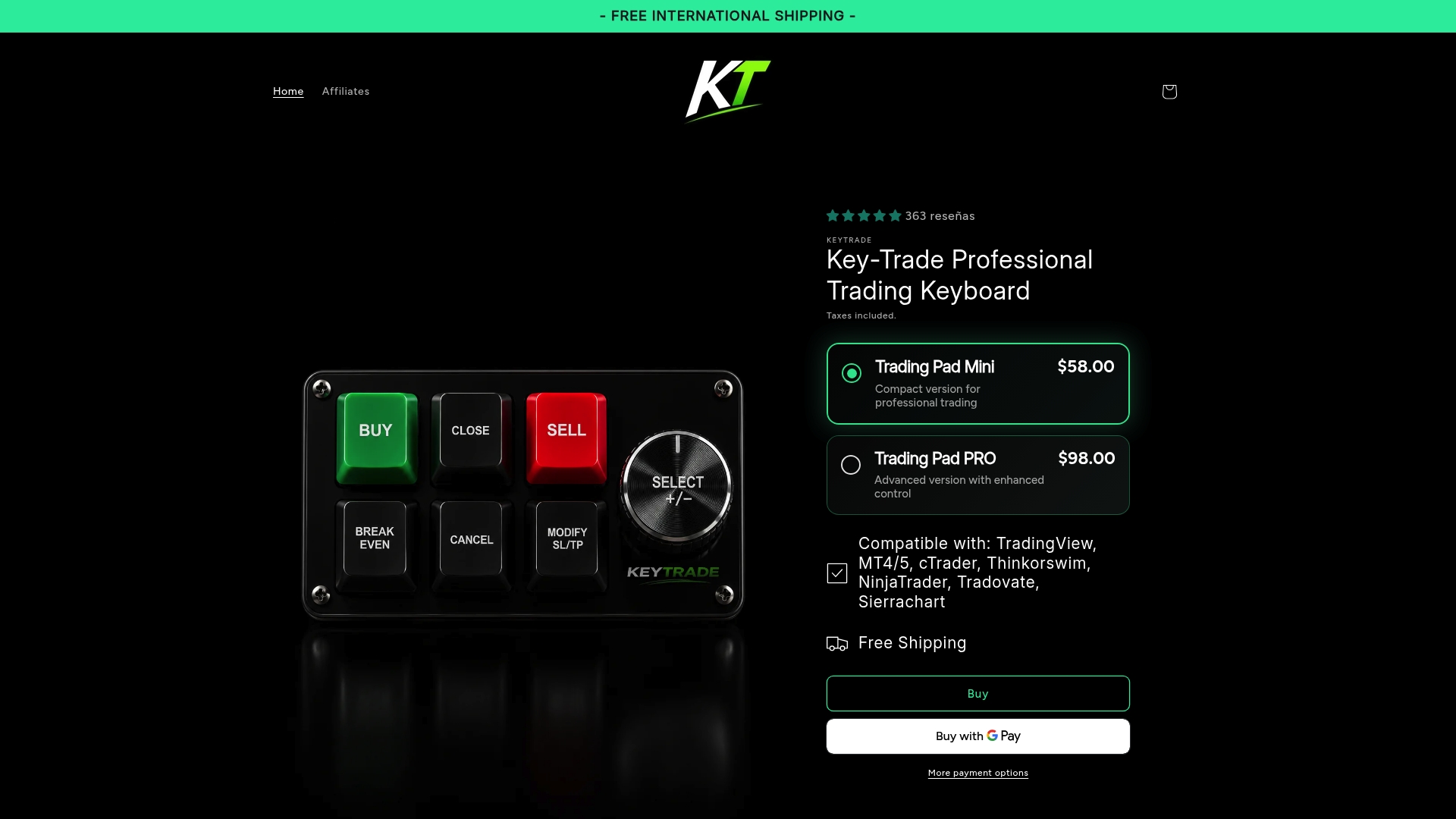
These keypads don’t replace TradingView’s hotkey system, they sit next to it, sending the same key combinations you’d type but through dedicated, labeled buttons. That means one press for a partial close, one press for moving your stop to breakeven, and one press for your remapped buy hotkey, all without your hand leaving a fixed position. For traders managing multiple positions during volatile sessions, that’s the difference between a clean risk adjustment and a fumbled one. If you want a deeper look at how sizing and risk automation pair with keyboard-driven execution, StockPilot’s blog covers that angle well too. Visit the Key-trade product page to see specs, platform compatibility, and setup support for your trading style.
FAQ
How Do You Buy on TradingView Using a Hotkey?
Click the chart to give it keyboard focus, then press Shift + B for a market buy or Shift + Alt + B for a limit buy at your cursor price.
How Do You Put Buy and Sell Buttons on TradingView?
Buy and Sell buttons appear automatically on the chart once your trading panel is connected to a supported broker; they sit alongside the order preset selector.
What Are the Most Useful TradingView Shortcut Keys?
Beyond Shift + B and Shift + S for buy and sell, traders rely on Alt + drag for measuring, Ctrl/Cmd + click on the DOM for placing limit orders, and the Alt + Ctrl cursor placement shortcut for dropping orders at a specific price without leaving the chart.
How Do You Set Up Custom Hotkeys on TradingView?
Open Settings → Hotkeys, find the action you want to remap, press your new key combination, and save; TradingView will warn you if that combo already conflicts with another binding.
Does a Buy Hotkey Always Send an Order Immediately?
No. It only sends immediately when your trading panel is connected to a broker with the right permissions; otherwise it opens a pre-filled ticket waiting for manual confirmation.