

Reduce el tiempo de entrada a 150–200 ms: teclas de acceso rápido de hardware para profesionales del trading bursátil
Yes. For scalpers, intraday pros, and prop traders, a programmable hardware keypad reliably cuts execution latency and gives you a one-press risk-control kill switch that software-only trading shortcuts can’t match. Stock trading hotkeys built into physical keypads deliver three outcomes that matter: faster market entries, a flatten button you can trust under pressure, and partial exits that fire the same way every single time.
TL;DR:
- Hardware hotkeys reduce order execution time to roughly 150-200 milliseconds, significantly faster than the 2-3 seconds typical for mouse clicks.
- Direct API integration and wired connections ensure faster, more reliable command execution compared to simulated keystrokes and wireless options.
- Essential hotkey setup includes five core actions and modular macros, with separate profiles for different instruments and account types for safety.
- A kill switch and extensive paper trading for at least two weeks are critical safety measures before executing hotkeys live.
- Compatibility across multiple trading platforms and build quality are more important than numerous features or complex software setup.
Table of Contents
- Why Hardware Hotkeys Beat Software Shortcuts for Fast Execution
- Which Hardware Features Actually Matter
- How to Map Hotkeys for a Minimal, Safe Workflow
- Building the Rest of Your Hotkey-First Desk
- Your Pre-Live Safety and Verification Checklist
- Key-Trade’s Perspective on Hardware Design for Serious Traders
- Get a Programmable Trading Keypad Built for Your Platform
- Sources
- FAQ
Why Hardware Hotkeys Beat Software Shortcuts for Fast Execution
Software keyboard shortcuts still route through your operating system, your browser, and often a laggy web socket before an order actually reaches the exchange. A dedicated keypad skips most of that chain. It talks to the platform through a direct integration or a wired input that never loses window focus, which is the single biggest failure point of software-only setups. Tab away to check a chart on a second monitor, and your “sell” keystroke can land in a text box instead of your order ticket. A physical device sitting next to your mouse has no such ambiguity.
The speed difference is not trivial. Hotkey execution can cut order entry time from the 2 to 3 seconds a mouse click chain typically takes down to roughly 150 to 200 milliseconds, which matters enormously during a fast momentum spike or a sudden reversal where every tick counts.
150 to 200 ms. That’s the execution window hardware hotkeys operate in, versus 2 to 3 seconds for a standard mouse click sequence, according to TradeAlgo’s execution timing analysis.
Beyond raw speed, a physical device adds error-reduction mechanisms software can’t replicate:
- Tactile switches confirm a press before you even glance down, so you know the order fired without breaking eye contact with the chart.
- LCD icon keys and rotary dials show live status (position size, current SL/TP, active profile) so you’re never guessing what a button does mid-trade.
- A dedicated device is redundant to your main keyboard. If one hangs or loses focus, the other still works.
Scalpers and prop traders running multiple simultaneous positions gain the most, since they’re the ones most exposed to a single slow click costing real money.
Which Hardware Features Actually Matter
Not every feature on a spec sheet earns its place on your desk. Here’s what actually changes your execution quality, ranked by impact.
Programmable button count and layering. More buttons only help if you can organize them. Look for devices supporting multiple layers or “pages,” so one physical key can hold a different action for futures versus stocks, or live versus paper accounts, without you needing forty buttons crammed onto one keypad.
Rotary dials for continuous control. A knob that adjusts lot size or stop distance in real time, without pulling your eyes off the chart, is one of the most underrated features on the market. Reviewers consistently point to rotary knobs as the single biggest quality-of-life upgrade over flat button grids for exactly this reason.
Direct API integration over simulated keystrokes. A device that sends commands directly into the platform’s API executes faster and more reliably than one that just simulates a keyboard press behind the scenes. Stream Deck plugins built for platforms like cTrader and NinjaTrader show what direct integration makes possible: one-press entries with attached brackets and live SL/TP adjustment, not just a keystroke relay.
- Linear switches are the better call for rapid-fire sequences, since they don’t have the tactile bump that slows repeated presses.
- N-key rollover matters if you ever chain multiple keys, and a wired connection removes the small but real latency and dropout risk Bluetooth introduces.
- Software usability and support responsiveness should be your last filter, not your first. A beautifully built keypad with confusing configuration software still costs you time every time you need to remap it.
Pro Tip: Test a device’s setup software before you test its buttons. If mapping a single key takes more than two minutes, that friction compounds every time you adjust your workflow for a new instrument.
How to Map Hotkeys for a Minimal, Safe Workflow
Start smaller than you think you need to. A recommended essential set covering buy, sell, flatten, cancel all, and stop placement handles roughly 90% of real-time hotkey needs for active day traders. Every extra key beyond that adds mental overhead before it adds value.
- Map the five essentials first. Buy market, sell market, flatten all, cancel all orders, and set stop. These go on your dominant hand’s easiest reach.
- Add bracket macros next. One key for entry plus stop plus target as a single sequence, one for partial close at 50%, and one for move to break-even.
- Physically separate destructive actions. Put flatten and cancel all on keys with a raised bezel, a different color cap, or a modifier requirement so a mispress during a fast market doesn’t accidentally close a winning position.
- Build modifier protection into risky keys. Require a shift or function-layer press before anything that closes or cancels, so a stray elbow can’t flatten your book.
- Run a two-week paper-trading test. Log every mispress and every hesitation. If you’re second-guessing which key does what after two weeks, the layout is wrong, not you.
- Separate profiles by instrument and account type. A profile built for futures scalping should never load on your options paper account by default. -->
Keep every macro modular. Design each key to do one job (entry only, break-even only, partial close only) rather than one giant button that tries to run an entire trade lifecycle. A modular design is easier to debug under stress, when a multi-step macro failing halfway through is the last thing you want to diagnose live.
Three months from now, at 9:31 AM with a fast tape, you won’t want to rely on memory.*

Building the Rest of Your Hotkey-First Desk
A keypad alone won’t fix a desk that fights you everywhere else. The order of upgrades matters more than most traders assume.
Start with your keyboard. A tenkeyless board paired with a separate numpad gives you dedicated space for order entry keys without cramping your typing hand, and linear switches consistently outperform tactile or clicky switches for rapid repeated presses since there’s no bump resistance slowing you down.
- Upgrade your mouse before anything else. Programmable side buttons make excellent redundancy for flatten or panic actions, since your hand is already there most of the session.
- Add a dedicated numpad next if you’re still using your main keyboard’s number row for orders.
- Bring in a Stream Deck or dedicated macro pad once your core setup is solid, using pages and color-coding to separate instruments or strategies without physically swapping devices.
The recommended upgrade order (mouse side buttons, then numpad, then macro pad) reflects real cost-to-benefit testing from traders who run multi-hour sessions daily, not a marketing sequence.
Cable management and USB hub placement seem trivial until a loose connection drops your keypad mid-trade. Run everything through a powered hub, keep cables clear of your chair’s rolling path, and position your primary execution monitor directly in your eyeline so no head turn stands between you and your next click.
Your Pre-Live Safety and Verification Checklist
Never trade a new hotkey setup live without running this sequence first.
- Test the kill switch in isolation. Open several small paper positions across instruments, hit flatten once, and confirm every position closes. Do this at least five separate times on different days.
- Paper-trade for two full weeks minimum. Track every mispress and every moment of hesitation in a simple log.
- Measure your actual latency. Time-stamp a hotkey press against the broker’s fill confirmation. Scalpers should stay under roughly 200 milliseconds one-way; if you’re measuring higher, check whether your device uses direct API integration or simulated keystrokes, and confirm you’re on a wired connection.
- Isolate your profiles. Live and paper accounts should never share a hotkey profile, and neither should two different instruments with different position-sizing rules. -->
A physically prominent, regularly tested kill switch is the single most important safety control on the entire desk, according to hands-on testing from traders running these setups daily.
Key-Trade’s Perspective on Hardware Design for Serious Traders
The devices that earn a permanent spot on a trading desk share one trait: they treat platform compatibility as a baseline requirement, not a selling point. Key-trade builds around that principle, targeting direct integration across TradingView, MetaTrader 4 and 5, cTrader, NinjaTrader, SierraChart, Thinkorswim, and Tradovate, because a keypad that only half-works with your platform is worse than no keypad at all.
Prop firms and serious retail traders don’t need forty features. They need buy, sell, flatten, and partial-close to fire the same way every time, on every instrument, without a software update breaking the mapping mid-session. That reliability, more than any single feature, is what separates a real trading tool from a novelty peripheral.
— key-trade
Get a Programmable Trading Keypad Built for Your Platform
If you scalp, run a prop desk, or manage multiple positions where a two-second delay costs real money, a dedicated hardware keypad solves the exact reliability gap software shortcuts can’t close.
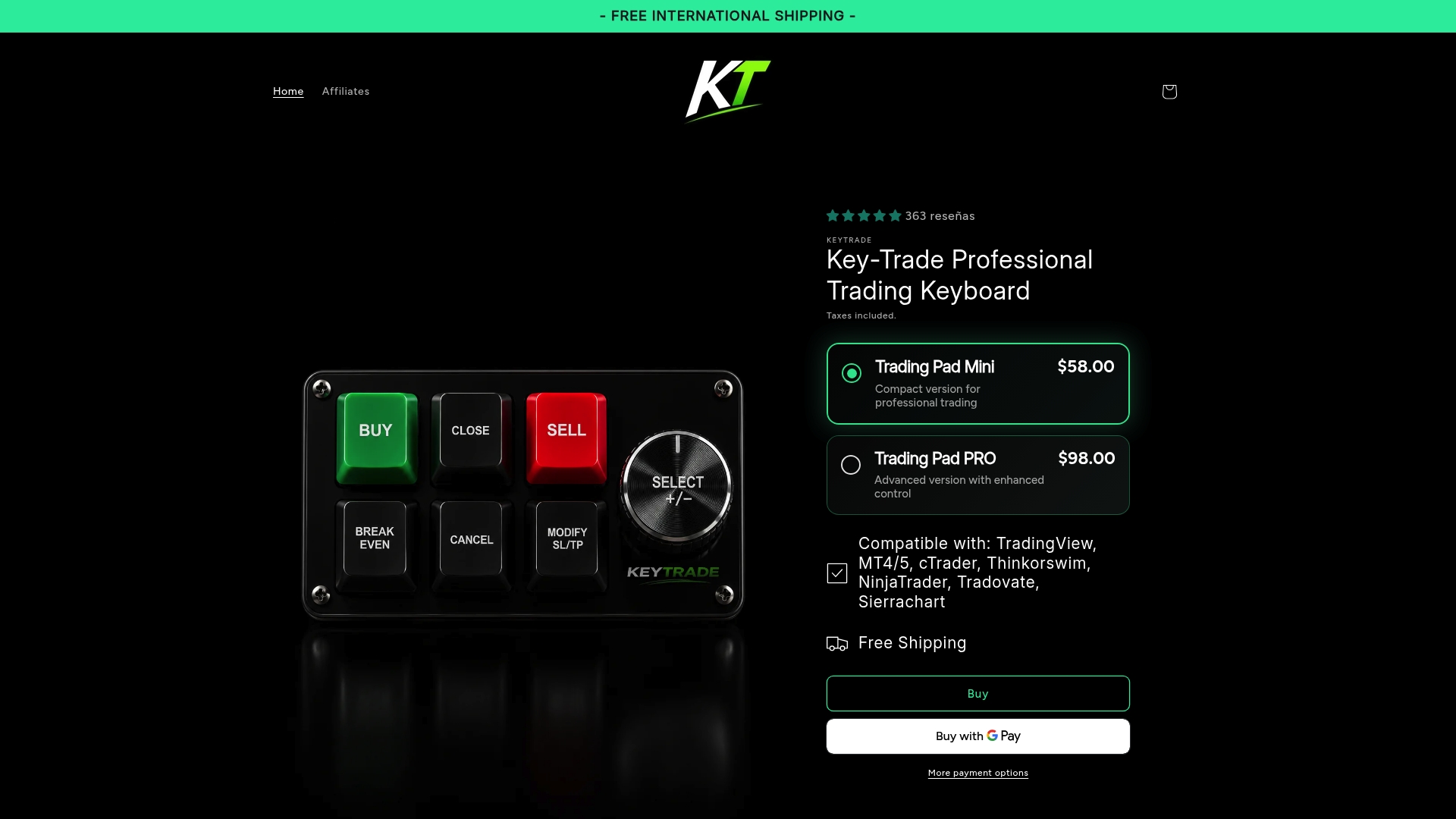
Some manufacturers build physical trading keypads with programmable buttons for order entry, partial closes, break-even shifts, and a one-press flatten key, integrating with multiple trading platforms. Devices often ship with setup guides and platform-compatibility support to help mapping hotkeys without requiring a technical background. If you’re ready to stop relying on mouse clicks during fast markets, check out the Key-trade lineup and find the keypad built for your platform.
Sources
- Hot Keys for Day Trading: Speed Execution Setup Guide for Every Platform | TradeAlgo
- StreamDeckHotkeys | cTrader
- Keyboard, Mouse, and Peripherals for Trading Workstations: The Setup That Reduces Execution Errors and Survives 6-Hour Sessions - NexusFi Academy
FAQ
What Are Stock Trading Hotkeys?
Stock trading hotkeys, in the hardware sense, are programmable physical buttons on a dedicated keypad that execute, modify, or cancel orders directly on your trading platform, bypassing the mouse-and-menu chain entirely.
Do Hardware Hotkeys Really Reduce Execution Speed?
Yes. Hotkey execution can bring order entry time down from 2 to 3 seconds with a mouse to roughly 150 to 200 milliseconds, which matters most during fast momentum or reversal moves.
How Many Hotkeys Do I Actually Need?
A core set of five actions (buy, sell, flatten, cancel all, and stop placement) covers about 90% of real-time needs for active day traders, with bracket and partial-close macros added afterward.
Which Platforms Work With Hardware Trading Keypads?
Some hardware devices integrate with platforms such as TradingView, MetaTrader 4 and 5, cTrader, NinjaTrader, SierraChart, Thinkorswim, and Tradovate, covering many professional and prop trading setups.
How Long Should I Paper Trade Before Going Live With New Hotkeys?
Run a minimum two-week paper-trading period, logging every mispress and hesitation, and test your flatten key in isolation at least five times before risking live capital.