

Evitar errores de teclas rápidas en Sierra Chart: configuración cableada para teclados profesionales
Yes, programmable hardware keypads work with Sierra Chart, and the integration runs deeper than a simple keyboard remap. You get four real paths in: global keyboard shortcuts, the UDP API, the DTC Protocol Server, and ACSIL hooks. Each one lets a physical button trigger a market order, a partial close, a stop adjustment, or a repeatable risk-control action without touching a mouse. Some keypad manufacturers build hardware devices designed around this workflow and provide setup resources to assist users.
TL;DR:
- Basic global shortcuts remain the most reliable and straightforward method for triggering market orders with programmable keypads in Sierra Chart.
- For advanced workflows, UDP offers parameterized commands, while DTC enables full account and market data integration; ACSIL provides conditional logic and automation.
- A professional trading keypad should have persistent on-device programmability, re-legendable keycaps, tactile switches, direct wired USB, macro safety controls, and simple software compatibility.
- Proper setup involves direct USB connection, disabling background input management software, and verifying correct key mappings within Sierra Chart’s trading menu.
- Reliable keypads from specialized manufacturers come with Sierra Chart profiles, documentation, and support for high-pressure trading environments.
Table of Contents
- How Does Sierra Chart Accept Hardware Hotkey Input?
- What Should You Look for in a Professional Trading Keypad?
- Setting Up Your Keypad: Checklist and Troubleshooting
- Mapping Templates That Actually Hold Up Under Pressure
- Wired connectivity, mechanical switches chosen for tactile certainty, and prebuilt profiles that map cleanly to Sierra Chart’s shortcut system are qualities that help build keypads focused on reliability as well as speed.
- Get a Keypad Built for Sierra Chart Execution
- Sources
- FAQ
How Does Sierra Chart Accept Hardware Hotkey Input?
Sierra Chart doesn’t treat hardware keypads as a special category of device. It treats them as keyboards, which is actually the point. A programmable keypad sends the same keystrokes a physical keyboard sends, and Sierra Chart’s shortcut system picks them up the same way. From there, you have four integration layers, each with a different ceiling on complexity and control.
Global keyboard shortcuts are the simplest route. You bind a physical key to a built-in Sierra Chart command, Sierra Chart sees it as a keystroke, and it fires. Support-board threads describing traders using programmable macro pads for hotkeys confirm this is a fully supported, well-worn path. Low complexity, high reliability. This is where most traders should start and often where they should stay.
The UDP API steps up the sophistication. Instead of a keystroke, your keypad (or its companion software) sends a short text command over a configured UDP port, typically to localhost. This matters when you need to trigger something a keyboard shortcut can’t reach, or when you want a hardware button to pass a parameter along with the command rather than just simulating a key press.
The DTC Protocol Server goes further still. It’s a TCP/IP socket interface built for full account and market-data interaction, not just command triggers. Third-party integration projects, including the Zorro plugin for Sierra Chart, show how DTC ports get configured for live trading and data feeds simultaneously. This is overkill for basic hotkeys but essential if your keypad workflow needs to read account state before acting.
ACSIL is the deepest layer. It gives you programmatic access to keyboard events themselves through functions like sc.ReceiveKeyboardKeyEvents, which means you can write conditional logic that reacts to a hardware trigger rather than just executing a fixed command. That’s the preferred path for deterministic automated responses tied to hardware events.
Pick based on what you actually need:
- Simple, mission-critical actions (buy, sell, flatten) → global shortcuts
- Compact custom commands not covered by built-in shortcuts → UDP
- Full market data and account integration → DTC
- Conditional logic, scripts, or bot-like reactions to hardware input → ACSIL
What Should You Look for in a Professional Trading Keypad?
A keypad built for casual gaming and one built for order execution look similar until you’re three trades deep in a fast market. The differences that matter aren’t cosmetic. They’re the ones that keep a stop-loss adjustment from becoming a fat-fingered market order.
- On-device programmability with persistent memory. Profiles should survive a reboot or a USB reconnect without you having to reload software first thing in the morning.
- Re-legendable or transparent keycaps. When you’re running different layouts for scalping versus swing management, a glance at the key should tell you what it does. Traders who work with mechanical, re-legendable keycaps report fewer mis-hits, especially under volatility.
- Mechanical switches with a deliberate feel. Tactile feedback confirms a press without you looking down. Choose quiet switches for shared desks, louder tactile or clicky switches for solo setups where feel matters more than noise.
- A direct wired USB connection. No hubs, no KVM switches, no docking stations in the signal path. Every layer between your keypad and your machine is another point of failure.
- Macro safety controls. Configurable delays between keystrokes and a confirmation step on destructive actions (flatten all, reverse position) prevent a single accidental press from cascading into a real loss.
- Software compatibility that keeps it simple. The keypad should send plain keystrokes by default, with optional virtual HID support and companion software for profile management when you need more than that.
Pro Tip: Don’t map your riskiest action to the easiest key to hit accidentally. Put “flatten all” somewhere your hand doesn’t rest, and put a confirmation step in front of it.
Setting Up Your Keypad: Checklist and Troubleshooting
Get the sequence right once and you rarely have to think about it again. Get it wrong and you’ll spend an afternoon guessing why Sierra Chart won’t see a key that clearly works everywhere else.
Setup, in order:
- Plug the keypad into a direct USB port on the machine running Sierra Chart. Confirm the operating system recognizes it as a keyboard device before touching Sierra Chart at all.
- Close any input-management software running in the background, including KVM client software and tools like Input Director, before testing.
- In Sierra Chart, open the Trade menu and confirm “Trading Keyboard Shortcuts Enabled” is checked. Without this, hardware input gets ignored regardless of how correctly it’s wired.
- Verify your global shortcut assignments match your keypad’s programmed outputs, and map Control Bar buttons if your workflow uses them.
- If you’re using UDP or DTC, enable and test the relevant port with a sample command before relying on it live.
- For ACSIL-based setups, load the keyboard events example study and confirm
sc.ReceiveKeyboardKeyEventsis active for your custom script or DLL.
If a key still doesn’t register, work through this before contacting support:
- Test the same key sequence on a regular keyboard to confirm the issue is hardware-specific, not a Sierra Chart setting.
- Swap the USB port and cable. Cheap cables and hub ports are a common silent culprit.
- Reboot Sierra Chart after any change, not just the keypad’s software.
- Disable other background input-management apps one at a time.
Community reports consistently point to one root cause above all others: KVM switches and input-management software intercepting the signal before Sierra Chart ever sees it. Moving the device to a direct connection on the host machine resolves it in most reported cases. If none of that fixes it, log the exact sequence, capture your Trade menu screenshot, and send both to your hardware vendor’s support team.
Mapping Templates That Actually Hold Up Under Pressure
The best keypad layouts aren’t clever. They’re boring, consistent, and impossible to misread at 2:00 in the afternoon when a position moves against you fast.

Template A: Entry page. One dedicated size key, Market Buy, Market Sell, Cancel All, and a Quick OCO button that sends a bracketed order in one press. Nothing else on this page.
Template B: Position management page. Partial close at 25%, 50%, and 75%, a move to break-even key, and a trailing stop toggle. Separate this physically or logically from the entry page so you can’t fire an exit command while trying to enter.
A few rules that separate a keypad that helps from one that eventually costs you money:
- Prefer switching between hardware pages over stacking multi-key combinations. Sierra Chart doesn’t always recognize simultaneous key combos consistently, and a missed modifier under stress is how mistakes happen.
- Require a two-step confirm on anything destructive: flatten, reverse, or close-all.
- Build in short programmable delays between keystrokes in any macro so Sierra Chart processes each command cleanly instead of dropping one.
- Label every key physically. Memory fails under pressure; labels don’t.
Pro Tip: Rehearse every new mapping on a sim account first, and keep dated, versioned profiles. If a layout change causes a problem, you want to roll back in seconds, not rebuild from memory.
Wired connectivity, mechanical switches chosen for tactile certainty, and prebuilt profiles that map cleanly to Sierra Chart’s shortcut system are qualities that help build keypads focused on reliability as well as speed.
Support conversations tend to cluster around the same handful of issues: profile installation, UDP and DTC configuration questions, and readiness checks for traders moving into ACSIL-based automation. The pattern that separates smooth desks from frustrated ones isn’t the hardware spec sheet. It’s discipline. Simple configurations, tested on sim accounts before going live, documented so a second trader on the desk can pick up the same mapping without guesswork.

Get a Keypad Built for Sierra Chart Execution
Some specialized manufacturers offer programmable keypads with Sierra Chart profile support, wired USB connectivity, and switches rated for the kind of repeated, high-pressure use a trading desk demands.
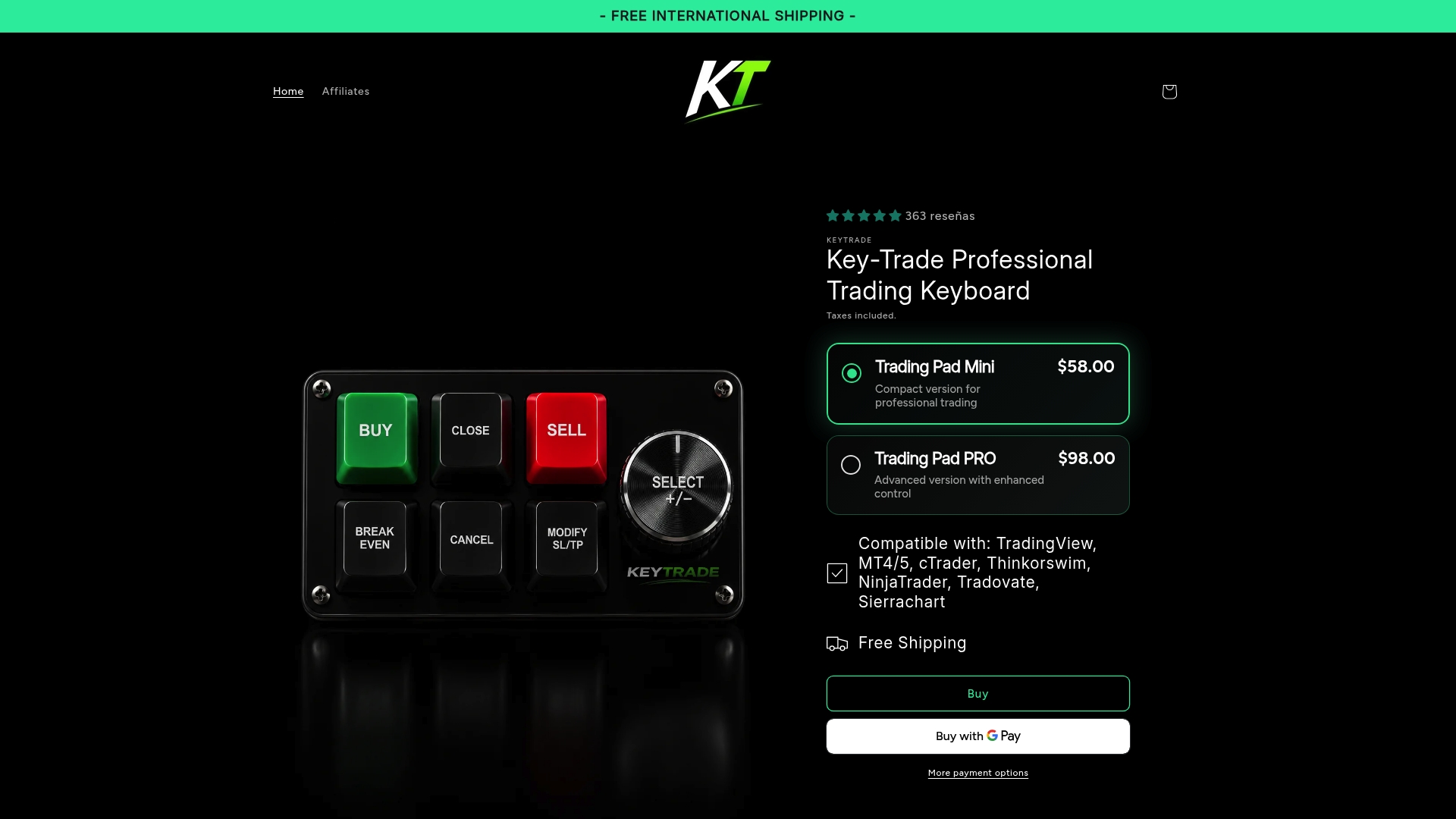
The Key-Trade trading keyboard comes with documentation for mapping entry, exit, and risk-control keys directly to Sierra Chart’s shortcut system, whether you’re running simple global shortcuts or building toward ACSIL-triggered automation. Test any new mapping in demo mode before it touches a live account. If you’re deploying across a desk or need custom mappings for a proprietary trading setup, reach out through Key-Trade to talk through enterprise configurations before you buy.
Sources
FAQ
Do I Need Special Software to Use a Keypad With Sierra Chart?
No. If your keypad sends standard keystrokes, Sierra Chart’s global shortcuts will recognize it once “Trading Keyboard Shortcuts Enabled” is checked in the Trade menu. Companion software only becomes necessary for UDP, DTC, or ACSIL-based setups.
Why Isn’t Sierra Chart Recognizing My Keypad?
The most common cause is a KVM switch or input-management software intercepting the signal before it reaches Sierra Chart. Connect the keypad directly to the host machine’s USB port and disable background input managers to resolve most cases.
What’s the Difference Between UDP and DTC for Hardware Integration?
UDP handles short, fast text commands over a local port for simple triggered actions, while DTC is a full socket-based protocol built for deeper account and market-data interaction. Choose UDP for compact commands and DTC when your workflow needs live account state.
Can a Hardware Keypad Trigger Custom Trading Logic?
Yes, through ACSIL. Programmatic keyboard-event handling lets a hardware trigger run conditional logic instead of a fixed action, which is the standard approach for bot-like or deterministic automated responses.
Does Key-Trade Offer Prebuilt Profiles for Sierra Chart?
Yes. Key-trade ships keypads with Sierra Chart profile support and setup documentation so traders can map order entry, partial closes, and risk-control keys without building a configuration from scratch.