

$59 Keypad Speeds Partial Close Hotkeys for Active Traders
Yes, you can partial-close a position with a hotkey by sending an opposing order sized to the portion you want to exit, or by using hardware and add-on tools built for that job. Most trading platforms let you assign a hotkey to an order template with a preset quantity, and some brokers surface a partial-close option directly. For traders who want to skip software menus entirely, a programmable keypad like the one Key-Trade sells offers a physical shortcut to the same result.
TL;DR:
- Hotkeys can be assigned to specific partial close quantities, but their implementation varies across platforms and may require separate templates or order configurations.
- TradingView supports partial closes only when instant order placement is turned off, and broker support may limit the availability of the feature.
- Interactive Brokers’ TWS allows creating hotkeys linked to order templates with preset partial quantities for more precise control.
- Many platforms’ hotkey systems cannot carry quantity values directly, requiring traders to set quantities manually in the order window before triggering the hotkey.
- Hardware keypads offer a faster, more reliable way to execute fixed partial closes by storing quantities on physical buttons, bypassing popup confirmations and unlinked fields.
Table of Contents
- Setting up a partial close hotkey on any platform
- Partial closes on TradingView and their confirmation limits
- Configuring partial close hotkeys in Interactive Brokers TWS
- What Sierra Chart and NinjaTrader traders say about hotkey limits
- Hardware keypads and add-ons built for instant scale outs
- Safety checks before you trust a hotkey with real money
- Configuring a Key-Trade keypad for one-touch partial closes
- Choosing between software hotkeys and a hardware keypad
- A practical option for one-keystroke partial exits
- Where to check platform-specific hotkey documentation
- Sources
- FAQ
Setting up a partial close hotkey on any platform
The mechanics of a partial close hotkey are the same no matter which platform you trade on: you tell the system how much of your position to exit, then trigger that exit with a single keystroke. The differences show up in how each platform lets you store that quantity.
Start by deciding your exit fractions. Most active traders work in quarters or halves, closing 25%, 50%, or 75% of a position rather than picking an arbitrary number each time. If you hold 8 contracts, a
close means sending an opposing order for 2 contracts, and a 50% close means 4.
- Pick your fractions and calculate quantity. Decide whether you typically scale out in quarters, thirds, or halves, then work out what that means in contracts or shares for your usual position size.
- Set the quantity in the order entry window. Enter the partial amount in the same field you would use for a full order, since most platforms treat a partial close as a normal opposing order rather than a special order type.
- Assign a hotkey to that order. Create one hotkey per fraction you use often (one for 25%, one for 50%, and so on) so you never have to retype a quantity mid-trade.
- Test everything in a demo account first. Confirm the hotkey fires on the correct window, check that any confirmation prompts behave as expected, and only then move to a live account.
The trickiest part for most traders is step 3: platforms vary widely in whether a hotkey can carry a quantity value or whether it just repeats whatever is already in the order ticket.
Pro Tip: Build a separate hotkey for each fraction you actually use rather than one hotkey you plan to edit on the fly. In a fast market, editing a field under pressure is where mistakes happen.

Partial closes on TradingView and their confirmation limits
TradingView supports partial position closes as a way to lock in gains or cut exposure without exiting a trade completely, such as closing 1 contract out of a 3-contract position. The catch is how that feature interacts with instant order placement.
According to TradingView’s own documentation, partial close only appears when Instant order placement mode is turned off, because the partial-close checkbox lives inside the order confirmation popup. With instant orders enabled, that popup never shows, so there is no partial-quantity field to check.
- Turn off instant order placement in your order settings if you want access to the partial-close checkbox.
- Click the “X” close action on your open position, then adjust the quantity field and check the partial-close box before confirming.
- Remember that not all broker accounts expose this feature at all: TradingView notes that if your broker does not support partial close, the option simply will not appear.
For traders who want a true single-keystroke exit without that popup, the practical workaround is pairing TradingView with an external macro or keypad that fires the close action and confirms the popup in one motion, or accepting the two-step confirmation as a deliberate safety check rather than a nuisance.
Configuring partial close hotkeys in Interactive Brokers TWS
Interactive Brokers’ Trader Workstation gives you more direct control over hotkeys than TradingView does, largely because TWS lets you build hotkeys around specific order templates rather than a single global close action.
Interactive Brokers’ own lesson on configuring TWS hotkeys walks through setting a Click Event, defining the hotkey’s scope, and pointing it at a target window or order ticket. A partial close in TWS is really just a hotkey attached to an opposing order with a smaller quantity than your open position.
- Open the hotkey configuration menu and create a new hotkey tied to a Click Event for your order ticket or chart trader panel.
- Build an order template with the partial quantity preset, then link the hotkey to that template instead of a blank order.
- Test the hotkey in chart trader mode first, since scope settings determine whether the key fires on the active window or a specific instrument only.
A common gotcha is scope: if the hotkey is not scoped correctly, it can fire on the wrong instrument or fail silently when the target window isn’t focused. Canceling and rebuilding the hotkey after any template change is worth the extra minute.
What Sierra Chart and NinjaTrader traders say about hotkey limits
Vendor support boards and user forums are candid about a limitation that platform manuals tend to gloss over: many hotkey systems cannot carry a quantity value directly, which means the hotkey itself only sends the order, and the quantity has to be set somewhere else first.
Sierra Chart’s support team addresses this directly on its support board, advising traders to send an opposing order for the quantity they want to close and to enable the relevant platform settings so the order behaves as expected.
NinjaTrader’s user community reaches a similar conclusion in a forum thread on partial-close hotkeys, where replies explain that the quantity typically needs to be set in the trade window first, and the hotkey then triggers the opposing order against that quantity.
- Set your desired quantity in the trade window or order ticket before pressing the hotkey, not the other way around.
- Watch for unlinked quantity fields, where the trade window and the hotkey system reference different values without warning.
- Confirm the trade window has active focus, since a hotkey fired at the wrong window can send an order for the wrong instrument or size.
The forum and documentation together sell a clear pattern: platform docs show the intended flow, while user threads expose the quirks that only show up in live use. Where available, ATM strategies or saved templates tend to be more reliable than raw hotkeys because they store the quantity alongside the order logic instead of depending on whatever is currently in the ticket.
Hardware keypads and add-ons built for instant scale outs

Software hotkeys get you most of the way there, but they still depend on the trade window holding the correct quantity and, on some platforms, a confirmation popup you have to click through. Three categories of tools remove that dependency.
Programmable hardware keypads sit outside the trading software entirely and send keystrokes or macros directly to the platform, so a single button press can carry a fixed quantity without touching an order ticket. Trade-manager plugins, such as the SCALE_OUT-style tools listed on the MQL5 marketplace, build partial-close automation directly into the platform, letting you exit at multiple profit levels without manual quantity entry each time. Scripted macros sit somewhere between the two, calling a saved platform template through a keyboard shortcut rather than a mouse click.
- Check platform compatibility before buying or installing anything, since not every tool supports every broker or trading platform.
- Install the required driver or companion software and confirm it recognizes your trading account.
- Map each button or macro to a specific quantity or saved template rather than leaving it generic.
- Run a full test cycle in a demo account before mapping anything to a live order.
Pro Tip: A local hardware device typically responds faster and more consistently than a cloud-based automation script, since there is no network round trip between the keystroke and the order.
Safety checks before you trust a hotkey with real money
A partial close hotkey removes friction, and removed friction cuts both ways: it makes correct trades faster and mistakes faster too. A short testing routine before going live catches most of the errors that matter.
- Test every hotkey in a demo account first, including edge cases like pressing it twice or from an unfocused window.
- Keep a written or printed map of every hotkey so you or anyone trading your setup can check what each key does without guessing.
- Add a confirmation step for large orders even if you skip it for small, routine partial closes.
- Set a size cap on any automated or hardware-triggered order so a stuck key or misfire cannot exceed your intended exposure.
- Review filled orders after each session to confirm hotkey-triggered trades matched the quantity and direction you intended.
| Safety check | What it prevents |
|---|---|
| Demo testing before live use | Untested hotkey behavior on real capital |
| Written hotkey map | Confusion over what each key does |
| Confirmation on large orders | Accidental full closes instead of partial |
| Size caps on automated triggers | Runaway orders from a stuck or repeated keystroke |
| Post-session fill review | Undetected sizing or direction errors |
Configuring a Key-Trade keypad for one-touch partial closes
A physical keypad handles the quantity problem differently than software hotkeys do: instead of relying on whatever is in the order ticket, each button is programmed with its own fixed action, so the quantity travels with the keystroke rather than depending on a field you set beforehand.
A typical setup on a Key-Trade device assigns programmable macros to specific buttons, stores settings per trading profile so different instruments can use different quantities, and lets you build quick-assign presets instead of retyping values.
- Button A closes 25% of the open position by sending a preset opposing order.
- Button B closes 50%, and button C closes 75%, each tied to its own saved quantity rather than a shared field.
- Each button can trigger either a direct opposing order or a saved platform template, depending on what the connected software supports.
This approach sidesteps the unlinked-quantity issue that shows up on some software hotkey systems, since the quantity lives on the device rather than in a window that has to stay focused and in sync.
Choosing between software hotkeys and a hardware keypad
Software hotkeys are enough for most traders who close positions in parts occasionally and don’t mind an extra confirmation click now and then. If you trade a handful of positions a day and treat a partial close as a planned decision rather than a reflex, TradingView’s confirmation popup or a TWS template-based hotkey will serve you fine.
Hardware or automation earns its cost when you scale out frequently or trade a style, like scalping, where a half-second of hesitation changes the outcome. At that point, a stuck confirmation popup or a mistyped quantity field is not a minor annoyance, it is a cost per trade.
Whichever route you pick, test it in demo first and roll it into live trading gradually rather than switching your entire workflow over in one session.
— key-trade
A practical option for one-keystroke partial exits
Si las teclas de acceso rápido (hotkeys) de software le causan problemas en ventanas emergentes de confirmación o campos de cantidad no vinculados, un teclado físico elimina esa dependencia al almacenar la cantidad en el propio botón en lugar de en una ventana que debe mantener enfocada. Un dispositivo de teclado para trading profesional puede configurarse para funcionar en diversas plataformas de trading, con una instalación diseñada para ser sencilla para usuarios sin conocimientos técnicos o de programación.
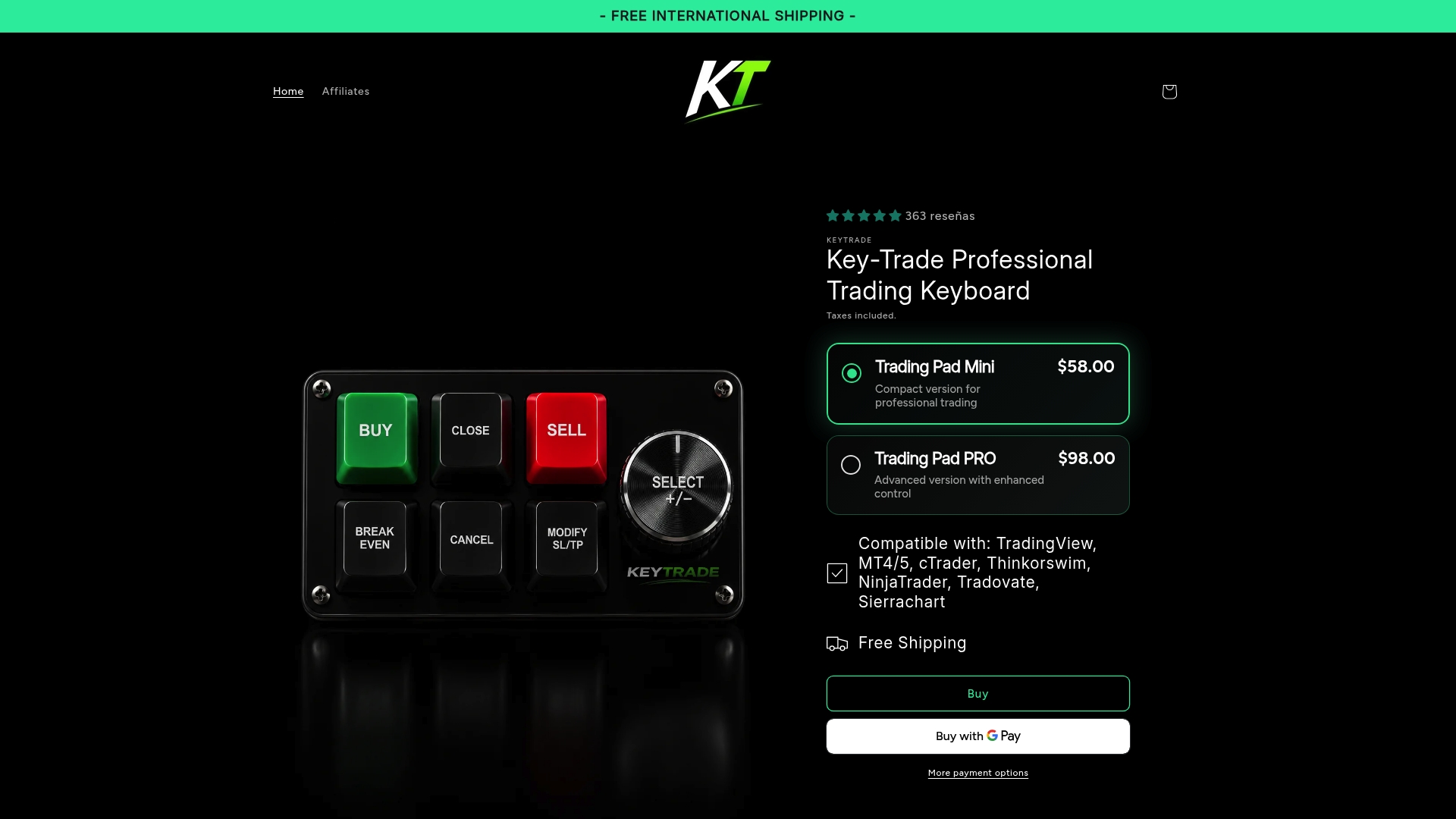
- Los botones programables pueden asignarse a cantidades fijas de cierre parcial para cada instrumento que opere.
- Las guías de configuración explican el proceso específico para cada plataforma, de modo que pueda probar el mapeo antes de operar en tiempo real.
- El dispositivo se envía a todo el mundo y funciona tanto con cuentas reales como con cuentas de trading fondeadas (prop trading).
El precio del teclado de trading profesional Key-Trade comienza en $59 como compra única. Pruebe su mapeo primero en una cuenta demo y luego consulte la gama completa de productos para ver qué configuración se ajusta a su plataforma.
Dónde consultar la documentación de hotkeys específica de cada plataforma
Para obtener los pasos exactos en su propia plataforma, vale la pena leer la documentación principal directamente en lugar de depender de resúmenes de terceros, ya que la configuración del lado del bróker puede alterar lo que realmente aparece en su ventana de órdenes.
- La guía de cierre parcial de posiciones de TradingView explica la función y cuándo se aplica.
- El tutorial de TradingView sobre cómo realizar un cierre parcial cubre la configuración de órdenes instantáneas que lo controla.
- La lección de hotkeys de TWS de Interactive Brokers detalla la configuración de teclas y plantillas.
- El hilo del foro de soporte de Sierra Chart y la discusión en el foro de NinjaTrader cubren soluciones prácticas. Confirme siempre la configuración de su propio bróker, ya que no todas las cuentas admiten el cierre parcial.
Fuentes
- Cierre parcial de posiciones — TradingView
- Cómo cerrar parcialmente con una tecla de acceso rápido - Tablero de soporte — Sierra Chart
Preguntas frecuentes
¿Qué es un cierre parcial en trading?
Un cierre parcial significa salir solo de una parte de una posición abierta en lugar de cerrarla por completo, como cerrar 1 contrato de una posición de 3 para asegurar algo de beneficio mientras se mantiene el resto de la operación abierta. Le permite reducir la exposición o retirar ganancias sin abandonar la posición restante.
¿Thinkorswim admite hotkeys?
Thinkorswim ofrece funcionalidad de teclas de acceso rápido para acciones de trading comunes, aunque los pasos exactos para establecer una cantidad de cierre parcial dependen de la configuración de su cuenta y de los valores predeterminados de las órdenes. Consulte el menú de configuración de hotkeys de su plataforma y pruebe cualquier tecla de cierre parcial en una cuenta de simulación (paper trading) antes de usarla en tiempo real.
¿Cómo cierro una opción put "sell-to-open" con una hotkey?
Cerrar una opción put "sell-to-open" significa enviar una orden "buy-to-close" por el mismo contrato y cantidad, lo cual puede asignar a una hotkey de la misma manera que lo haría con cualquier orden opuesta. Establezca primero la cantidad en su ticket de orden y luego asigne una tecla de acceso rápido a esa plantilla "buy-to-close" para que se ejecute con una sola pulsación.
¿Cómo configuro una hotkey de cierre parcial si mi plataforma no admite la cantidad en la propia tecla?
Establezca la cantidad deseada en la ventana de operación u orden primero, luego active una tecla de acceso rápido que envíe la orden opuesta contra esa cantidad, que es la solución comúnmente recomendada en el tablero de soporte de Sierra Chart y el foro de NinjaTrader. Una plantilla guardada o estrategia ATM, donde la plataforma lo permita, es más fiable ya que almacena la cantidad con la orden en lugar de depender de un campo que debe establecer por separado.
¿Pueden los teclados físicos realizar cierres parciales más rápido que las hotkeys de software?
Un teclado físico puede ejecutar un cierre parcial sin necesidad de una ventana emergente de confirmación o un campo de cantidad sincronizado, ya que la cantidad está programada directamente en el botón. Algunos teclados de trading profesionales asignan cantidades fijas de cierre parcial a botones individuales en las plataformas de trading más populares.