

From $59 to $250+: What Professional Traders Pay for Trading Keypads
Trading keypads generally fall into entry-level, mid-tier, and professional-grade units, with prices increasing alongside features such as programmability and durability. For most active and professional traders, a mid-tier or pro keypad is the better buy because entry models often cut corners on switch durability and onboard memory, and we recommend treating Key-Trade’s Professional Trading Keyboard as a direct option in that range. Stock status matters as much as sticker price, since backordered units can add weeks to delivery or push you toward a pricier in-stock alternative.
TL;DR:
- Higher-priced keypads offer more programmable keys, durable switches rated for millions of operations, and onboard memory for multiple profiles.
- Backordering can significantly delay delivery, often making a slightly more expensive in-stock device a better choice for active traders.
- Platform compatibility is critical; a keypad that does not support your trading software renders its features useless regardless of its price.
- For heavy daily trading, wired connections and high-durability switches reduce input lag and device failure risk, justifying mid-to-pro tier costs.
- Starting with an entry or mid-tier keypad and upgrading only when core limitations emerge can save money and ensure better workflow fit.
Table of Contents
- Typical price ranges and what you get at each tier
- Features and specifications that drive price
- How to pick a trading keypad within your budget
- Availability, lead times, and where to buy
- Why Key-Trade is a direct option for professional traders
- Author perspective: when spending more is worth it
- Ready to buy: Key-Trade pricing and how to check out
- FAQ
- Sources
Typical price ranges and what you get at each tier
Price tiers for trading keypads roughly track three things: how many keys you get, how rugged the switches are, and how much the firmware lets you customize. Entry-level keypads, generally priced from $60 to $150, tend to have fewer programmable keys, simpler plastic housings, and limited onboard memory for saved profiles. They work fine for traders who need a handful of one-touch actions (buy, sell, close) but start to feel restrictive once you add partial closes, scaling, or multi-account switching to your workflow.
Mid-tier keypads, priced from roughly $150 to $250, add more programmable keys, better switch quality, and onboard memory that stores multiple profiles so you can switch between platforms or accounts without reprogramming. The XBE-24 BEAR Trading Keypad illustrates this bracket: its vendor listing shows a sale price of $248.75, and the same page notes the unit may be on backorder, a reminder that the listed price is not always the price you actually pay once you factor in wait time or the cost of a faster in-stock alternative.

Pro-tier keypads, generally $250 and above, typically bundle higher key counts, RGB backlighting for visual profile cues, more durable mechanical switches rated for heavy daily use, and deeper software integration across multiple trading platforms. These units are built for traders who execute dozens or hundreds of orders a day and need the keypad to survive years of repetitive strikes without drifting out of calibration.
A few patterns show up across all three tiers:
- MSRP rarely matches street price: vendor sale pricing, bundle discounts, and regional shipping costs can move the effective price up or down from the number printed on the box.
- Backorder status changes the real cost: a keypad listed at a lower price but out of stock for six weeks may end up costing you more in lost execution speed than a slightly pricier in-stock unit.
- Secondhand units save money but skip warranty coverage: used keypads can undercut retail pricing, but switch wear and voided support are real tradeoffs for a device you rely on every trading session.
- Platform compatibility narrows your options before price does: if a keypad does not support your trading platform, its price tier is irrelevant.
Your starting point should not be “what is the cheapest keypad” but “what is the cheapest keypad that covers my actual order-execution workflow.” A trader who only ever needs to buy, sell, and close buttons can get by on an entry unit. A trader running multiple accounts across different platforms, or executing scaled entries and partial closes throughout the day, will outgrow an entry keypad within weeks and end up paying twice: once for the cheap unit, once for the upgrade.
Features and specifications that drive price
Key count is the most visible price driver, but it is not the only one, and sometimes not even the most important one. A 24-key layout costs more to manufacture than a 12-key layout, and it also opens up more combinations for macros, multi-step order sequences, and dedicated risk-management buttons like break-even or stop-loss adjustment. Product listings for keypads such as the XK-24 show how this plays out in practice: that listing specifies 24 programmable keys, RGB backlighting, wired USB connectivity, and onboard memory for stored macros, a feature set that commands a higher price than a bare-bones 12-key pad with no memory.
Switch durability is a quieter price factor that matters more the heavier your usage. The same XK-24 product page lists a durability specification of roughly 1 million key operations, along with removable feet that let you adjust the angle of the unit on your desk. For a trader hitting the same four or five buttons dozens of times a day, that operation-cycle rating is the difference between a keypad that lasts years and one that starts missing inputs within months.
Statistic to watch: switches rated for roughly 1 million operations are built for traders who execute high volumes of repeat actions daily, a rating worth checking before you buy if your workflow involves rapid, repetitive order entry.
Several other specs shift price without necessarily showing up in a headline feature list:
- Onboard memory and profiles: the ability to store multiple macro sets lets you switch between platforms or accounts without reprogramming every key, a feature more common on mid and pro tiers.
- Backlighting: RGB or single-color lighting helps you confirm which profile is active at a glance, useful when you run several platforms side by side.
- Connectivity: wired USB connections generally offer lower input latency than wireless options, a meaningful consideration for execution-sensitive workflows.
- Ergonomics: removable feet, adjustable angles, and tactile key markings affect day-to-day comfort more than they affect raw capability.
- Warranty and support: longer warranty windows and responsive support resources add cost to the manufacturer but reduce your risk of being stuck with a dead unit mid-session.
Key count alone does not define what a keypad can do. Two devices with the same number of keys can ship with different firmware limits, different macro capacities, and very different switch lifespans, so reading the full spec sheet matters more than comparing key counts side by side. Programmability and ergonomics are also separate buying criteria worth weighing independently. Some traders prefer fewer, well-placed keys with clear tactile markings over a dense grid of small, identical buttons, especially when speed and accuracy under pressure matter more than raw button count.
For high-frequency workflows, the combination of wired USB with minimal polling latency and high-durability mechanical switches reduces operational risk in a way that wireless or lower-durability designs generally cannot match. That combination tends to sit in the mid-to-pro price bracket, which is part of why those tiers command a premium over entry-level units.
How to pick a trading keypad within your budget
Choosing a keypad is less about finding the best device on paper and more about matching features to your actual trading workflow and being honest about what that workflow costs you when execution lags. Start with the actions you perform most often: one-touch market orders, partial closes, stop-loss or break-even adjustments, or managing multiple accounts across different platforms. A keypad that nails those core actions beats one with more total keys but worse layout for your specific habits.
Here is a practical sequence for narrowing down your purchase:
- List your core order-execution actions and count how many dedicated keys you actually need, including any risk-management shortcuts like break-even or scale-out.
- Confirm platform compatibility first, before comparing price, since a keypad that does not integrate with your trading platform is not a real option regardless of cost.
- Match switch durability to your trading volume: high-frequency traders should prioritize units with higher-rated operation cycles, while lower-volume traders can accept a less durable, less expensive switch.
- Check onboard memory and profile support if you trade on more than one platform or manage multiple accounts, since reprogramming keys manually between sessions wastes time you do not have during active trading.
- Price out the full purchase, not just the keypad: shipping cost, applicable tax, and warranty terms all affect what you actually pay versus the number on the product page.
- Check current stock status before committing, since a backordered unit can delay delivery by weeks and may justify paying slightly more for an in-stock alternative.
Pro Tip: If you are unsure whether you need a pro-tier keypad, start with an entry or mid-tier unit, run it for a full trading cycle, and track how often you hit a limitation (missing macro slots, no profile switching, worn-out switches) before upgrading.
Connectivity and durability deserve extra weight if your trading style is aggressive, meaning high order volume, frequent scaling, or rapid reaction to fast-moving markets. A wired connection avoids the input lag that wireless devices can introduce, and a switch rated for a high number of operation cycles avoids the slow degradation that turns a reliable keypad into an unreliable one after a year of daily use.
Software mapping is another piece worth confirming before you buy rather than after. Some keypads ship with platform-specific mapping tools that let you assign order types, lot sizes, and risk parameters directly to keys, while others require more manual configuration. If your trading platform is not explicitly supported, you may find yourself stuck remapping generic keystrokes instead of using purpose-built trading functions, which defeats much of the point of buying dedicated hardware in the first place.
Total cost of ownership is where budget-conscious buyers often get surprised. The device price is just the starting point. Add in shipping costs (which can vary significantly for international orders), any applicable sales tax, and the practical cost of a backorder delay if your chosen unit is not immediately available. A keypad listed at $150 that ships in two days can be a better financial decision than one listed at $130 that takes six weeks to arrive, especially if that delay means trading without the execution speed you were counting on. Warranty terms matter here too: a keypad with a short or unclear warranty window shifts repair or replacement costs back onto you if a switch fails within the first year of heavy use.
Availability, lead times, and where to buy
Three buying channels dominate the trading keypad market: in-stock retail listings, direct manufacturer purchase, and backorder or preorder arrangements. Each carries a different risk profile, and that risk translates directly into effective cost even when the listed price looks identical across channels.
In-stock retail listings are the lowest-risk option because you know what you are getting and when it will arrive. Direct manufacturer purchase often gives you better access to support resources, setup guides, and warranty service, since you are buying straight from the source rather than through a reseller. Backorder or preorder arrangements can offer the lowest listed price, but they come with the real possibility of delays, and those delays have a cost even when they do not show up on an invoice.
The XBE-24 BEAR Trading Keypad is a useful example of this dynamic: its listing shows a sale price alongside a backorder notice, meaning the advertised price does not guarantee immediate delivery. Vendor pages for niche trading hardware show this pattern often enough that it is worth checking stock status before assuming the listed price is the full story.
Before buying, a short checklist protects you from unpleasant surprises:
- Check the stock page directly rather than relying on a search result or cached listing, since availability can change daily.
- Ask the vendor for an estimated lead time if the item shows as backordered, especially if you need the device for an active trading setup.
- Confirm shipping costs and timeframes separately from the device price, particularly for international orders.
- Review the return and warranty policy before purchasing, since trading hardware sees heavy daily use and failure within the first year is not uncommon for lower-quality switches.
For a direct purchase channel, Key-Trade’s product collection lists current pricing and variants for its Professional Trading Keyboard line. As with any vendor, confirm the listed price, stock status, and shipping terms on the page itself before completing a purchase, since those details can shift over time.
Why Key-Trade is a direct option for professional traders
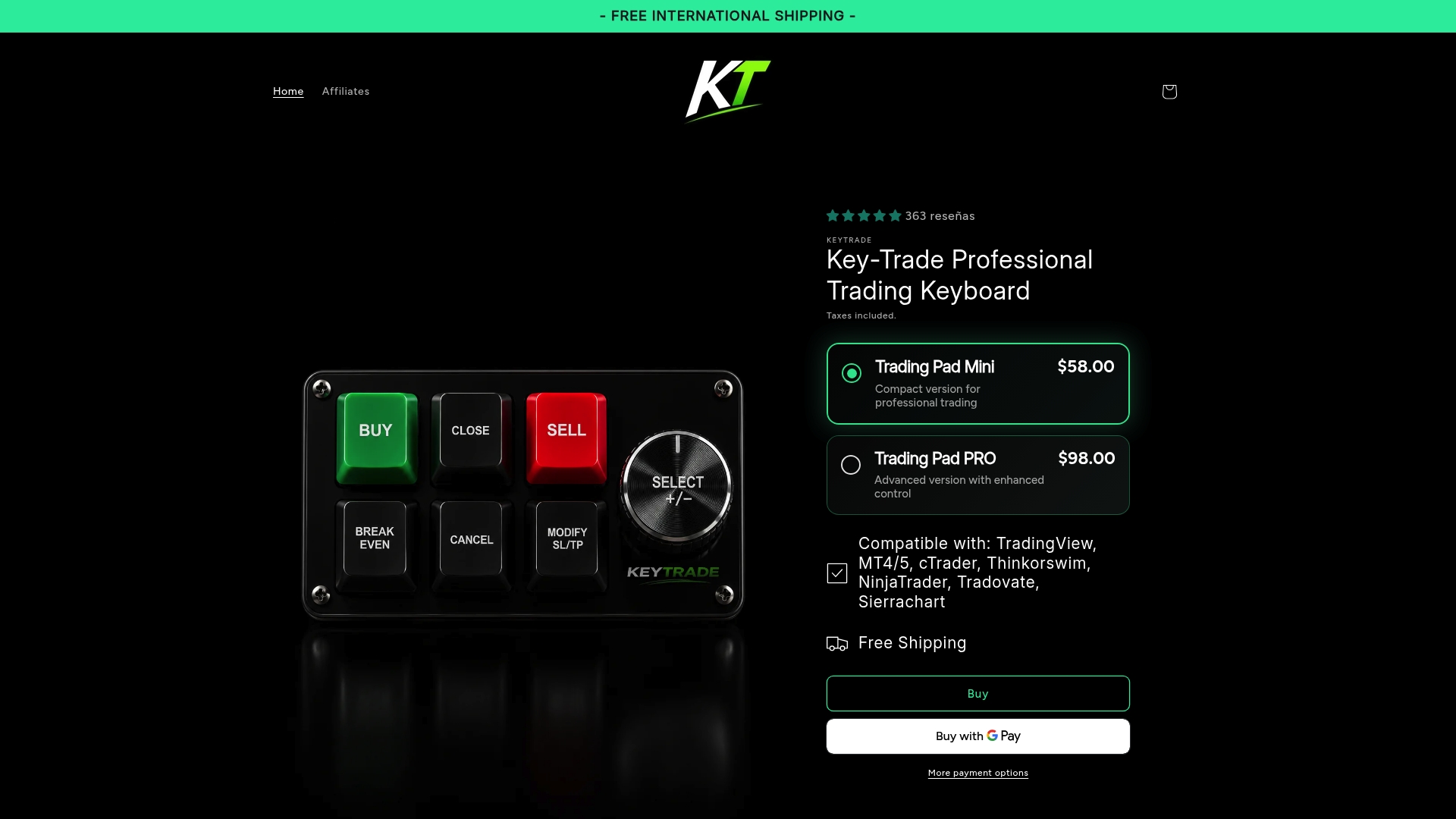
If platform compatibility and execution speed are your main buying criteria, the Key-Trade Professional Trading Keyboard is built around exactly that problem. Our product pages describe compatibility with TradingView, MetaTrader 4 and 5, cTrader, NinjaTrader, SierraChart, Thinkorswim, and Tradovate, with more platforms planned, which matters if you trade across more than one system or manage accounts on different brokers. Rather than remapping generic keystrokes, our programmable buttons are designed to handle order execution, partial closures, and risk controls like break-even and stop-loss adjustments directly.
We price the Professional Trading Keyboard from $59 USD as a one-off purchase, with no subscription required to use the core hardware functions. That pricing sits at the accessible end of the mid-tier range described earlier in this guide, which makes it a reasonable entry point for traders who want dedicated hardware without committing to the highest pro-tier price brackets first.
Our setup process is built for traders without a technical background: the plug-and-play design and online guides are meant to get you executing trades through programmable buttons without writing code or configuring complex firmware. We ship worldwide, and our support resources cover platform-specific integration steps for each supported trading platform.
As with any hardware purchase, we recommend confirming the current price, shipping estimate, and warranty terms directly on our product page before checkout, since stock levels and shipping timeframes can shift. Our blog also covers pricing notes, backorder status, and purchasing guidance specific to our product line, which is a useful second check if you want more detail before committing to a purchase.
For traders comparing dedicated hardware against software-only automation, resources like Darkbot’s coverage of automation and integration are worth a look, since programmable key mapping and onboard profiles are the same underlying concepts that make both hardware keypads and automated trading tools useful. The core tradeoff stays the same regardless of approach: faster, more consistent execution against the cost and complexity of setting it up.

Author perspective: when spending more is worth it
Spending more on a trading keypad makes sense for a specific set of traders: anyone executing high order volumes daily, managing multiple accounts across different platforms, or running strategies where a half-second delay in closing a position has a real cost. For those traders, the jump from an entry-level keypad to a mid or pro-tier unit is less about comfort and more about reducing execution errors that compound over hundreds of trades a month.
For everyone else, the math is less obvious. A trader placing a handful of trades a week does not need a pro-tier keypad with a six-figure operation-cycle rating. The honest move is to start with an entry or mid-tier unit, track how often its limitations actually slow you down over a full trading cycle, and only upgrade once you can point to a specific feature you are missing rather than a vague sense that more buttons would help.
— key-trade
Ready to buy: Key-Trade pricing and how to check out
If platform compatibility, programmable risk controls, and plug-and-play setup matter more to you than squeezing out the lowest possible sticker price, the Key-Trade Professional Trading Keyboard is a direct, no-code route to faster order execution across the platforms most active traders already use.
Before you check out, run through this short list to avoid surprises after purchase:
- Confirm your trading platform is supported on the product page, since compatibility varies by platform version.
- Check current shipping estimates for your region, since worldwide shipping timeframes vary by destination.
- Review warranty and support terms listed on the page so you know what is covered if a switch or button fails.
Pricing starts from $59 USD for the Professional Trading Keyboard, one-off purchase, no subscription required for core functions. Visit Key-Trade’s product collection to confirm current price, available variants, and checkout options.
FAQ
What is the typical price range for a trading keypad?
Trading keypads generally run from $60 to $150 for entry-level units, $150 to $250 for mid-tier devices, and $250 and above for professional-grade keypads with extended programmability and higher switch durability. The Key-Trade Professional Trading Keyboard is priced from $59 USD as a one-off purchase, sitting at the accessible end of that range.
Does a higher price always mean better trade execution?
Not automatically. A higher price usually reflects more programmable keys, higher-durability switches, and onboard memory for multiple profiles, but the features that actually improve your execution depend on your specific workflow, such as how many accounts you manage or how often you use partial closes.
Why do some trading keypads show as on backorder?
Niche trading hardware is produced in smaller volumes than mainstream peripherals, so demand can outpace stock, as seen with the XBE-24 BEAR Trading Keypad listing, which shows a sale price alongside a backorder notice. Checking stock status directly on the vendor’s page before buying helps you avoid unexpected delivery delays.
What specs should I check before comparing prices?
Prioritize platform compatibility, key count, switch durability rating, and onboard memory for stored profiles, since these drive both price and day-to-day usefulness. Specification listings such as the XK-24 product page show how features like a roughly 1 million operation durability rating and onboard macro memory factor into the price of a mid-tier keypad.
Where can I buy a trading keypad directly?
You can buy directly from a manufacturer’s own site or through a reputable retail listing, and checking both gives you a sense of current pricing and stock status. For the Key-Trade Professional Trading Keyboard, the product collection page lists current pricing, variants, and checkout options.