

Scaling Out Strategy for Active Traders: 3 Templates and a $59 Keypad
Scaling out means exiting a position in planned partials instead of closing it all at once, locking in some profit while keeping part of the trade open for continuation. It trades a share of potential upside for lower remaining exposure and a smoother equity curve, and it tends to work best in trending markets or when liquidity makes a single large exit risky.
TL;DR:
- Scaling out works best in trending markets or when liquidity makes large full exits risky by reducing market impact.
- Strictly test and document your partial exit percentages and triggers to ensure they enhance overall profitability and expectancy.
- Use smaller contract variants like micro or nano futures to facilitate more precise staging and reduce commission costs.
- Automated order management tools such as OCO brackets and programmable keypads improve execution speed and minimize slippage when scaling out.
- Be aware that partial exits can temporarily affect margin levels, depending on your broker’s intraday margin rules and how they handle deficits in real time.
Table of Contents
- What scaling out is and why professional traders use it
- Practical methods and rules for scaling out
- Position sizing, contract selection and execution mechanics
- Risk, margin and regulatory considerations for staged exits
- Worked examples and reusable templates for a scaling-out plan
- How specialist trading hardware supports fast, precise scaling out
- The psychology behind closing a position in pieces
- How staged exits affect your overall portfolio
- Scaling out across day trading, swing trading, and position trading
- Tax implications of partial exits in different jurisdictions
- Common mistakes and pitfalls when implementing scaling out strategies
- When I use scaling out and why
- How specialized execution hardware can help
- FAQ
- Sources
What scaling out is and why professional traders use it
A full exit closes an entire position at one price. Scaling out breaks that same exit into two or more pieces, each closed at a different level or trigger. According to Investopedia’s breakdown of the method, a typical plan combines an initial partial exit, one or more later targets, and sometimes a trailing stop on the final piece. The approach locks in realized gains early while leaving room to capture more of a trend.
Traders favor staged exits for a few concrete reasons:
- Locking in partial profit reduces the emotional pressure of watching an open winner give back gains.
- Smaller remaining size after a partial exit lowers dollar risk if the market reverses.
- Staged exits fit trending conditions and large positions where a single exit could move the market against you.
The same source is clear that scaling out is not automatically more profitable than a single exit. If the first partial is too large or triggers too early, it can cap expectancy rather than improve it, so the plan needs to be tested and journaled rather than assumed.
Practical methods and rules for scaling out
Most scaling out plans fall into three families, and professional traders usually commit to one before the trade is even opened.
- Fixed-percentage splits: close a set share of the position at each stage, such as 30% at the first target, 30% at the second, and the final 40% on a trailing stop or discretionary exit.
- Tiered profit targets: set Target 1 at a modest distance (often tied to the initial stop distance), Target 2 further out, and Target 3 as a trend-following piece with no fixed price.
- Trailing-stop partials: take one partial at a predefined level, then trail the stop on the remainder using a volatility-based distance so the position only closes on a genuine reversal.
Order mechanics matter as much as the percentages. Limit orders control price but may not fill in fast markets; immediate-or-cancel orders prioritize speed over price certainty. One-cancels-the-other (OCO) brackets let you set a target and a stop simultaneously so neither order needs manual cancellation. For larger size, iceberg or working orders hide the full quantity from the order book, reducing the chance that other participants trade against your exit.
Automated alerts and OCO brackets are worth setting up for any plan with more than one exit level: manual execution across multiple targets invites missed fills and hesitation, especially in fast-moving sessions.
Pro Tip: Write your exit percentages and trigger levels into the trade plan before entry, not after you’re already in the position watching the price move.

Position sizing, contract selection and execution mechanics
The size of your tradable unit determines how finely you can scale out. A 100-share stock position splits evenly into thirds of roughly 33 shares, but a single futures contract cannot be split at all without smaller contract variants. CME Group notes that micro and E-nano contract families let traders break exposure into smaller units, which makes staged exits operationally feasible for accounts that would otherwise be stuck rounding to whole contracts.
Every partial exit changes the math on what’s left:
- Recalculate your stop loss and break-even price after each partial, since the remaining position’s risk per point has not changed but your total dollar risk has shrunk.
- Factor commissions and slippage into your target sizing: three small partials multiply per-trade costs, and micro or nano contracts can offset that if liquidity supports them.
- Check the bid-ask spread and available depth before placing a partial on a thinly traded instrument.
- Confirm your working order quantity matches the intended partial, not the full position, before you click send.
A short operational checklist before every partial-exit order: confirm liquidity, confirm spread, confirm quantity, confirm the stop on the remainder.
Risk, margin and regulatory considerations for staged exits
Partial exits interact directly with margin and intraday exposure. FINRA’s Regulatory Notice 26-10 revises intraday margin expectations and requires broker-dealers to determine intraday margin deficits in real time, with a 90-day freeze provision for accounts that repeatedly fail to satisfy those deficits.
New intraday margin mechanics can allow a broker to compute margin deficits and block trades that would create one, according to FINRA’s notice. That means a partial exit that reduces size mid-session may or may not free up margin immediately, depending on how your specific broker implements the rule.
The SEC’s guidance on day trading is a useful backdrop here: day trading is high risk, often leveraged, and traders should never fund it with money they cannot afford to lose. Scaling out doesn’t remove that risk, it only changes its shape. Practical controls include monitoring intraday margin usage throughout the session, reading your broker’s specific house rules rather than assuming a standard, and setting a minimum position size below which partial exits aren’t worth the added commission and complexity.
Worked examples and reusable templates for a scaling-out plan
Three templates cover most active-trading situations. Each should be logged in a trade journal and compared against a full-exit benchmark before you trust it with size.
- Intraday scalper: close 50% at a quick first target (often 1x the initial risk), then trail the remaining 50% with a tight stop just behind the most recent swing low or high.
- Trend swing: close 25% at Target 1, 25% at Target 2, and move the stop on the remaining 50% to break-even after Target 1 fills, then trail it behind each new higher low (or lower high) as the trend extends.
- Large position or block trade: break the position into thirds or quarters using micro or E-nano contracts, exiting one unit at each predefined level so no single order has to absorb the full size at once.
The journal rule that ties all three together: record every staged exit’s price, size, and timing, then calculate what a single full exit at the final price would have returned. Over enough trades, that comparison tells you whether your specific percentages are adding value or just adding complexity. Partner guidance on tranche rules offers worked P&L examples if you want a starting template rather than building one from scratch.
How specialist trading hardware supports fast, precise scaling out
Programmable keypads map a single button press to a partial-close action, an OCO bracket, or a stop adjustment, cutting the clicks between decision and execution. For a trader running tiered targets across TradingView, MT4/5, NinjaTrader, or Thinkorswim, that matters most in the seconds after a target hits, when manual order entry is slowest. Setup involves mapping each button to a platform-specific action and confirming it fires correctly before trading live size. Hardware reduces execution risk, it does not change a strategy’s underlying expectancy.
The psychology behind closing a position in pieces
Scaling out changes how a trade feels, not just how it performs. Locking in a partial gain early satisfies the urge to “be right” quickly, which is part of why the method is popular even among traders who haven’t tested whether it helps their results.
That same satisfaction can work against you. The behavioral pull toward early de-risking is strongest right after a losing streak, when a trader wants to feel safe again, and weakest during a hot streak, when the instinct is to hold everything for more.
The fix is mechanical rather than emotional: predefine every percentage and trigger before the trade, then follow the plan regardless of how the position feels in the moment. Reviewing a trade journal after the fact, rather than trusting memory, is the only reliable way to tell whether your emotional response to partial exits is helping or just making you feel better about average results. Traders who skip the journal step tend to remember their best staged exits vividly and forget the ones that cost them the bulk of a trend.
How staged exits affect your overall portfolio
Scaling out operates at the position level, but its effects roll up into portfolio-level risk. When you take a partial exit, you free capital that can be redeployed into a different instrument or sector, which is one practical way staged exits support diversification: profits from one trending position become dry powder for another setup rather than staying locked into a single bet until it fully closes.
The flip side is that partial exits can create a false sense of diversification if the freed capital just gets redeployed into a correlated instrument. Taking profit on part of a long equity index position and immediately putting that capital into a single tech stock doesn’t reduce concentration risk, it just moves it. Genuine diversification benefit from scaling out shows up when the capital gets spread across uncorrelated instruments or asset classes rather than recycled into the same market theme.
Position sizing also interacts with diversification here: an account running several large positions at once needs staged exits more than an account with one position at a time, simply because reducing several positions gradually smooths the portfolio’s overall volatility more than a handful of simultaneous full exits would.
Scaling out across day trading, swing trading, and position trading

The mechanics of scaling out stay the same across styles, but the time pressure and target spacing change substantially.
Day traders scaling out intraday usually work with tight target distances and fast trailing stops, since the entire trade lifecycle might last minutes. Execution speed matters more here than in any other style, because a delayed partial exit in a fast market can mean the difference between locking a gain and watching it evaporate.
Swing traders have more room to use tiered targets spaced across days, moving stops to break-even after the first partial and trailing the remainder behind daily swing points. The slower pace gives more time to adjust orders manually, though automated alerts still reduce the chance of missing a target overnight.
Position traders holding for weeks or months tend to use fewer, larger partial exits, often tied to major technical levels or fundamental catalysts rather than tight price triggers. A position trader might take one partial at a long-term resistance level and hold the rest indefinitely, closer to a hybrid between scaling out and simply trimming a core holding.
Tax implications of partial exits in different jurisdictions
Every partial exit is its own taxable event in most jurisdictions, which means a scaling-out plan with three exits generates three separate gains or losses to track rather than one. In the United States, the holding period of each specific partial determines whether it’s taxed as short-term or long-term, and the distinction matters most for position traders whose later partials can cross the one-year threshold while earlier ones don’t.
Jurisdictions outside the United States handle this differently: some tax jurisdictions apply flat capital gains rates regardless of holding period, while others offer exemptions tied to account type or residency. Because tax treatment varies by country and by account structure, traders should confirm the specific rules for their own jurisdiction and account type with a qualified tax professional rather than assuming any rule from another market applies to them.
The practical takeaway for scaling out specifically is recordkeeping: a staged-exit plan multiplies the number of taxable events compared to a single exit, so the trade journal that tracks your staged-exit performance should also capture the price, size, and date of each partial for tax reporting purposes.
Common mistakes and pitfalls when implementing scaling out strategies
The most common mistake is choosing percentages arbitrarily rather than testing them. A 50/50 split feels intuitive, but without comparing it against a full-exit benchmark in a trade journal, there’s no way to know whether it’s helping or quietly capping your results.
A second common error is taking the first partial too early or too large, which the Investopedia overview of scaling out specifically flags as a way the method can reduce rather than improve expectancy. If the bulk of the position closes before a trend has room to develop, the remaining piece can’t do much even if the trade keeps working.
Other frequent pitfalls include forgetting to recalculate the stop and break-even level on the remaining size after each partial, letting commissions on small partials eat into gains without checking whether a micro or nano contract would reduce that cost, and placing partial-exit orders on illiquid instruments without checking the spread first. Many traders also skip the journal step entirely, which means the plan never gets tested and simply persists out of habit rather than evidence.
When I use scaling out and why
I lean on scaling out mainly in trending conditions where a single exit would leave too much on the table or too much at risk. The discipline that makes it work is predefining every percentage and trigger before entry, logging each staged exit, and checking the result against a full-exit benchmark. The plan only earns a permanent spot in my rules after enough logged trades show it actually helps.
— key-trade
How specialized execution hardware can help
Staged exits put a premium on speed: the gap between a target hitting and your order filling is where slippage and missed partials happen. Programmable trading keyboards map partial-close, bracket, and stop-adjustment actions to programmable buttons across platforms such as TradingView, MetaTrader 4 and 5, NinjaTrader, and Thinkorswim, cutting the manual steps between decision and fill.
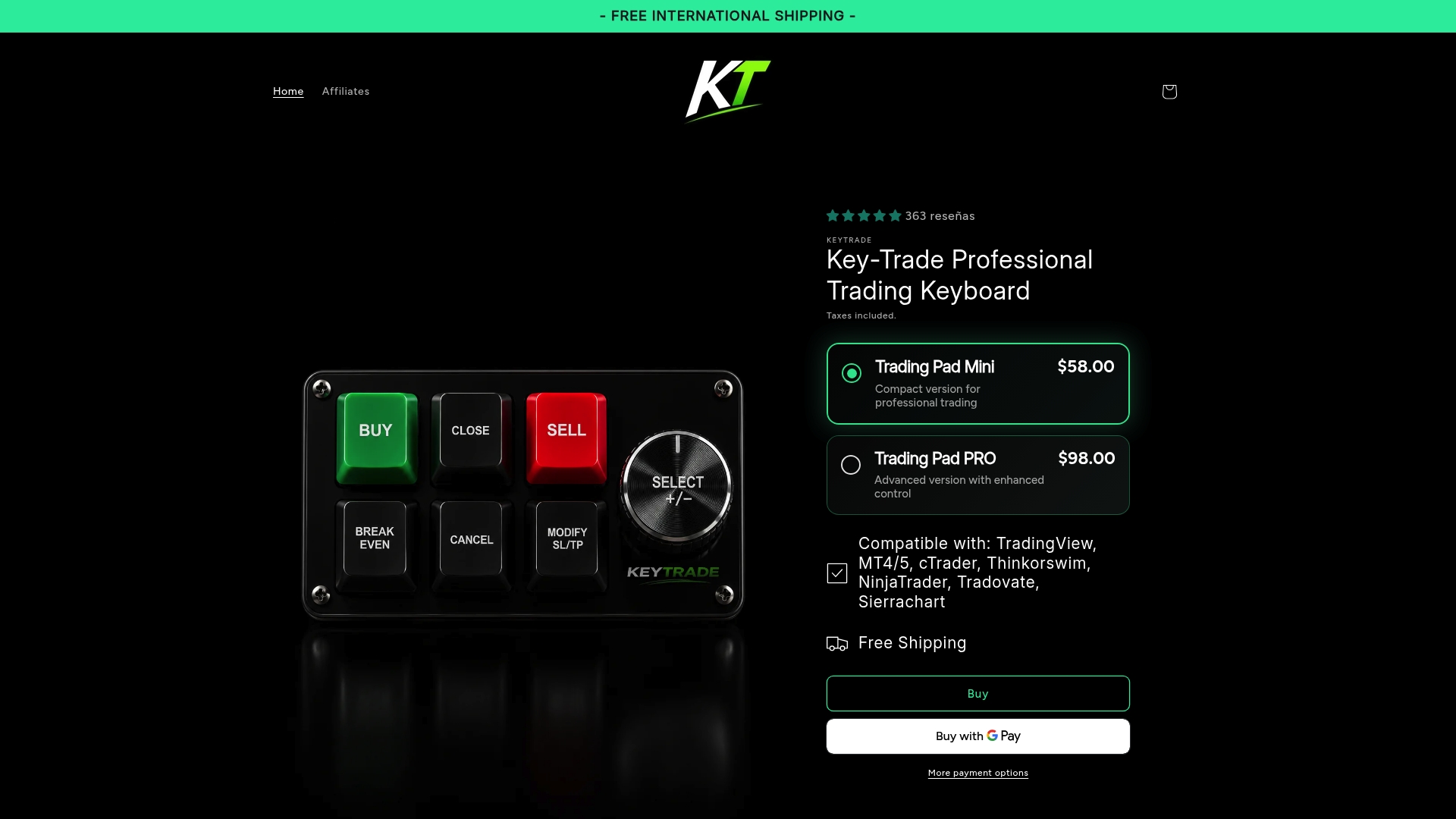
If execution lag is the weak point in your scaling-out plan, the Key-Trade Professional Trading Keyboard is available from $59 one-off on the product page, where you can check compatibility with your platform before buying.
This article is general information, not a substitute for advice from a qualified financial advisor. Consult a qualified financial professional about your own circumstances before acting on anything here.
FAQ
What is a scaling out strategy in trading?
Scaling out is closing a position in planned partials rather than all at once, usually to lock in some profit while keeping part of the trade open. According to Investopedia, common plans combine an initial partial, later targets, and a trailing stop on the final piece.
Is it possible to make $1,000 a day day trading?
Day trading results vary enormously by account size, strategy, and market conditions, and there’s no fixed outcome traders can expect. The SEC warns that day trading is high risk and often leveraged, and that traders should never fund it with money they can’t afford to lose.
What is the 3-5-7 rule in trading strategy?
Definitions of common multi-level exit rules vary across trading education sources, and these are not standardized regulatory or industry frameworks. Traders who reference such rules generally use them as personal risk-limiting guidelines rather than fixed definitions, so check the specific source before applying it.
How does scaling out affect margin during the trading day?
A partial exit reduces position size, which can lower margin usage, but the timing depends on how your broker implements intraday margin rules. FINRA’s Regulatory Notice 26-10 allows broker-dealers to calculate intraday margin deficits in real time, so relief from a partial exit isn’t automatic or instant at every broker.
Does scaling out improve trading results compared to a full exit?
Not automatically. Scaling out can smooth returns and reduce psychological pressure, but Investopedia notes it isn’t inherently more profitable and can reduce expectancy if the first partial is too large or triggers too early, so it needs to be tested against a full-exit benchmark.