

Pass Prop Firm Evaluations: 5 Step Platform Compatibility for Traders
Yes, physical trading keypads can work with major trading platforms and in prop firm account environments, but only when you verify platform hotkey support, check order defaults, and confirm the prop firm’s rules first. Compatibility is real and common, but it depends on configuration, not assumption. Always test every mapped action in a demo or evaluation account before risking funded capital.
TL;DR:
- Using a trading keypad requires verifying the platform’s support for configurable hotkeys and testing all mapped actions in a demo environment first.
- Compatibility depends on hotspot support, window focus, order defaults, and firm-specific policies, which must be confirmed and documented beforehand.
- Most issues stem from incorrect window focus, mismatched order templates, or system restrictions, which are fixable through proper mapping and setup procedures.
- Prop firms often differentiate between manual hotkey use and automated trading, requiring permission and evidence of manual operation during evaluations.
- The Key-Trade Professional Trading Keyboard, priced from $59, simplifies setup with platform-specific guides, but safety precautions like a kill key are essential.
Table of Contents
- Compatibility checklist: what to verify before you connect a keypad
- How keypads talk to trading platforms: hotkeys, plugins, and focus
- What’s different about prop firm environments
- Setup and testing plan: demo, evaluation, funded
- Common problems and quick fixes
- A publisher’s take on safe keypad defaults
- Where to find the Key-Trade Professional Trading Keyboard
- FAQ
- Sources
- Platform docs and setup resources
Compatibility checklist: what to verify before you connect a keypad
Before you plug in any hardware device, run through a short verification process. This catches the issues that cause misfires or policy disputes later.
- Confirm your platform supports configurable hotkeys or accepts keyboard input for order actions.
- Check window sensitivity: know which window needs focus before a keypad command fires.
- Review the platform’s current order defaults, including quantity, attached stop loss or take profit, and templates, since the keypad fires whatever the platform has set.
- Ask your prop firm directly about allowed peripherals and automation rules, and keep written confirmation of any approval.
- Validate operating system and driver requirements, along with the keypad’s HID (human interface device) mode.
- Run full demo tests on every mapped action before moving to a funded account.
Pro Tip: Keep a written log of your prop firm’s peripheral policy reply. If a dispute ever comes up over order activity, that confirmation is your first line of defense.
How keypads talk to trading platforms: hotkeys, plugins, and focus
A trading keypad works by emulating a keyboard. Each button sends a keystroke to whichever window currently has focus on your computer, and the trading platform interprets that keystroke as a native hotkey command. This is why hotkey support is the real foundation of compatibility, not the keypad itself.
Platforms vary in how much of their order flow is exposed to hotkeys. NinjaTrader lets you build custom order actions and assign them to hotkeys, but its documentation is explicit that these hotkeys are window sensitive and will only execute on the active order entry window. NinjaTrader Web goes further, offering a complete list of configurable hotkeys across the order ticket, SuperDOM, chart, and orders modules, covering buy, sell, cancel, reverse, and attached-order commands.
- cTrader ships with a set of default shortcuts and lets you reassign them in application settings.
- Sierra Chart requires you to enable trading keyboard shortcuts per chart or Trade DOM before they function at all.
- Tradovate Web exposes hotkeys for SuperDOM, chart, and order ticket actions, including Buy Market, Sell Market, and Cancel All.
Platform hotkey coverage is broad enough that most order actions can be mapped to a keypad once the platform’s own shortcut system is enabled. That breadth is also the catch: a keypad only triggers what the platform is configured to do, so a mismatched order template fires the wrong size or the wrong attached stop just as easily as the right one. When raw keystrokes cannot reach a specific function, some setups rely on middleware or a vendor plugin rather than pure keyboard emulation, which is worth checking against your specific platform version.
What’s different about prop firm environments
Prop firm accounts add a layer of policy on top of platform mechanics. Before relying on a keypad in an evaluation or funded account, work through these steps.
- Ask the firm how it defines automated trading versus human-triggered hotkeys, since many firms permit one and restrict the other.
- Run your full test script inside the firm’s evaluation or trial environment first, saving logs or screenshots as proof of manual operation.
- Confirm the keypad is targeting the correct account when you manage multiple accounts or when the firm uses auto-routing rules.
- If the firm uses automated monitoring or rule enforcement, ask whether peripherals require device whitelisting or prior disclosure.
- Where macros or chained automated sequences are prohibited, rework your mappings so each key fires a single manual action with a confirmation step, rather than a multi-order sequence.
Sierra Chart’s trade window documentation notes that keyboard shortcuts only operate when trading shortcuts are enabled on the relevant chart or DOM and that window has focus, which is exactly the kind of detail worth demonstrating to a prop firm reviewer. A reliable demo-to-funded test sequence, recorded and logged, is the most practical way to get signoff and avoid having manual hotkey use flagged as automated activity.
Setup and testing plan: demo, evaluation, funded
A structured rollout keeps you from discovering a mapping problem with real money on the line.
- Lab install: confirm driver installation and HID mode, then verify raw output in a text editor or a keyboard tester app before touching any platform.
- Platform configuration: enable trading hotkeys on your platform, set your order templates, and build a demo trade configuration specifically for keypad-triggered orders.
- Demo test script: place, cancel, modify, reverse, and partial-close a position using only the keypad, recording the result of each action.
- Evaluation run: repeat the identical script inside the prop firm’s evaluation account, saving logs or screenshots at each step.
- Final safety pass before funded use: map an emergency-cancel key, an account-lock key, and start with reduced position sizes for the first live sessions.
Pro Tip: Build a dedicated “kill” key into your layout from day one. A single press that cancels all open orders is the cheapest insurance you will ever set up.
Common problems and quick fixes
Most keypad issues trace back to one of a handful of causes, and most have a fast fix.
- Wrong active window firing the order: use a dedicated focus key or switch to a single-window trading mode on the platform.
- Wrong quantity or order template executing: map the keypad to a specific platform trade configuration rather than a raw keystroke sequence.
- Keys not registering at all: check for OS-reserved key combinations, try an alternate combination, or switch the keypad’s HID mode, then update firmware if the issue persists.
- Platform or firm flags the activity as suspicious: share your saved demo logs and request explicit written policy approval.
- When to escalate: contact platform support for hotkey behavior questions, such as those detailed in cTrader’s hotkey documentation, and contact the keypad vendor for HID mode or mapping firmware issues.
A publisher’s take on safe keypad defaults
Our devices map programmable buttons to platform order actions, bundle mapping software for setup, and include safety-oriented defaults rather than raw, unguarded triggers. Our stance after years of fielding setup questions: a keypad should never fire a live order on the first press of a new mapping. We recommend a confirmation key for any order-altering action, a demo-only layer you can switch into before touching a funded account, deliberately small initial lot sizes, and a hardware kill key that cancels everything with one press. Document every test, and loop in both platform support and your prop firm’s support desk whenever a mapping behaves unexpectedly. That combination of caution and paper trail is what actually protects an account, not the hardware alone.
— key-trade
Where to find the Key-Trade Professional Trading Keyboard
The Key-Trade Professional Trading Keyboard ships with mapping software built for integration across platforms including TradingView, MetaTrader 4 and 5, cTrader, NinjaTrader, Sierra Chart, Thinkorswim, and Tradovate, with more platforms added over time. Setup guides cover platform-specific connections so you are not mapping keys from scratch. Start with a demo layer, confirm your first order mapping matches your platform’s default template, then move to evaluation testing before funded use.
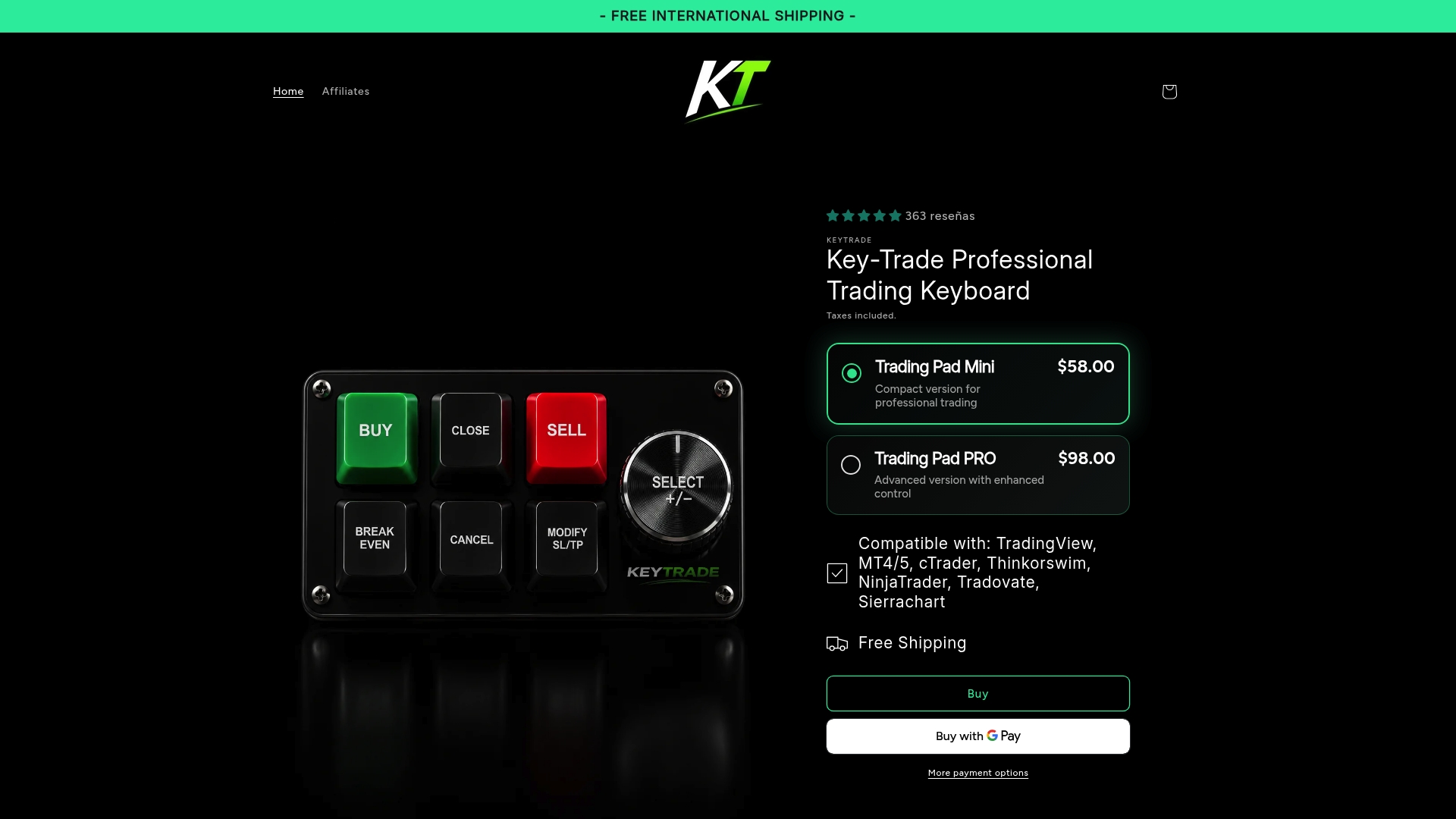
- Buy the Key-Trade Professional Trading Keyboard, priced from $59 one-off.
- Use bundled mapping software to connect to your platform without writing code.
- Follow the included setup guides for platform-specific hotkey configuration.
| Step | Action |
|---|---|
| 1 | Install device and confirm HID mode |
| 2 | Map keys using bundled software and platform templates |
| 3 | Test full script on demo before evaluation or funded accounts |
For a deeper look at execution quality once your hardware is dialed in, improving trade execution covers techniques that pair well with faster manual order entry.
FAQ
Will a trading keypad work with any platform I choose?
It depends on whether the platform supports configurable hotkeys or keyboard-driven order entry. Platforms like NinjaTrader, cTrader, Sierra Chart, and Tradovate document hotkey systems that a keypad can trigger once mapped and enabled.
Do prop firms allow hardware keypads during an evaluation?
Many firms allow manual, human-triggered hotkey use but restrict fully automated trading, so the distinction matters. Confirm the firm’s specific definition in writing and test your mappings inside their evaluation environment before relying on the device.
Why did my keypad send the wrong order size?
A keypad fires whatever order template or default quantity the platform currently has loaded, so a mismatched template is the most common cause. Check and reset your platform’s order defaults before mapping any button to a live action.
What does the Key-Trade keyboard cost?
The Key-Trade Professional Trading Keyboard is priced from $59 one-off and ships with mapping software and setup guides included.
How do I prove to a prop firm that my orders were manual, not automated?
Keep saved logs or screenshots from your demo and evaluation test runs showing each action triggered by the keypad. A short recorded test script covering place, cancel, modify, and reverse actions is generally accepted as proof of manual operation.
Sources
- Operations > Hot Keys > Trading with Hot Keys
- Basic Trading and the Trade Window - Sierra Chart
- cTrader hotkeys documentation
Platform docs and setup resources
Before configuring any mapping, check the platform’s own documentation for the exact steps and current behavior. NinjaTrader’s hotkey trading guide and its web hotkey list cover order entry and window sensitivity. Sierra Chart’s trade window documentation explains enabling shortcuts per chart or DOM, and cTrader’s hotkey help page details reassigning keys in application settings. Pair these with the setup guides on the Key-Trade product pages for device-specific mapping instructions.
