

Avoid Synthetic OCO Risk with Platform Hotkeys, $59 Keypad
An OCO bracket hotkey submits an entry plus a linked stop-loss and take-profit with one keystroke, letting you enter and protect a trade instantly. The main payoff is speed and discipline: you remove the split-second decisions that lead to emotional exits, and your risk parameters get enforced the moment your order fills. One thing to watch is whether your platform manages the OCO natively on the exchange or synthetically on your own machine, since that affects what happens if your connection drops.
TL;DR:
- Native OCO orders on the exchange persist through disconnections, reducing risk compared to synthetic orders managed solely by trading software.
- Hotkeys typically map to order templates with predefined entry, stop, and target parameters, enabling instant execution and risk enforcement.
- Using a simulated account to test hotkeys, especially after platform updates, minimizes the chance of costly mistakes during live trading.
- Programmable keypads replicate platform hotkeys, offering physical buttons for faster, more consistent bracket control without altering the existing trading setup.
- Active trading strategies like scalping and breakout trading benefit most from hotkeys, while discretionary trading or algorithms might favor manual or custom-coded controls.
Table of Contents
- How OCO bracket hotkeys work
- Common hotkey patterns and controls across platforms
- Quick setup notes for the major trading platforms
- Risk controls and testing before you go live
- Pairing a programmable keypad with your platform hotkeys
- When hotkeys make sense versus manual or algorithmic control
- A hardware option for faster bracket control
- Sources
- FAQ
How OCO bracket hotkeys work
An OCO, or one-cancels-the-other order, links two or more orders so that filling one automatically cancels the rest. A bracket order wraps an OCO exit pair, a stop-loss and a take-profit, around a single entry trigger, according to Optimus Futures. When the entry fills, both exit legs go live together, and whichever one hits first cancels the other.
Partial fills complicate this. If your entry only fills halfway, a well-built bracket adjusts the paired stop and target quantities to match, rather than leaving you with mismatched exposure on one side.
Hotkeys work by mapping a single keystroke to a pre-built order template. The template holds your entry type, offset distances for the stop and target, and default quantity. Pressing the key inserts those parameters and transmits the order without you touching a mouse or retyping numbers. Some platforms use built-in hotkey editors, others rely on scripting or keyboard macros layered on top of the trading software.
The native versus synthetic distinction matters more than most traders realize:
- Native OCO orders live on the exchange or broker server, so they persist even if your platform crashes or your internet drops.
- Synthetic OCO orders are managed by your trading software, which means a disconnection can leave one leg live with no matching cancel order behind it.
Before you build a hotkey around a bracket, confirm which type your platform sends. AvaTrade’s education desk points out that synthetic OCOs are vulnerable to client-side disconnection, which is a real risk if you are trading through a laptop on unreliable Wi-Fi.
Execution latency for a well-configured hotkey setup on direct-access platforms can be very low, allowing fast trade execution, according to Optimus Futures. That gap between a hotkey press and a mouse-driven order entry is often the difference between getting filled at your intended price and chasing it.
Common hotkey patterns and controls across platforms
Almost every serious trading platform organizes its hotkeys around the same handful of actions, even when the menus look different. Learning these categories once means you can transfer the logic to a new platform in minutes.
- Select OCO or bracket template. This key loads your saved entry, stop, and target combination.
- Buy or sell at bid, ask, or market. Separate keys for aggressive versus passive entries let you choose your fill style on the fly.
- Set order quantity. A dedicated key or numeric shortcut adjusts size without opening a dialog box.
- Transmit. This sends the order live. On many platforms it is separate from the key that builds the order, which gives you a chance to glance at the ticket first.
- Cancel or abandon. A single key that pulls a working order or bracket leg immediately.
- Move last order up or down. Useful for nudging a stop or limit price by a tick without retyping it.
Most platforms default to Ctrl, Alt, and Shift combinations, along with F-keys and the numeric keypad, because those keys sit away from normal typing and reduce accidental presses. A sensible default scheme keeps destructive actions, like transmit and cancel, on keys that require a modifier, while less risky actions like price nudges can sit on single keys or the numpad.
A workable template-building process looks like this: create the order template first, setting your entry offset and your stop and target distances in ticks or points. Assign that template to a dedicated key you will not confuse with anything else. Then map a separate, clearly different key for canceling the same order, since a cancel key that sits next to your buy key is asking for a mistake. Finally, test the whole sequence in a simulator using an instrument with a known tick size, so you can verify the offsets landed exactly where you expected.
Pro Tip: Use a two-step transmit, preview then confirm, whenever you are testing a new template or sizing up beyond your normal position, so a single mis-mapped key does not turn into a live loss.
Quick setup notes for the major trading platforms
Hotkey menus vary by platform, but the setup logic is consistent enough that a short checklist works almost everywhere: open your hotkey preferences, build or select a template, assign a key, then test it in a simulated account before going live.
NinjaTrader keeps its order-entry hotkeys in a dedicated settings panel, and the platform includes an OCO Orders toggle mapped to Ctrl+Z by default, according to NinjaTrader’s support documentation. From there you can map buy and sell actions to bid, ask, or market pricing, and NinjaTrader’s simulated connections make it easy to confirm your bracket fires correctly before you risk real capital.
Trading Technologies (TT) documents its reserved keys in detail, including a default Ctrl+Alt+O for selecting native OCO and a default bracket key mapped to the left bracket character, according to Trading Technologies’ hotkey preferences page. TT explicitly separates native OCO from its own TT Bracket type, so check which one your template is set to before you rely on it during a fast market.
TradeStation builds OCO and OSO support directly into its Trade Bar, and a bracket OCO decrements the paired quantity automatically when a partial fill happens, per TradeStation’s help documentation. You attach bracket templates from the same pull-down, and the platform supports stacking multiple OSO rows if your strategy needs staged exits.
TradingView handles bracket orders through its broker integrations rather than a native order engine, offering order presets and bracket-management tools to adjust or cancel legs as your position changes, according to TradingView’s support page. Because the actual order routing depends on which broker you connect, your hotkey options will depend on that broker’s own hotkey bridge or API.
DAS Trader and Sierra Chart both expose hotkey configuration panels with range and bracket support, and active communities on platforms like Sierra Chart’s support boards regularly request features like a dedicated cancel-last-order key for scaling out of positions. Workarounds built from custom scripts can fill gaps in native hotkey primitives, but they need careful testing since they can behave inconsistently around partial fills.
Interactive Brokers (TWS) lets you assign nearly any keystroke, including Ctrl and Shift combinations, to order creation, transmit, and cancel actions, according to Interactive Brokers’ configuration guide. Pay attention to how your quantity rules map, since TWS can apply account-size logic that changes your effective order size if your template is not built carefully.
For any of these platforms, the same four steps apply: open the hotkey preferences menu, build your order template, assign it to an unused key, and run it in a simulated account until it behaves exactly as expected.

Risk controls and testing before you go live
Hotkeys speed up execution, but a fast mistake is still a mistake. A short pre-flight routine catches most of the problems before they cost you money.
- Run every new template in a simulated account first, and confirm the fill price, quantity, and both bracket legs match what you built.
- Verify the template defaults, especially quantity and tick offsets, since a saved template from a different instrument can carry over the wrong values.
- Assign a dedicated abort or flatten hotkey that closes everything immediately, separate from your normal cancel key.
- Check how your platform behaves on a dropped connection, since a native OCO holds on the exchange while a synthetic one may leave a leg unprotected, per AvaTrade.
On sizing, resist the urge to set your stops at the tightest tick distance your platform allows. Many experienced traders size stops off a volatility measure like the Average True Range rather than a fixed number of ticks, since a stop that is too tight gets clipped by ordinary intraday noise long before your idea has a chance to play out, a point echoed in TradeStation’s bracket settings guidance.
For active management, single-key breakeven moves and scale-out sequences let you adjust a live bracket without rebuilding it from scratch, but treat any synthetic scale-out feature with the same connectivity caution as a synthetic OCO. As a matter of policy, it is worth restricting your highest-risk keys, like size increases or template overrides, to an account-protected mode, and requiring the two-step transmit for anything unfamiliar.
Pro Tip: Keep a physical or on-screen confirmation, even something as simple as an LED on a keypad, so you always know a hotkey press registered before you assume the order is working.
Pairing a programmable keypad with your platform hotkeys
A programmable trading keypad sits on top of your existing platform hotkeys rather than replacing them. The keypad emulates the exact keystrokes your platform already recognizes, so a button press sends the same signal a keyboard shortcut would, just without you needing to find the right key combination under pressure.
Traders commonly assign keypad buttons to the actions that matter most for bracket work: firing an entry with its attached bracket template, canceling the last working order, nudging a stop or target up or down, and toggling between preset position sizes. Because the buttons are physically labeled and fixed in place, your hand travel drops and your mappings stay consistent across sessions, which matters on a prop desk where speed and repeatability are both graded.
A basic setup checklist looks like this:
- Install the keypad’s companion software and confirm it is recognized by your operating system.
- Configure each macro to emit the exact hotkey sequence your platform expects.
- Map that macro to your platform’s saved order template.
- Test the full sequence in a simulator, then adjust before trading live.
Pro Tip: Test one mapping at a time in simulation rather than programming an entire keypad at once, since a single wrong keystroke sequence can misfire an entire bracket.
When hotkeys make sense versus manual or algorithmic control
Hotkeys earn their place with strategies that need fast, repeatable entries at predictable price levels: scalping, breakout trading, and any style where hesitation costs you the fill. If your edge depends on discretion, reading order flow, or waiting for confirmation that no template can capture, a manual ticket or an algorithm that encodes your exact rules will likely serve you better than a rigid hotkey sequence.
The tradeoff is real. Hotkeys buy you speed, but every added mapping is one more thing that can misfire, and a synthetic bracket introduces connectivity risk that an exchange-native order does not carry. I would rather see a trader run three well-tested hotkeys than ten half-configured ones.
One habit worth building into your routine: re-test your hotkey mappings after any platform update or driver change. A shortcut that worked perfectly last month can silently break after a patch, and you do not want to discover that during a live trade.
— key-trade
A hardware option for faster bracket control
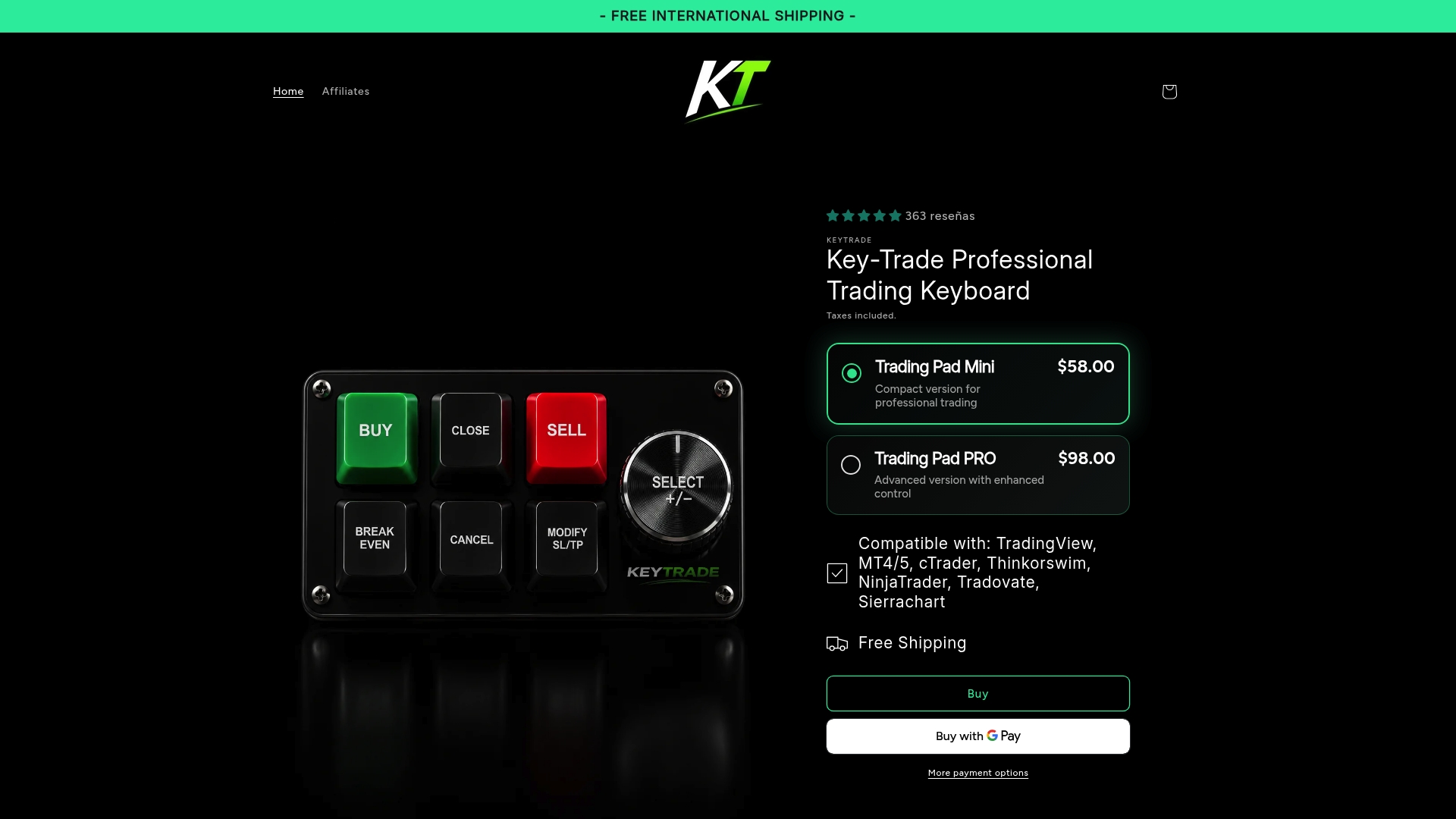
If you have mapped your platform’s OCO bracket hotkeys and still find yourself hunting across a keyboard mid-trade, a physical keypad closes that gap. A professional trading keyboard is designed to integrate with major platforms including TradingView, NinjaTrader, MetaTrader 4 and 5, cTrader, SierraChart, Thinkorswim, and Tradovate, with more platforms added over time.
- Programmable buttons map directly to your existing bracket templates, so you keep the logic you already tested.
- Dedicated keys for entries, cancels, and size toggles cut hand travel compared to a full keyboard.
- Setup requires no coding, just mapping each button to the hotkey sequence your platform already recognizes.
Try mapping your own bracket template to a keypad button in a simulator first. When you are ready for a physical setup, the Key-Trade Professional Trading Keyboard starts at $59 one time, with setup guides for each supported platform.
Sources
- OCO & Bracket Orders (Optimus Futures Learn)
- Hotkeys Preferences – Trading Technologies
- OCO, OSO Orders on the Trade Bar - TradeStation Help
- Order brackets — TradingView Support
FAQ
What does an OCO bracket hotkey actually do?
It sends an entry order along with a linked stop-loss and take-profit using a single keystroke, so all three legs are built and transmitted together. The moment either exit fills, the platform cancels the other automatically, per Optimus Futures.
Is native OCO better than synthetic OCO for hotkeys?
Native OCO orders are managed on the exchange or broker server, so they stay active even if your platform disconnects, while synthetic OCO orders depend on your own software staying connected. AvaTrade’s education guide recommends confirming which type your platform uses before relying on it for unattended risk management.
Which platforms support customizable OCO bracket hotkeys?
NinjaTrader, Trading Technologies, TradeStation, TradingView, DAS Trader, Sierra Chart, and Interactive Brokers TWS all support some form of customizable order hotkeys, though the depth of native bracket support varies. NinjaTrader includes a built-in OCO toggle, documented as Ctrl+Z by default, while TradingView routes bracket orders through its broker integrations rather than a native engine.
Can a physical keypad replace platform hotkeys?
A keypad does not replace platform hotkeys, it emulates the same keystrokes your platform already recognizes through programmable buttons. Devices like the Key-Trade Professional Trading Keyboard are built to work alongside platforms such as NinjaTrader, TradingView, and Thinkorswim rather than as a separate order system.
How do I test a new OCO bracket hotkey safely?
Build the template, assign it to a key you will not confuse with another action, and run it in a simulated account first to confirm the entry, stop, and target all land where you expect. Check how the bracket behaves on a partial fill and on a dropped connection before you ever use it with real capital.