

Active Traders: Five DOM Trading Hotkeys and a $59 Panic Keypad
Configure a minimal core set of essential hotkeys before you place another live order, such as Buy market, Sell market, Cancel all, Flatten (Sell all), and size presets. These five cover the actions that cost you money when they’re slow, and they’re the difference between closing a losing trade in half a second and fumbling through a mouse click while the market runs away from you. Test every one of them in a demo account first. A hardware keypad with dedicated buttons cuts mis-execution risk further, since you’re not hunting for the right key on a full keyboard mid-trade.
TL;DR:
- Using a hardware keypad for critical hotkeys can significantly reduce mis-execution risk and improve reaction times during fast market moves.
- Hotkeys for buy, sell, cancel all, flatten, and size presets should be assigned to single keys without modifiers, tested thoroughly in demo accounts first.
- Platform-specific quirks, such as focus issues or separate hotkey controls for chart versus DOM, require independent mapping and verification for reliable execution.
- Limiting your hotkey set to three to five essential actions helps build muscle memory and reduces hesitation under pressure.
- Regular testing and practice are crucial to ensure hotkeys fire accurately and quickly before live trading, especially in volatile conditions.
Table of Contents
- How Do You Set Up DOM Trading Hotkeys?
- What Are the Core Hotkeys Every Trader Needs?
- Which Platform Quirks Trip Up New Hotkey Users?
- How Do You Test Hotkeys Safely Before Trading Live?
- Does a Physical Keypad Actually Improve Hotkey Reliability?
- How Do Hotkeys Fit Into Your Broader Trading Setup?
- Why Fewer, Better-Practiced Hotkeys Beat a Feature-Bloated Layout
- Get a Hardware Layer Built Around Your Core Hotkeys
- Sources
- FAQ
How Do You Set Up DOM Trading Hotkeys?
Every DOM trading platform buries hotkey settings in a slightly different menu, but the workflow is nearly identical everywhere. Here’s the checklist:
- Open the hotkey configuration panel inside your DOM (usually under Settings or Preferences) and decide whether you’ll use single keys or modifier combinations like Shift or Ctrl.
- Assign your highest-priority actions first — Buy, Sell, Cancel, Flatten — to single keys with no modifier required, since modifiers add a fraction of a second you don’t have during a fast exit.
- Test each hotkey in a demo account before touching a live order. Fire every binding at least ten times to confirm it does exactly what you expect.
- Export or save your hotkey profile if the platform supports it, and write down your fallback controls (mouse clicks) in case a hotkey fails mid-session.
- Verify active-window behavior if you run multiple DOM windows. Confirm each hotkey only fires on the DOM currently in focus.
Pro Tip: Print your hotkey map on an index card and tape it next to your monitor for the first week. Muscle memory takes longer to build than most traders expect, and a visual reference prevents costly guesses during volatile opens.
What Are the Core Hotkeys Every Trader Needs?
A well-designed hotkey layout does one thing above all: it protects you from yourself during the moments you’re least able to think clearly. These are the mappings worth copying rather than reinventing.
- Buy market / Sell market: single keys, no modifier. Some traders prefer an alternate mapping of “buy at ask” and “sell at bid” for slightly more control over fill price, but that adds a decision step under pressure, so reserve it for slower markets.
- Cancel all orders: one key, always active, regardless of which order type is open. This should never require confirmation.
- Replace / Modify: used to adjust a working order’s price or size without canceling and re-entering, which matters most when you’re scaling into a position.
- Flatten / Sell all: your single most important binding. ATAS documents specific position management hotkeys for exactly this purpose, letting a trader exit an entire position from either the chart or the Smart DOM with one press.
- Size presets: three to five quick toggles (1 lot, 5 lots, 10 lots, and a custom “max” size) so you’re never typing a number into a box while price moves.
- Partial exit / scale-out: a dedicated key for closing 25% or 50% of a position, separate from your full flatten key.
The design rule that matters most: your panic key never depends on a modifier. If Flatten requires Shift plus a number, you’ve built in a failure point. Reserve modifier combinations for less urgent actions like adjusting chart settings, and keep every hotkey tied to capital preservation as a single, unmodified press.
Pro Tip: Bind Flatten to a key you can reach without looking, like the space bar or a dedicated function key. If you have to glance down to find it, you’ve already lost a second you didn’t have.
Which Platform Quirks Trip Up New Hotkey Users?
Platform behavior varies enough that a mapping copied blindly from a forum post can misfire on your setup. A few documented quirks are worth knowing before you configure anything.
- ATAS treats hotkeys differently depending on whether you’re working in a chart window or the Smart DOM module. A key that flattens a position from the chart may not behave identically inside Smart DOM, so map your panic key in both locations and confirm each independently, a detail covered in ATAS’s developer documentation.
- Quantower separates general hotkeys from trading hotkeys entirely. General hotkeys control chart navigation and layout; trading hotkeys live inside DOM Trader settings and control order sizing, placement, and cancellation. Quantower’s own documentation walks through this split, and skipping it is the most common reason a trader’s flatten key “does nothing” the first time they try it.
- Sierra Chart users have documented workarounds in community threads for binding keyboard shortcuts to DOM order placement, including known issues with active-window focus and NumPad key behavior, discussed at length in a long-running Sierra Chart support thread.
- Universal caution: any platform running multiple DOM windows risks sending a hotkey command to the wrong window if focus isn’t where you think it is. This is the single most common cause of an accidental order on the wrong contract.
How Do You Test Hotkeys Safely Before Trading Live?
Testing isn’t optional, and it isn’t a five-minute formality either. Run through this sequence in a demo account before a single hotkey touches real capital.
- Fire each hotkey individually at least ten times and confirm the resulting order matches your expectation exactly, including size and direction.
- Validate your panic key specifically. Press Flatten while holding an open position and time how long it takes for the position to close. Anything that feels sluggish needs a different binding or a hardware solution.
- Test under simulated stress, not just calm conditions. Widen your demo chart’s time frame to a fast-moving session and fire your exit key while price is actually moving.
- Log your sessions. Note any mis-fire, delay, or wrong-window execution, and fix it before your next demo run.
Keep your working hotkey count to three to five actions. Experts studying hotkey configuration consistently point to a minimal set as the safer approach, and Quantower’s own guidance on hotkey scope reflects the same principle: a smaller, heavily practiced set beats a large suite you only half remember under pressure.
Professional traders treat the single-press flatten key as non-negotiable and don’t go live until it’s fired dozens of times in simulation without hesitation. Muscle memory, not intention, is what holds up when a position moves against you fast.
Does a Physical Keypad Actually Improve Hotkey Reliability?
A keyboard shared with email, chat, and browser tabs is a liability when seconds matter. A dedicated hardware keypad solves a specific problem: it gives every critical action a fixed physical location you can hit without looking, and a large isolated panic button that’s nearly impossible to miss.
- Tactile feedback means you feel confirmation that a key registered, unlike a laptop key that might not have made contact.
- Consistent mapping across sessions, so muscle memory built on Monday still works on Friday.
- A dedicated flatten button, physically separated from every other control, reduces the odds of an adjacent mis-press during a fast market.
- Plug-and-play USB/HID behavior means most keypads work without special drivers, though vendor software often lets you fine-tune mappings per platform.
Pro Tip: Map your keypad’s largest, most isolated button to Flatten and nothing else. Every other action can share smaller keys. Your panic key should be the one button you could hit blindfolded.
Test any keypad macro in demo exactly the way you’d test a software hotkey, and keep your mouse as a documented fallback in case the device disconnects mid-session.
How Do Hotkeys Fit Into Your Broader Trading Setup?
Hotkeys don’t operate in isolation. They sit alongside charting software, order management systems, and often a second monitor running market scanners or news feeds, and how well they integrate with that setup determines whether they actually save you time or just add another layer to manage.
The biggest integration risk is conflict. If your charting platform and your DOM both listen for the same key combination, you can trigger the wrong action in the wrong window, which circles back to the active-window problem covered earlier. Before finalizing any hotkey layout, audit every application running during your session and check for overlapping bindings.

Multi-monitor setups add a layer of complexity worth planning for. If your DOM lives on one screen and your charts on another, your hotkeys need to work regardless of which window currently holds focus, or you need a clear visual cue showing which window is active before you press anything. Some traders solve this by keeping their DOM permanently maximized and never letting another window steal focus during market hours.
Hardware keypads sidestep a chunk of this problem because their inputs are typically registered at the operating system level and routed to whichever application is set as the target, rather than competing with your keyboard’s own shortcuts. That’s part of why pairing a keypad with a disciplined single-DOM workflow tends to outperform trying to layer software hotkeys across five different applications at once.
Why Fewer, Better-Practiced Hotkeys Beat a Feature-Bloated Layout

Every trader who’s built a keypad hardware integration eventually learns the same lesson: the layouts that fail aren’t the ones with too few hotkeys, they’re the ones with too many. A trader trying to remember fifteen bindings hesitates exactly when hesitation costs the most money.
Engineering work on platform integrations across popular trading platforms keeps surfacing the same pattern: traders who commit to five hotkeys and drill them until they’re automatic outperform traders juggling a sprawling custom layout. Speed without accuracy isn’t an advantage. It’s a faster way to lose money. Build your layout around the handful of actions that protect capital first, and add complexity only once those are second nature.
— key-trade
Get a Hardware Layer Built Around Your Core Hotkeys
Software hotkeys get you most of the way there, but they still compete with every other key on your keyboard for your attention during the exact moments you can least afford a mis-press. The Key-Trade Professional Trading Keyboard exists to remove that competition entirely, with programmable buttons dedicated solely to trade execution.
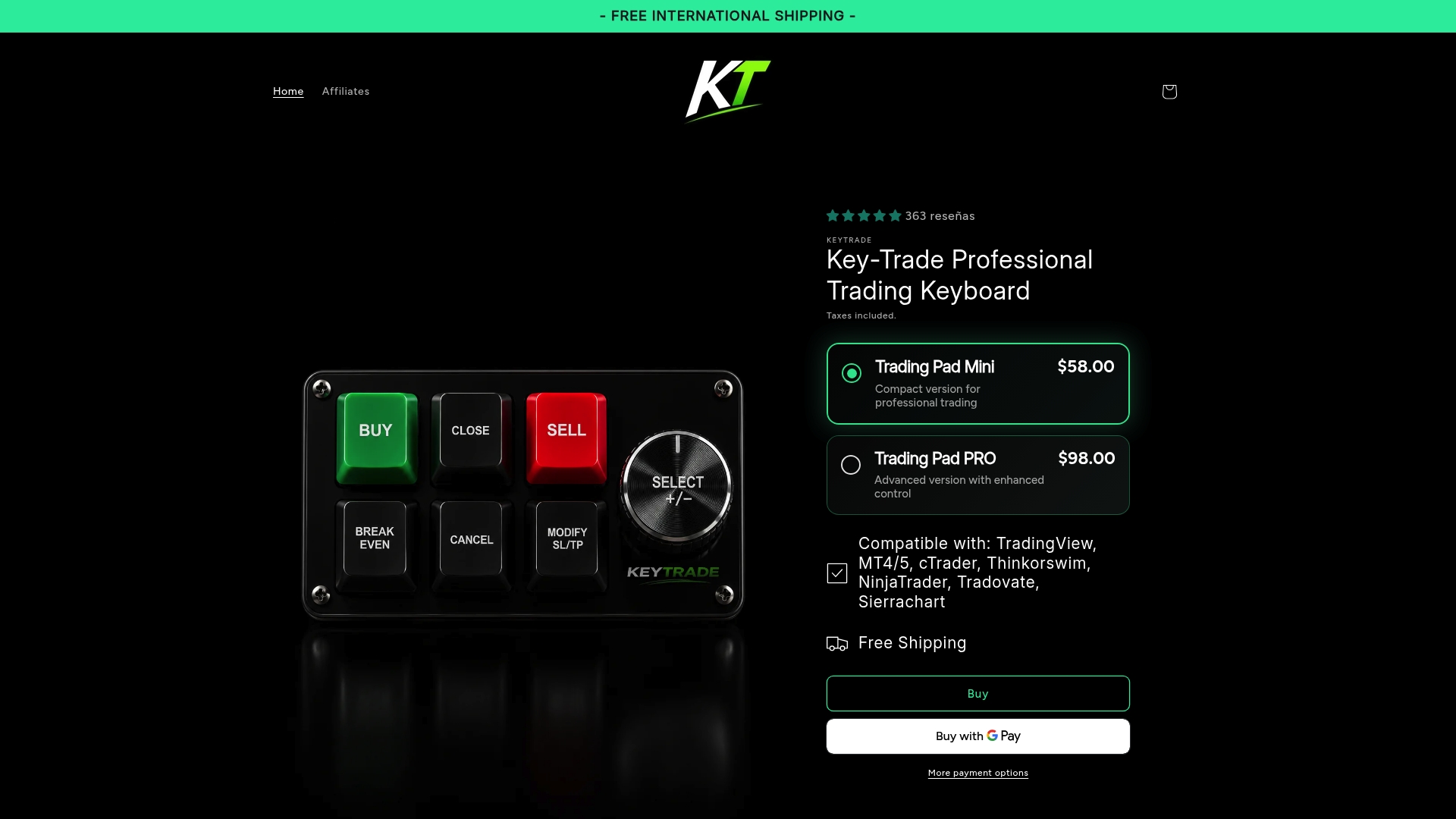
The keypad connects as a plug-and-play device, no coding required, and integrates with the platforms covered in this guide, including TradingView, NinjaTrader, Sierra Chart, Tradovate, MetaTrader 4 and 5, cTrader, and Thinkorswim. You can map its buttons to mirror the exact core set discussed above: Buy, Sell, Cancel all, Flatten, and your size presets, each on its own dedicated key instead of sharing space with your email shortcuts. Partial closures and break-even adjustments get their own buttons too, so scaling out of a position doesn’t require a multi-key sequence under pressure. Pricing starts from $59 one time, with worldwide shipping and setup guides for platform-specific mapping.
Test your mapped layout in a demo account first, exactly as you would with any software hotkey, before running it live. Full specs and setup resources are on the product page.
Sources
- Trading with Hotkeys
- Hotkeys | Quantower
- Keyboard Shortcuts to place orders on DOM - Support Board
- Docs
FAQ
How Do You Use the DOM for Trading?
A DOM (Depth of Market) window shows live bid and ask levels so you can click or hotkey directly into the order book instead of using a standard order ticket. You click a price level to place a limit order, or use a hotkey to fire a market order instantly, and most active traders pair the DOM with hotkeys precisely because clicking becomes too slow once volatility picks up.
What Are Hotkeys for Trading?
Trading hotkeys are keyboard or keypad shortcuts assigned to specific order actions, like buying, selling, canceling, or flattening a position, so you can execute without navigating menus. Platforms including ATAS and Quantower support extensive hotkey customization for exactly this purpose, and a hardware keypad like the Key-Trade Professional Trading Keyboard extends the same idea into dedicated physical buttons.
What Is the 3-5-7 Rule in Trading?
The 3–5 core hotkeys rule is a recommended guideline to limit your working hotkey count to three to five essential actions, reducing cognitive load and mis-execution risk; definitions of any other similar rules vary, so verify against your own risk framework.
Can You Make $1,000 a Day With Day Trading?
Day trading profit depends entirely on capital, strategy, market conditions, and execution discipline, so no fixed daily figure is realistic or guaranteed for any trader. Faster, more reliable execution through a minimal hotkey set or a hardware keypad can reduce slippage and mis-execution, but it doesn’t change the underlying risk of the strategy itself.
How Many Hotkeys Should a Beginner Set Up?
Start with five: Buy, Sell, Cancel all, Flatten, and one size preset, then add more only once those are automatic. A larger set learned too quickly tends to produce hesitation exactly when speed matters most, which is the opposite of what hotkeys are supposed to deliver.