

Developer First Breakeven Stop Strategy: Code, Backtests, and Hotkeys
A breakeven stop moves your stop-loss to entry, or entry plus a small buffer, once a trade reaches a defined profit threshold, locking out loss while leaving the position open to run. It works best when activation and distance are chosen deliberately rather than by habit, since a stop that moves too soon tends to eject trades that would have kept trending. A sensible starting point is an activation near a small percentage gain or an ATR multiple, tested before it touches live capital.
TL;DR:
- Breakeven stops are most effective when activated at small gains or ATR multiples rather than arbitrary thresholds to avoid premature exits.
- Variants include manual adjustments, automatic triggers, buffers above entry, partial closes, and trailing stops that extend protection as the trade develops.
- Activation thresholds should be tested carefully across volatility regimes, with ATR-based settings providing better adaptability than fixed points or percentages.
- Rigorous backtesting with out-of-sample data and fixed parameter grids helps prevent overfitting and ensures consistent live performance.
- Hardware programmable keypads can greatly improve stop management speed and accuracy during fast market conditions.
Table of Contents
- How breakeven stops work and the main variants to know
- Platform setup and code: TradeStation, NinjaTrader, and hotkeys
- Choosing activation thresholds and distance
- [Backtesting and tuning exits without fooling yourself](#backtesting-and-tuning-exits-without-fooling-yourselfhttpsassymetrixcomlearnprediction-market-backtesting-a-quant-framework)
- Live rollout: a practical checklist
- What most traders get wrong about exits
- Hardware-assisted execution for faster stop management
- FAQ
- Sources
How breakeven stops work and the main variants to know
A breakeven stop is just a conditional order modification: once price moves favorably by a set amount, your platform cancels the resting stop and replaces it at (or near) your entry price. Most implementations generate a stop market order, since a stop limit risks not filling during a fast reversal, though some traders accept that risk to avoid slippage. TradeStation’s documentation describes this through SetBreakEven, which places the exit at average entry price once a configured profit floor is exceeded, applied either per position or per contract.
Several variants build on this core idea:
- Manual move: a trader watches price and moves the stop by hand or hotkey once a target is hit.
- Auto-breakeven: the platform or strategy code moves the stop automatically once a trigger condition is met.
- Breakeven-with-buffer: the stop lands a few ticks above entry (on longs) to cover commissions and slippage rather than sitting exactly at cost.
- Stop-profit or partial take-profit: part of the position closes at a target while the remainder runs with a breakeven or trailing stop.
- Trailing interaction: once at breakeven, the stop can continue trailing price rather than staying fixed, extending protection as the trade develops.
The tradeoff is constant: moving to breakeven too early caps upside on trades that would have worked, while moving too late defeats the purpose of protecting gains.
Platform setup and code: TradeStation, NinjaTrader, and hotkeys
Implementation details vary by platform, but the logic is consistent: detect activation, cancel the old stop, submit the new one.
TradeStation and MultiCharts (EasyLanguage). The SetBreakEven function takes a profit floor input and applies it per position or per contract, which matters for multi-lot trades since per-contract breakeven activates earlier on a scaled entry. A simplified excerpt:
Inputs: BEProfit(500), BEBasis(0); // 0 = per position, 1 = per contract
If BEBasis = 0 then
    SetBreakEven(BEProfit)
Else
    SetBreakEven(BEProfit, True);
A common gotcha when backtesting: points-based activation and monetary (dollar) activation behave differently once contract size or tick value changes between instruments, so a setting tuned on one symbol will not transfer cleanly to another.
NinjaTrader. The platform’s Auto Breakeven feature lives inside the ATM Strategy or can be enabled on a working stop loss, with parameters controlling the trigger distance and the offset applied once breakeven activates. It generates a standard stop-market modification rather than a new order type.
Generic pseudocode, useful for any platform or custom bot:
- Track unrealized profit per position (per contract or aggregate).
- When profit crosses the activation threshold, cancel the existing stop order.
- Submit a new stop at entry price plus buffer.
- If a partial-close rule exists, execute it before or alongside the stop move.
- On any manual override or disconnect, restore or cancel pending modifications to avoid duplicate orders.
Hardware hotkeys. A programmable keypad button can be mapped to fire the move-to-breakeven routine and a partial-close command in a single press, which removes the mouse-and-menu path that adds delay during fast markets.
Pro Tip: Log the exact timestamp and price at which breakeven activates in every test run, not just the final trade outcome, so you can audit how often the rule fires versus how often it should.
Choosing activation thresholds and distance
Activation can be defined several ways: a percent gain, a fixed number of ticks or points, an ATR multiple, or a flat dollar amount per contract. Each has a failure mode. Fixed-tick activation ignores volatility shifts, while percent-gain activation ignores instrument-specific tick value, and ATR-based activation adapts to volatility but needs its own lookback tuning.
- Percent or dollar activation: simple to code, weak across volatility regimes.
- Fixed ticks/points: predictable but stale when volatility changes.
- ATR multiple: adapts to current conditions, requires a stable lookback window.
- Buffer above entry: typically a few ticks to cover commissions and slippage rather than exact breakeven.
One recent framework tested candidate defaults including a 3% trailing activation and a 5% trailing distance against a 10% stop-loss baseline, moving the resulting Sharpe ratio from 0.419 to 0.653 after ATR refinement and circuit-breaker overlays, according to a study on exit-rule parameterization. Treat figures like these as starting candidates for your own grid search, not settings to copy directly, since they came from a specific dataset of more than 900 historical trades.
During testing, track activation frequency (how often the rule actually fires), realized slippage at the fill, and drawdown behavior in the bars immediately after activation, since a stop placed too tight right at entry can get clipped by normal noise.

Backtesting and tuning exits without fooling yourself
Exit rules are the part of most systems that gets the least testing, and a breakeven stop tuned only on in-sample data will look better than it performs live. A disciplined workflow treats exit parameters with the same scrutiny as entry signals.
- Split data into a chronological holdout and a separate randomized-replay set, since randomized replay helps reveal whether a parameter set merely exploited one historical regime.
- Run a constrained grid search over a narrow, defensible parameter set (activation threshold, trailing distance, buffer size) rather than an unconstrained sweep across hundreds of combinations.
- Overlay ATR-based scaling on top of fixed candidates to see whether volatility adaptation improves stability across both splits.
- Add a circuit-breaker rule and a stale-close condition (closing a position that has gone nowhere after a set number of hours) and compare results with and without them.
- Require any candidate configuration to perform consistently across both the chronological and randomized splits before it moves toward live testing.
Key metrics to compare across configurations:
| Metric | What it reveals |
|---|---|
| Sharpe ratio | Risk-adjusted return across the full test period |
| Profit factor | Gross profit relative to gross loss |
| Maximum drawdown | Worst peak-to-trough equity decline |
| Activation frequency | How often the breakeven rule actually fires |
The same exit-parameterization research found that pairing a tighter stop-loss with partial take-profit and a stale-close rule (recommending a 48-hour stale close and a 75% partial take-profit fraction as candidates) produced the largest gains once combined with ATR overlays, rather than any single parameter change in isolation. Document every tested configuration, including the ones that failed, so later tuning does not repeat the same dead ends.
Live rollout: a practical checklist
Moving from backtest to live capital needs its own checklist, since execution quality on a demo rarely matches a live connection under load.
- Pre-live: run the configuration on a demo account long enough to see it through a handful of activations, and stress-test connection latency under volatile conditions.
- Runtime confirmation: verify the platform actually replaced the stop order after activation rather than assuming the log is accurate.
- Partial-close sequencing: confirm partial closes execute before or alongside the breakeven move, not after, to avoid a brief window with no protection.
- Stale-close and circuit-breakers: build in an automatic cancel-and-restore routine if a connection drops mid-modification.
- Red flag: if the rule is firing far more often than your backtest predicted, disable it and check for a parameter mismatch before continuing to trade it live.
Pro Tip: Keep a manual override within one keypress at all times. Automated breakeven logic should never require more than one action to pause.
What most traders get wrong about exits
Most teams spend far more time refining entries than testing exits, then wonder why a backtest that looked strong falls apart live. The fix is boring: log every activation, then validate ATR-scaled distances against a randomized replay before trusting a single backtest run.
— key-trade
Hardware-assisted execution for faster stop management
Moving a stop to breakeven or triggering a partial close only helps if the order actually lands before conditions change, and clicking through platform menus under pressure is where most delay and mistakes happen. We build programmable trading keypads specifically for that gap: a single physical button fires the move-to-breakeven or partial-close routine instantly, instead of routing through nested menus.
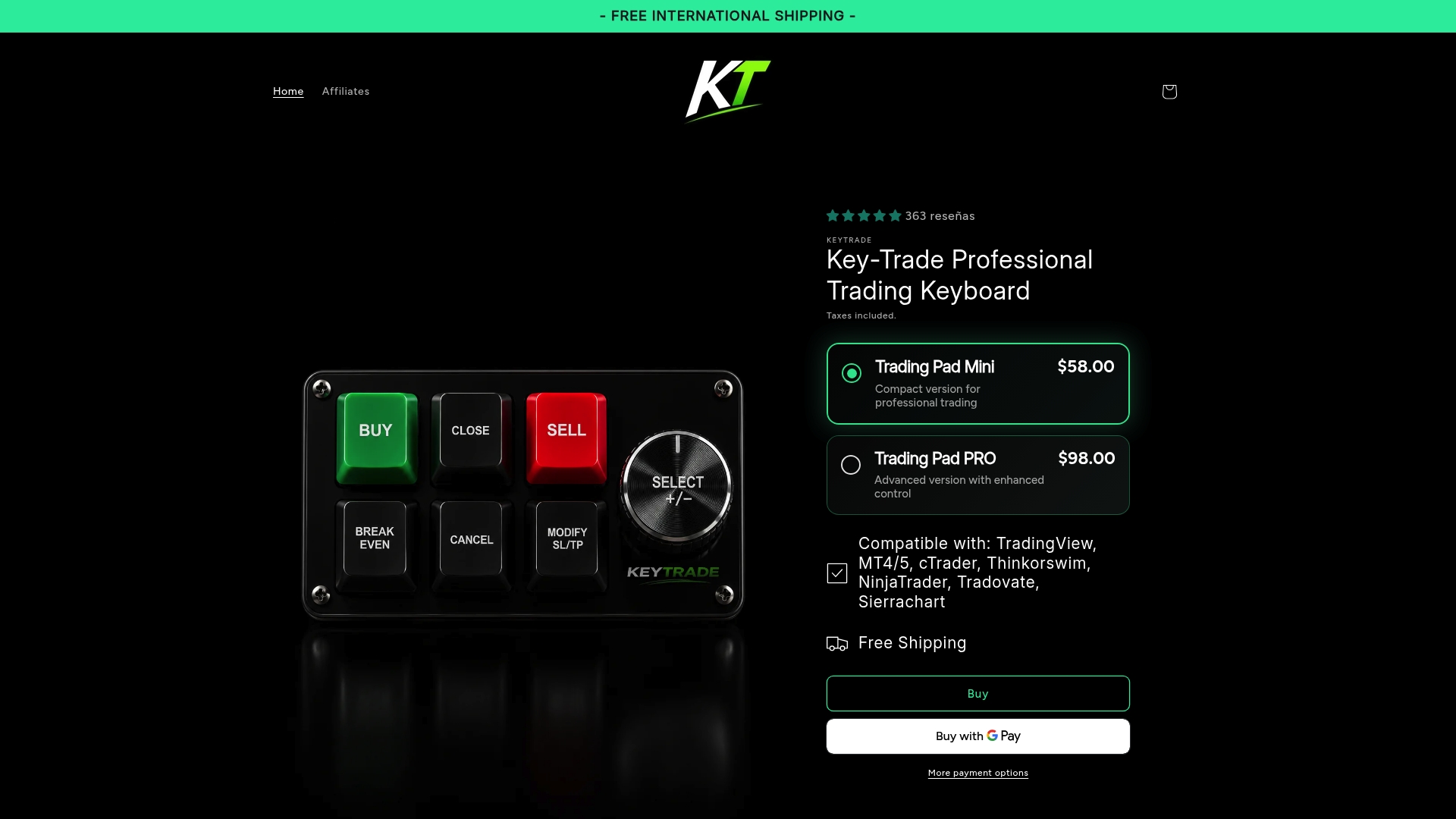
- Devices integrate with major platforms including TradingView, MetaTrader 4 and 5, cTrader, NinjaTrader, SierraChart, Thinkorswim, and Tradovate.
- Buttons support partial closures, stop-loss and take-profit modification, and other risk controls without requiring any coding.
- The Key-Trade Professional Trading Keyboard ships worldwide, with setup guides for platform-specific integration.
Browse the current lineup on the Key-Trade collection page and see which model fits your platform setup.
FAQ
What is the 7% rule for stop loss?
Treat it as one possible fixed-percentage stop choice rather than a validated standard, and test it against ATR-based or ticket-based alternatives for your own instrument.
When should you move a stop to breakeven?
A common approach activates breakeven once a trade reaches a defined profit floor, such as a percent gain, a fixed tick distance, or an ATR multiple, confirmed through backtesting rather than guesswork. TradeStation’s breakeven stop documentation frames this as a configurable profit floor applied per position or per contract.
How do I set a stop-loss at breakeven?
On most platforms, you cancel the existing stop order and submit a new one at your entry price, or slightly beyond it as a buffer to cover slippage and commissions. Platforms like NinjaTrader offer this as a built-in Auto Breakeven feature inside the ATM strategy, while TradeStation and MultiCharts handle it through EasyLanguage functions like SetBreakEven.
Is a 20% stop-loss good?
Research on trailing stop-loss rules found that simple stop rules can reduce downside risk and improve risk-adjusted returns, though they may lag buy-and-hold in raw return terms, so test any fixed percentage against your own data before relying on it.
Can hardware keypads help with breakeven stop execution?
Physical programmable keypads can reduce the steps needed to move a stop or execute a partial close, since a single button press replaces navigating platform menus. Our keypads integrate with platforms including TradingView, MetaTrader, NinjaTrader, and Tradovate for this purpose.